Showing posts with label bruce r. mcconkie. Show all posts

Wednesday, November 5, 2025

The Powers of Priesthood

I was in the Provo City Center Temple recently for an endowment session. One of the delightful elderly sister workers, commented that my yellow tie was “swanky.” That’s an adjective I haven’t heard in a very long time.

Provo City Center Temple

I don’t think about looking swanky when I go to the temple (I know, shocker!) Instead, I am most often searching for the inspiration of the moment as I ponder the endowment ordinance. Lean back your chairs as you read this chapter, it’s going to be a long one, I predict.

We have recently witnessed the succession of another President of the Church, this time President Dallin H. Oaks as the 18th President is now in place. I invite each of you to consider with me how you would respond to the following question posed to the members of the Church many years ago by President David O. McKay: “If at this moment each one of you were asked to state in one sentence or phrase the most distinguishing feature of the Church of Jesus Christ of Latter-day Saints, what would be your answer?” (“The Mission of the Church and Its Members,” Improvement Era, Nov. 1956, 781).

The response President McKay gave to his own question was the “divine authority” of the priesthood. The Church of Jesus Christ of Latter-day Saints stands apart from other churches that claim their authority is derived from historical succession, the scriptures, or theological training. We make the distinctive declaration that priesthood authority has been conferred by the laying on of hands directly from heavenly messengers to the Prophet Joseph Smith. We declare that authority came by ordination under the hands of John the Baptist and Peter, James and John.

I was studying D&C 121 earlier in the morning and learned again what the Prophet Joseph was called upon to endure in Liberty Jail. His whole soul cried out in agony:

1 O God, where art thou? And where is the pavilion that covereth thy hiding place?

2 How long shall thy hand be stayed, and thine eye, yea thy pure eye, behold from the eternal heavens the wrongs of thy people and of thy servants, and thine ear be penetrated with their cries?

3 Yea, O Lord, how long shall they suffer these wrongs and unlawful oppressions, before thine heart shall be softened toward them, and thy bowels be moved with compassion toward them?

4 O Lord God Almighty, maker of heaven, earth, and seas, and of all things that in them are, and who controllest and subjectest the devil, and the dark and benighted dominion of Sheol—stretch forth thy hand; let thine eye pierce; let thy pavilion be taken up; let thy hiding place no longer be covered; let thine ear be inclined; let thine heart be softened, and thy bowels moved with compassion toward us.

5 Let thine anger be kindled against our enemies; and, in the fury of thine heart, with thy sword avenge us of our wrongs.

6 Remember thy suffering saints, O our God; and thy servants will rejoice in thy name forever.

He was imprisoned on false charges during the winter of 1839, in conditions that were almost unimaginable. We can get some slight appreciation when we go there today, a site that has been restored as a Visitors Center by the Church. In his agony Joseph penned some of the most sublime language I have ever read in scripture. In his solitude he was shown the majesty of the “doctrine of the priesthood.”

Here were the words of comfort the Lord spoke to him in Liberty Jail:

26 God shall give unto you knowledge by his Holy Spirit, yea, by the unspeakable gift of the Holy Ghost, that has not been revealed since the world was until now;

27 Which our forefathers have awaited with anxious expectation to be revealed in the last times, which their minds were pointed to by the angels, as held in reserve for the fulness of their glory;

28 A time to come in the which nothing shall be withheld, whether there be one God or many gods, they shall be manifest.

29 All thrones and dominions, principalities and powers, shall be revealed and set forth upon all who have endured valiantly for the gospel of Jesus Christ.

30 And also, if there be bounds set to the heavens or to the seas, or to the dry land, or to the sun, moon, or stars—

31 All the times of their revolutions, all the appointed days, months, and years, and all the days of their days, months, and years, and all their glories, laws, and set times, shall be revealed in the days of the dispensation of the fulness of times—

32 According to that which was ordained in the midst of the Council of the Eternal God of all other gods before this world was, that should be reserved unto the finishing and the end thereof, when every man shall enter into his eternal presence and into his immortal rest.

33 How long can rolling waters remain impure? What power shall stay the heavens? As well might man stretch forth his puny arm to stop the Missouri river in its decreed course, or to turn it up stream, as to hinder the Almighty from pouring down knowledge from heaven upon the heads of the Latter-day Saints.

34 Behold, there are many called, but few are chosen. And why are they not chosen?

35 Because their hearts are set so much upon the things of this world, and aspire to the honors of men, that they do not learn this one lesson—

36 That the rights of the priesthood are inseparably connected with the powers of heaven, and that the powers of heaven cannot be controlled nor handled only upon the principles of righteousness.

37 That they may be conferred upon us, it is true; but when we undertake to cover our sins, or to gratify our pride, our vain ambition, or to exercise control or dominion or compulsion upon the souls of the children of men, in any degree of unrighteousness, behold, the heavens withdraw themselves; the Spirit of the Lord is grieved; and when it is withdrawn, Amen to the priesthood or the authority of that man. (D&C 121:26-37).

Just imagine how welcomed these words of comfort and power and must have thrilled the Prophet when he heard them and as he wrote them under inspiration! I was overcome with the reality of the priesthood power I felt yesterday. Then I went home and opened my scriptures again. Into my copy of the Doctrine and Covenants I had inserted these inspired thoughts from Elder Bruce R. McConkie:

Elder Bruce R. McConkie

This doctrine, this doctrine of the priesthood — unknown in the world and but little known even in the Church — cannot be learned out of the scriptures alone. It is not set forth in the sermons and teachings of the prophets and Apostles, except in small measure.

The doctrine of the priesthood is known only by personal revelation. It comes, line upon line and precept upon precept, by the power of the Holy Ghost to those who love and serve God with all their heart, might, mind, and strength. (See D&C 98:12.)

We have the revealed promise that if our souls are “full of charity towards all men, and to the household of faith” and if we “let virtue garnish [our] thoughts unceasingly; then shall [our] confidence wax strong in the presence of God; and the doctrine of the priesthood shall distil upon [our souls] as the dews from heaven.” (D&C 121:45.)

… His word goes forth by the mouths of his servants as they minister and labor in their weakness. That word is then carried into receptive hearts by the still small voice of the Spirit. (See D&C 85:6.)

… What, then, is the doctrine of the priesthood? What is this doctrine, framed in the courts above, which can distil upon faithful men as the dews from heaven? (See D&C 121:45.)

Priesthood is power like none other on earth or in heaven. It is the very power of God himself, the power by which the worlds were made, the power by which all things are regulated, upheld, and preserved.

It is the power of faith, the faith by which the Father creates and governs. God is God because he is the embodiment of all faith and all power and all priesthood. The life he lives is named eternal life.

And the extent to which we become like him is the extent to which we gain his faith, acquire his power, and exercise his priesthood. And when we have become like him in the full and true sense, then we also shall have eternal life.

Faith and priesthood go hand in hand. Faith is power and power is priesthood. After we gain faith, we receive the priesthood. Then, through the priesthood, we grow in faith until, having all power, we become like our Lord.

Our time here in mortality is set apart as a time of probation and of testing. It is our privilege while here to perfect our faith and to grow in priesthood power.

We received the priesthood first in the premortal existence and then again as mortals. Adam held the keys and used the priesthood when he participated in the creation of the earth. After his baptism he received the priesthood again, and he now stands as the presiding High Priest over all the earth.

All of us who have calls to minister in the holy priesthood were foreordained to be ministers of Christ, and to come here in our appointed days, and to labor on his errand.

The holy priesthood did more to perfect men in the days of Enoch than at any other time. Known then as the order of Enoch (see D&C 76:57), it was the power by which he and his people were translated. And they were translated because they had faith and exercised the power of the priesthood.

It was with Enoch that the Lord made an eternal covenant that all who received the priesthood would have power, through faith, to govern and control all things on earth, to put at defiance the armies of nations, and to stand in glory and exaltation before the Lord.

Melchizedek was a man of like faith, “and his people wrought righteousness, and obtained heaven, and sought for the city of Enoch.” (JST, Genesis 14:34.) Since his day the priesthood has been called after his name.

There are in the Church two priesthoods: the Aaronic or Levitical, and the Melchizedek. The Aaronic Priesthood is a preparatory priesthood, a schooling priesthood, a lesser priesthood, a divine system that prepares men to receive the Melchizedek Priesthood.

The Melchizedek Priesthood is the highest and holiest order ever given to men on earth. It is the power and authority to do all that is necessary to save and exalt the children of men. It is the very priesthood held by the Lord Jesus Christ himself and by virtue of which he was able to gain eternal life in the kingdom of his Father.

Both of these priesthoods are given by covenant. (See D&C 84:33–41.) Both of them surpass any earthly power; both of them prepare men for salvation.

Those who receive the Aaronic Priesthood covenant and promise to magnify their callings, to serve in the ministry of the Master, to forsake the world, and to live as becometh Saints.

In return, the Lord covenants and promises to enlarge the standing and station of all who keep their Aaronic covenant. He promises to give them the Melchizedek Priesthood, out of which eternal life comes.

Those who receive the Melchizedek Priesthood covenant and promise, before God and angels, to magnify their callings, to “live by every word that proceedeth forth from the mouth of God” (D&C 84:44), to marry for time and all eternity in the patriarchal order, and to live and serve as the Lord Jesus did in his life and ministry.

In return the Lord covenants and promises to give them all that his Father hath, meaning eternal life, which is exaltation and godhood in that eternal realm where alone the family unit continues in eternity.

In return the Lord admits them to his eternal patriarchal order, an order that prevails in the highest heaven of the celestial world, an order that assures its members of eternal increase, or in other words of spirit children in the resurrection. (See D&C 131:1–4.)

These are the most glorious promises given to men. There neither is nor can be anything as wondrous and great. And so the Lord uses the most powerful and emphatic language known to the human tongue to show their importance and immutability. That is to say, the Lord swears with an oath in his own name, because he can swear by no greater, that everyone who keeps the covenant made in connection with the Melchizedek Priesthood shall inherit, receive, and possess all things in his everlasting kingdom, and shall be a joint-heir with that Lord who is his Only Begotten.

God swore with an oath that Christ would be exalted, and he swears anew, at the time each of us receives the Melchizedek Priesthood, that we will have a like exaltation if we are true and faithful in all things. [“The day will come, when you will be chosen, called up and anointed…” we are taught in the temple endowment].

Speaking messianically of the Lord Jesus, David said, “The Lord hath sworn, and will not repent, Thou art a priest for ever after the order of Melchizedek.” (Psalms 110:4.)

And Paul, after quoting this messianic word, this eternal oath sworn by God himself, said that Christ was “called of God an high priest after the order of Melchisedec.” (Hebrews 5:10.)

Then of Melchizedek, to whom Abraham paid tithes, Paul said, “For this Melchizedek was ordained a priest after the order of the Son of God, which order was without father, without mother, without descent, having neither beginning of days, nor end of life.” (JST, Hebrews 7:3.)

Anciently the Aaronic Priesthood was limited to the Levites. It came because of father and mother; it was conferred only upon the worthy male descendants of Levi. But the Melchizedek Priesthood was to be conferred upon any male person of any lineage who was worthy to receive it.

And so Paul continued, “And all those who are ordained unto this [higher] priesthood are made like unto the Son of God, abiding a priest continually.” (JST, Hebrews 7:3.)

Christ is the prototype; he is the Son; he is the Heir of the Father. But we, as joint-heirs, inherit equally with him because we also abide as priests forever.

Thus we make the covenant with Deity; and God swears the oath to us all, to show the importance and eternal worth of the covenant.

This matter of swearing with an oath in ancient days was far more significant than many of us have realized.

For instance: Nephi and his brethren were seeking to obtain the brass plates from Laban. Their lives were in peril. Yet Nephi swore this oath: “As the Lord liveth, and as we live, we will not go down unto our father in the wilderness until we have accomplished the thing which the Lord hath commanded us.” (1 Nephi 3:15.)

Thus Nephi made God his partner. If he failed to get the plates, it meant God had failed. And because God does not fail, it was incumbent upon Nephi to get the plates or lay down his life in the attempt.

One of the most solemn oaths ever given to man is found in these words of the Lord relative to Joseph Smith and the Book of Mormon. “He [meaning Joseph Smith] has translated the book, even that part which I have commanded him,” saith the Lord, “and as your Lord and your God liveth it is true.” (D&C 17:6.)

This is God’s testimony of the Book of Mormon. In it Deity himself has laid his godhood on the line. Either the book is true or God ceases to be God. There neither is nor can be any more formal or powerful language known to men or gods.

And so it is with the Melchizedek Priesthood. As the Lord lives, it is his holy order, and all those priesthood holders of every nation and kindred and tongue and people and race and color who will keep the covenant shall abide as priests forever, ruling and reigning everlastingly with the great High Priest of our profession, who is the Lord Jesus Christ.

What, then, is the doctrine of the priesthood? And how shall we live as the servants of the Lord?

This doctrine is that God our Father is a glorified, a perfected, and an exalted being who has all might, all power, and all dominion, who knows all things and is infinite in all his attributes, and who lives in the family unit.

It is that our Eternal Father enjoys this high status of glory and perfection and power because his faith is perfect and his priesthood is unlimited.

It is that priesthood is the very name of the power of God, and that if we are to become like him, we must receive and exercise his priesthood or power as he exercises it.

It is that he has given us an endowment of heavenly power here on earth, which is after the order of his Son and which, because it is the power of God, is of necessity without beginning of days or end of years.

It is that we can enter an order of the priesthood named the new and everlasting covenant of marriage (see D&C 131:2), named also the patriarchal order, because of which order we can create for ourselves eternal family units of our own, patterned after the family of God our Heavenly Father.

It is that we have power, by faith, to govern and control all things, both temporal and spiritual; to work miracles and perfect lives; to stand in the presence of God and be like him because we have gained his faith, his perfections, and his power, or in other words the fulness of his priesthood.

This, then, is the doctrine of the priesthood, than which there neither is nor can be anything greater. This is the power we can gain through faith and righteousness.

Truly, there is power in the priesthood — power to do all things! (Ensign, April 1982, emphasis mine).

* * *

I cherish my temple time. I am routinely overwhelmed with the language I hear in the temple. Yesterday after reading D&C 121-123, I remembered something President Brigham Young had written about the priesthood keys. He was away in the East on a mission when he got the word of the martyrdom and was waiting for a train on the platform:

“The first thing which I thought of,” President Brigham Young recalled in his journal, “was whether Joseph had taken the keys of the kingdom with him from the earth; brother Orson Pratt sat on my left; we were both leaning back on our chairs. Bringing my hand down on my knee, I said the keys of the kingdom are right here with the Church.” (Manuscript History of Brigham Young, 1801-1844, comp. Elden Jay Watson [1968], 171, LDS Church Archives).

Notice in the Center - Only 9 Apostles Had All the Keys

He remembered what the Prophet Joseph had taught them:

From the summer of 1841 until the deaths of Joseph and Hyrum on 27 June 1844, the Twelve were extensively tutored by the Prophet and heavily involved with the temporal and spiritual governance of the Church. In the months before his death, the Prophet Joseph expressed his forebodings concerning his death. “He often observed that he was laying the foundation, but it would remain for the Twelve to complete the building,” observed Elder Parley P. Pratt. “Said [Joseph]: … I am constrained to hasten my preparations, and to confer upon the Twelve all the ordinances, keys, covenants, endowments, and sealing ordinances of the priesthood, and so set before them a pattern in all things pertaining to the sanctuary and the endowment therein.

“Having done this he rejoiced exceedingly; for, said he, the Lord is about to lay the burden on your shoulders and let me rest awhile; and if they kill me, continued he, the kingdom of God will roll on, as I have now finished the work which was laid upon me, by committing to you all things for the building up of the kingdom according to the heavenly vision, and the pattern shown me from heaven.”

This last charge to the Twelve from Joseph the Prophet included not only instruction and the conferral of priesthood keys and authority to govern the Church, but also essential temple ordinances, including the endowment and the fulness of all priesthood blessings. This was an essential element of the Twelve’s claim to succession inasmuch as others who claimed the leadership of the Church after Joseph and Hyrum’s death had not received these priesthood ordinances and keys. Elder Wilford Woodruff testified that Joseph instructed the Quorum of the Twelve a few months before his death to prepare them for the endowment:

“And when they [the Twelve] received their endowment, and actually received the keys of the kingdom of God, … he [Joseph] exclaimed, ‘upon your shoulders the kingdom rests, and you must round up your shoulders, and bear it; for I have had to do it until now. But now the responsibility rests upon you. It mattereth not what becomes of me.’”

In March 1844, nine members of the Twelve met with the Prophet Joseph and heard him prophetically declare:

“Brethren, the Lord bids me hasten the work in which we are engaged. … Some important scene is near to take place. It may be that my enemies will kill me; and in case they should, and the keys and power which rest on me not be imparted to you, they will be lost from the earth; but if I can only succeed in placing them upon your heads, then let me fall a victim to murderous hands if God will suffer it, and I can go with all pleasure and satisfaction, knowing that my work is done, and the foundation laid on which the kingdom of God is to be reared in this dispensation of the fulness of times. Upon the shoulders of the Twelve must the responsibility of leading this church henceforth rest until you shall appoint others to succeed you.”

With the deaths of Joseph and Hyrum Smith, the Twelve became the presiding quorum of the Church. President Brigham Young heard the news of the Martyrdom while on a mission in the East.

… Brigham was unwavering in his assurance that the Quorum of the Twelve Apostles had become the Presidency of the Church. With this assurance, Brigham declared to the Saints at the special conference in Nauvoo on 8 August 1844, that the Twelve were “ordained and anointed to bear off the keys of the Kingdom of God in all the world. … If you let the Twelve remain and act in their place the keys of the Kingdom are with them, and they can manage the affairs of the Church and direct all things aright.” (From Brent L. Top and Lawrence R. Flake, “The Kingdom of God Will Roll On: Succession in the Presidency,” Ensign, Aug. 1996, 22).

I am writing today to add my witness to the early prophets in this dispensation. I am intentionally including it in Volume 6 of my memoirs for all my posterity to look upon in a future day with assurance. We are led by living prophets, who trace their priesthood keys and powers directly to the Lord Jesus Christ. Those keys will never be taken again from the earth.

It is by the authority of those very priesthood keys that we will claim all our blessings as a family in eternity.

And it will have little or nothing to do with “swankiness.”

Wednesday, February 7, 2024

Dystopian or Utopian


“The standard of truth has been erected. No unhallowed hand can stop the work from progressing; persecutions may rage, mobs may combine, armies may assemble, calumny may defame, but the truth of God will go forth boldly, nobly, and independent till it has penetrated every continent, visited every clime, swept every country, and sounded in every ear, till the purposes of God shall be accomplished and the great Jehovah shall say the work is done.”

— Joseph Smith, 1842

How audacious can one person be? Toward the end of his mortal life, Joseph Smith made the foregoing utterance. This is the boy prophet who humbly knelt in a grove of trees in upper state New York in the year 1820, and was answered by a visitation from the Father and the Son. His inquiry was which of all the churches was right, and which should he join? He was told to join none, and that he would be the instrument of the Restoration of the gospel of Jesus Christ. By 1842, he had traversed through a myriad of extremities, any one of which could have destroyed the work he was chosen to do. But he persisted in faith until he could make such a bold declaration. 

Contrasted to that vision of futurity, there has been a parallel track developing that runs in the opposite direction. While Joseph’s vision was utopian in every way, Satan’s vision is dystopian and gains traction among his adherents. A word of definition from the dictionary might be in order here:

dystopian

adjective

dys·to·pi·an (ˌ)dis-ˈtō-pē-ən 

variants or less commonly dystopic 

(ˌ)dis-ˈtō-pik 

-ˈtä- 

Synonyms of dystopian

: of, relating to, or being an imagined world or society in which people lead dehumanized, fearful lives: relating to or characteristic of a dystopia

A twisted romantic haunted by dystopian visions, Gibson borrows the language of science fiction and crafts doomed love stories with high-tech trappings.

—Maitland McDonagh

Dystopian visions are in a sense mythopoeic: depicting a creation myth in a future world of darkness and silence.

—Sarah Lefanu

Biotechnology is a force for good, but without adherence to the ideal of universal human equality, it opens the door to the soft tyranny of Gattaca and, ultimately the dystopian nightmare of Brave New World.

—Wesley J. Smith

Like many advances in science and technology, the dystopian implications of data mining have been described best by science-fiction writers.

—John Markoff

… Orwellian has become a word itself: an adjective denoting a dystopic world where language is cut adrift from meaning.

—Harvey A. Daniels

Letter by letter, we read of a society that seems to move from one dystopic nightmare to another …

—Simon Winchester

George Orwell wrote the infamous novel “1984,” describing a dystopian existence that gratefully did not materialize in its time. However, Orwell saw political leaders in Germany, Spain and the Soviet Union who had absolute power, and he realized the danger that this presented. He illustrated that danger with the world in his book, where everyone is monitored and must conform to the views of the elite.

The Tehran Conference was a meeting between Franklin Delano Roosevelt, Winston Churchill and Joseph Stalin. Orwell thought the three could plan to divide the world amongst each other. In “1984,” Orwell uses this idea with the three super-states of Oceania, Eurasia and Eastasia. The three sides control the world and are in a never-ending war.

Orwell lived in England with his family during World War II, when acts of violence could occur at any time. This atmosphere is replicated in the book.

In a letter, Orwell mentions that he felt totalitarian regimes were on the rise in many parts of the world. He said the United States and Great Britain were exceptions, but neither nation had known defeat or suffering. He also brought up several ideas that would later be a part of “1984,” including that history could be rewritten by whoever was in charge.

I am among the millions for whom “1984” was mandatory reading in high school. It was chilling and a cautionary tale for freedom-loving people everywhere. It seems there is a steady drumbeat always and forever that runs counter to Joseph Smith’s optimistic vision of the future.


President Russell M. Nelson

President Russell M. Nelson has put the Church in position to fulfill that vision. We are determined to move forward with faith in its realization despite all the dystopian voices out there in the world.

We are in the midst of yet another runup to a presidential election in America. There are those who would have us believe the two major candidates vying for the hearts and minds of Americans will surely produce a meltdown of all we hold sacred. Either one being elected in 2024 will undoubtedly bring our representative republic to ruin. 

And yet, it seems there is no alternative that suggests itself at this writing in February 2024. Time will tell if a new “savior” is yet to appear on our horizon, but don’t hold your breath. My experience as an observer of politics for many years is that politicians can neither save nor destroy the nation. They simply do not have the power because our system of government was designed to divide power to prevent the type of totalitarian regimes Orwell warned about. 

That brings to mind another popular “Mormon myth” about the Constitution someday “hanging by a thread” and the country in its ultimate peril being rescued by the elders of Israel. First impressions of “the White Horse Prophecy” might be alarming. Did Joseph give this “apocalyptic” prophecy? Has it been used to support “American-centric” or militant ideals? Is there some weird secret doctrine that tells Mormons to take over the world?

It turns out, Joseph Smith probably didn’t give the “White Horse Prophecy” or at the very least, not the version which was recorded decades later by Edwin Rushton. That account was recorded in 1898, 54 years after Joseph’s death, and has been condemned by multiple Church leaders.

But the Constitution “hanging by a thread” idea can still feel uncomfortable, especially when coupled with it being saved by the “Elders of Israel” — and the historical record indicates that Joseph Smith taught those ideas. At the time, the Saints had been driven from their homes and experienced government-sponsored persecution, which may have impacted their views on religious freedoms as protected by the Constitution.

Today, the Church encourages civic engagement from its members, supports democracy and the peaceful transfer of power, and denounces riots and usurpations. While making sense of the political history of our religion, we can remember the gospel teaches a message of peace.

Think about the trajectory the Church is on today. We are building temples around the world at an accelerated pace. Each time a temple is dedicated the kingdom of God on the earth reclaims territory that might otherwise have been the domain of wickedness. We consecrate and make holy those environs. We do it “boldly, nobly and independently,” above all the competition that would claim it otherwise. 

Each of us individually has a stake in the work of salvation. A little twelve-year-old girl who goes to the temple to do baptisms for the dead, an elderly widow who serves as an ordinance worker, an unpaid harried and overwhelmed young bishop with a family and a career, a mother who nurtures and cares for her small brood of children, a missionary who goes into the world wherever he or she is called to serve, and an old man who sits at his computer early in the morning to encourage his posterity in the course of their marvelous destiny as I do this morning - all these in their path of discipleship are advancing the work toward the ultimate fulfillment Joseph described in 1842. 

I want you all to know these words were given to me sometime around 4:30 a.m. this morning as I lay awake after a completely restful and heavy night of sleep (a blessed outcome for me these days). I hope none of you is dissuaded in the least by the dystopian voices that bombard your consciousness, either from the written word, news reports, movies or whatever worldly source you encounter. 

Mortality has always been about your choices, your moral agency, and your Heavenly Father providing living prophets coupled with the words of the dead prophets to point the way unerringly back to Him. 

I would encourage all of you to read 2 Nephi 31, as I did this morning. It lays out “the doctrine of Christ” and is a sure and certain witness of the path we are to follow as disciples. As you all know, I am a great admirer of Elder Bruce R. McConkie. I will conclude with his words that describe a utopian plan for each of us:

“…everyone in the Church who is on the straight and narrow path, who is striving and struggling and desiring to do what is right, though is far from perfect in this life; if he passes out of this life while he’s on the straight and narrow, he’s going to go on to eternal reward in his Father’s kingdom.

“We don’t need to get a complex or get a feeling that you have to be perfect to be saved. You don’t. There’s only been one perfect person, and that’s the Lord Jesus, but in order to be saved in the Kingdom of God and in order to pass the test of mortality, what you have to do is get on the straight and narrow path — thus charting a course leading to eternal life — and then, being on that path, pass out of this life in full fellowship. I’m not saying that you don’t have to keep the commandments. I’m saying you don’t have to be perfect to be saved. If you did, no one would be saved. The way it operates is this: you get on the path that’s named the ‘straight and narrow.’ You do it by entering the gate of repentance and baptism. The straight and narrow path leads from the gate of repentance and baptism, a very great distance, to a reward that’s called eternal life. If you’re on that path and pressing forward, and you die, you’ll never get off the path. There is no such thing as falling off the straight and narrow path in the life to come, and the reason is that this life is the time that is given to men to prepare for eternity. Now is the time and the day of your salvation, so if you’re working zealously in this life — though you haven’t fully overcome the world and you haven’t done all you hoped you might do — you’re still going to be saved. You don’t have to do what Jacob said, ‘Go beyond the mark.’ You don’t have to live a life that’s truer than true. You don’t have to have an excessive zeal that becomes fanatical and becomes unbalancing. What you have to do is stay in the mainstream of the Church and live as upright and decent people live in the Church — keeping the commandments, paying your tithing, serving in the organizations of the Church, loving the Lord, staying on the straight and narrow path. If you’re on that path when death comes — because this is the time and the day appointed, this the probationary estate — you’ll never fall off from it, and, for all practical purposes, your calling and election is made sure. Now, that isn’t the definition of that term, but the end result will be the same.

“There’s great hope for Latter-day Saints. There’s great hope for anyone who will repent, believe, obey, strive, struggle and seek to work out his salvation. There isn’t hope for anyone who will not. Our revelation says, ‘Surely every man must repent or suffer; for I, God, am Endless.’ Well, either we suffer for our sins, according to the law of justice, or we repent, and through the atoning sacrifice, the Lord Jesus bears our sins and we become inheritors of mercy. Now we can go forward. We can have every reward that the scriptures speak of. We’re not an austere people. We don’t remove ourselves from the world. We’re deliberately in the world so that we’ll have opportunity to overcome the world. We can have in the Church every association and felicity and good feeling that anyone can have. Anything that’s wholesome and good is available to us. We’re denied nothing, and that’s good. In addition to that, we can have the hope of glorious immortality — meaning eternal life — in the realms and the worlds that are ahead.” (Elder Bruce R. McConkie, “The Probationary Test of Mortality,” address given at the University of Utah Institute of Religion January 10, 1982).

Saturday, August 20, 2016

The Inspiration of the Moment

As members of The Church of Jesus Christ of Latter-day Saints, after we are baptized we are invited to "receive the Holy Ghost." It is not a bestowal of a gift from a hand-to-head conveyance that is automatic. Rather, it comes in the form of an admonition to accept the proffered gift from a loving Heavenly Father. It requires aligning our thoughts with His.

Almost from the moment the gospel was restored to the earth through the instrumentality of the Prophet Joseph Smith, many and varied have been the ideas associated with the Holy Ghost. Speculations about who, what, and how the Holy Ghost ministers to men and women continue into our day. I could make a very long post with a summary of all those opinions, but I will refrain.

Joseph Smith
When President Martin Van Buren asked Joseph Smith "wherein we differed in our religion from the other religions of the day, Brother Joseph said we differed in mode of baptism, and the gift of the Holy Ghost by the laying on of hands. We considered that all other considerations were contained in the gift of the Holy Ghost." (History of the Church, 4:42).

After his martyrdom, the Prophet Joseph appeared to President Brigham Young and said of the Spirit:

"Tell the people to be humble and faithful, and be sure to keep the spirit of the Lord and it will lead them right. Be careful and not turn away the small still voice; it will teach you what to do and where to go; it will yield the fruits of the kingdom. Tell the brethren to keep their hearts open to conviction, so that when the Holy Ghost comes to them, their hearts will be ready to receive it. They can tell the Spirit of the Lord from all other spirits; it will whisper peace and joy to their souls; it will take malice, hatred, strife and all evil from their hearts; and their whole desire will be to do good, bring forth righteousness and build up the kingdom of God. Tell the brethren if they will follow the spirit of the Lord they will go right. Be sure to tell the people to keep the Spirit of the Lord; and if they will, they will find themselves just as they were organized by our Father in Heaven before they came into the world." (Watson, Manuscript History of Brigham Young).

I have always treasured these words that describe the workings of the Holy Spirit:

"I will impart unto you of my Spirit, which shall enlighten your mind, which shall fill your soul with joy." (D&C 11:13).

President Boyd K. Packer has said:
President Boyd K. Packer

The Holy Ghost speaks with a voice that you feel more than you hear. It is described as a "still small voice." (D&C 85:6). And while we speak of "listening" to the whisperings of the Spirit, most often one describes a spiritual prompting by saying, "I had a feeling . . ." . . . Revelation comes as words we feel more than hear. Nephi told his wayward brothers, who were visited by an angel, "Ye were past feeling, that ye could not feel his words." (1 Nephi 17:45).

The scriptures are full of such expressions as "The veil was taken from our minds, and the eyes of our understanding were opened" (D&C 110:1) or "I will tell you in your mind and in your heart" (D&C 8:2) or "I did enlighten thy mind" (D&C 6:15) or "Speak the thoughts that I shall put into your hearts." (D&C 100:5). There are hundreds of verses which teach of revelation. (BKP, Mine Errand From the Lord, 94–05, p. 60).

Revelation comes to us through the ministrations of the Holy Ghost, synonymous with the Holy Spirit. There are some wonderful members of the Church who, in pursuit of the "greater things," or the "mysteries of God," often go beyond the mark of the simple gospel truths. I caution those who are so disposed to stay within the mainstream of the Church. Danger lies on either side of the straight and narrow path - "more than" is just as dangerous as "less than."

What do I mean by "more than" the simple doctrines of salvation? It is specious, speculative and uninspired interpretation of scriptures and old sermons written or transcribed. Some who are not anchored in the Word we have received go beyond the mark. One example: The age of the earth, how it was created and the possibility of the existence of pre-Adamites. Another: The endless debates in high priest groups about trivial minutiae never founded upon scripture, going over the top in stretching for meanings never before revealed. Another: Some talks in the Church that should be prefaced with "I will now proceed to present a discourse upon a subject about which the Lord has revealed little or nothing, and His servants have never spoken about." These are examples of "more than" the plain and simple doctrines of salvation. There seems to be a presumption among us that we must go beyond what the Lord has revealed to display our gospel scholarship. Such ideas add to the "more than" doctrine category.

"They despised the words of plainness, and killed the prophets, and sought for things that they could not understand. Wherefore, because of their blindness, which blindness came by looking beyond the mark, they must needs fall." (Jacob 4:14).


Elder Dean L. Larsen
In his October 1987 general conference address, Elder Dean L. Larsen of the Presidency of the Seventy said: "I have wondered what was actually in Jacob's mind as he wrote of 'looking beyond the mark' in describing a failing that was common to ancient Israel. . . .

"Jacob speaks of people who placed themselves in serious jeopardy in spiritual things because they were unwilling to accept simple, basic principles of truth. They entertained and intrigued themselves with 'things that they could not understand.'

"They were apparently afflicted with a pseudosophistication and a snobbishness that gave them a false sense of superiority over those who came among them with the Lord's words of plainness. They went beyond the mark of wisdom and prudence and obviously failed to stay within the circle of fundamental gospel truths which provide a basis for faith. They must have reveled in speculative and theoretical matters that obscured for them the fundamental spiritual truths. As they became infatuated by these 'things that they could not understand,' their comprehension of and faith in the redeeming role of a true Messiah were lost, and the purpose of life became confused."

In pursuit of the "greater things" those who chase the shiny objects have often gone far afield from where they started and lost the very things that were most precious to them - their families. At one time in my life I was one of those who sought for things I could not always understand. I know whereof I speak. And now in my old age I am content with simplicity. All the ex-Mormons for Jesus and others I once read and chased are now silenced by the passage of time as the caravan moves on toward the city of Zion. Please, do not be deceived, especially if you are among the elect in these last days. (See D&C 45:56-59). Take the Holy Spirit for your guide, and no one else.

I am grateful for the small and simple things that happen every day in the ministrations of the Holy Ghost when I am seeking guidance in my daily walk. I am not perfect by any stretch. But I am grateful for the inspiration of the moment, and cannot imagine life without it.

The workings of the Spirit within us are so fragile, so transient, and so subtle we must never take them for granted nor discount them when they come to us. If we are attuned to the Infinite we may rely upon that inspiration and grow in light and truth day by day, year by year, seeking to stay in the straight and narrow path that leads toward eternal life.
Elder Bruce R. McConkie

"You don't have to do what Jacob said, 'Go beyond the mark.' You don't have to live a life that's truer than true. You don't have to have an excessive zeal that becomes fanatical and becomes unbalancing. What you have to do is stay in the mainstream of the Church and live as upright and decent people live in the Church - keeping the commandments, paying your tithing, serving in the organizations of the Church, loving the Lord, staying on the straight and narrow path. If you're on that path when death comes - because this is the time and the day appointed, this the probationary estate - you'll never fall from it, and, for all practical purposes, your calling and election is made sure. Now, that isn't the definition of that term, but the end result will be the same." (Elder Bruce R. McConkie, "The Probationary Test of Mortality," address delivered at U of U Institute of Religion, Salt Lake City, Utah, January 10, 1982).


Wednesday, March 18, 2015

"My Favorite Scripture"

My 93 year-old father continues his tradition of writing to his former missionaries twice a year at General Conference time. His labor of love becomes increasingly taxing on his diminishing physical strength, but as you will note below, his mental acuity is still very much in evidence. I am so grateful for his thoughts in this latest post.

We all have a favorite scripture(s), and Dad encourages us all to share the reasons why in his latest missive. I hope you will all take a moment and offer some reflective insights on what and why you may value a particular scripture passage. Enjoy!


Beloved Missionaries:

George Frederic Handel
George Frederic Handel, one of the world’s most celebrated musicians, performed as a violinist and organist at an early age. After composing his first opera in Germany, he went to the center of the operatic world and composed operas and chamber music in Italy.

In 1711, at the age of 26, he moved to England where initially his works gained some acceptance, but with changing public tastes in music his style ultimately became outdated. He found it difficult to stay solvent. Under great pressure, he frantically wrote four operas within 12 months, but it took its toll on him, and the 52 year-old composer suffered a stroke. His right arm was paralyzed temporarily and a doctor told his secretary that he thought Handel’s brain had been permanently damaged.

Nevertheless, he recovered his health at the Aachen, Germany hot springs, and was delighted later to find he could again play the organ. Encouraged, he moved again to England and resumed composing, but his works were not well accepted and creditors again pushed him into the depths of despondency.

Late one August afternoon in April, 1741, Handel went for a long walk. Upon his return, he found that a poet and previous collaborator, Charles Jennens, had left him a manuscript with a request that he put his libretto to music. The text quoted abundantly from Isaiah and the New Testament, unfolding the birth, ministry, crucifixion and resurrection of the Lord Jesus Christ. It was to be an oratorio. Handel was apprehensive as he turned the pages of the text, but the glorious scriptures “Comfort Ye”, “For Unto Us a Child is Born”, and “He Shall Feed His Sheep Like a Shepherd”, chased away his gloom and he felt uplifted as he read the mighty conclusion “Worthy Is The Lamb”. He could not write fast enough to keep apace with the inspiration he felt as he commenced his composing.

Even though he composed profusely, Handel has become world renowned because of just this one masterpiece, “Messiah”, an oratorio which he wrote when 56 years of age, in just three weeks during the summer of 1741. He humbly acknowledged the inspiration of the Almighty by saying of his work, “God has visited me.”

I first became acquainted with this wonderful music when I sang alongside my father in the chorus of the Salt Lake Oratorical Society. The performance was a community tradition, then held in the Salt Lake Tabernacle each year on the Sunday nearest to New Year’s Day. Guest artists and celebrated conductors from New York and London were imported to head the casts. I came to love the music and I later found the texts also were forever imprinted in my mind.


Brent, top center, 1942
In 1942, I left for my mission to Texas, and was immediately assigned for the summer to visit the isolated members of the church to upgrade their records and perform neglected ordinances. My introduction to missionary work was going “without purse or scrip”, depending for meals and lodging on the generosity of strangers while en route to the next member’s distant home. In this stretching manner I learned what true faith really is, which was a perfect introduction to my ministry.

At the end of the summer, we settled into work in the city where at last I could begin an organized study of the gospel. I never had the benefit of Seminary or Institute classes, so I was just then becoming acquainted with the scriptures. I commenced my studies in the New Testament, because Texas was part of the “Bible Belt” where people were more inclined to listen to one who quotes from the Bible.

I hadn’t advanced far along in my early morning private studies until I came to Matthew 11:28-39. The text overwhelmed me with familiarity:

“Come unto me, all ye that labour and are heavy laden, and I will give ye rest. Take my yoke upon you, and learn of me; for I am meek and lowly in heart: and ye shall find rest unto your souls. For my yoke is easy and my burden is light.”

With the words pulsating to Handel’s music, my heart was penetrated. I found I knew already from the “Messiah” the gospel texts before I found their scriptural origins. I became enveloped for the second time with the overwhelming power of the Holy Ghost. Humble, and moved by the Spirit, I wrote in the margin of my Bible the word, “Beautiful”, to frame my emotional response. That headline has remained in my Bible ever since to remind me of this wonderful witness of the Holy Spirit.

Helen and Brent Goates, 1975
In 1975, I was presiding over the California Arcadia Mission with Christmas approaching. A sudden
phone call came from our daughter-in-law Janie, and without warning or explanation she asked, “Dad, what is your favorite scripture?” Pressed for an immediate answer, I instinctively replied, “Matthew 11:28-30.”

The conversation was forgotten, but before Christmas came we received in the mail the words of this favorite scripture beautifully woven in needlepoint. It has always been one of our most treasured Christmas presents. Sister Goates had the art piece framed and it has been featured in our mission home, and ever since then in the dining room of our homes in Salt Lake City. I have marveled many times at the popularity of this scripture, as it has been a theme of many conferences.

But one’s favorite scripture must offer more than just poetic and emotional rewards. A doctrinal basis must be explored to find the real treasure. In my scripture the question was: “What is the meaning of ‘rest’ in this promise?” Was the key word “rest” a condition or a place? A condition is suggested similar to Alma’s description of the reward for the faithful in Paradise, who will rest from all their cares and sorrows (Alma 41:12). Or is it the ultimate place in eternity with God and Christ?

Elder Bruce R. McConkie (1915-1985) taught, “The rest of the Lord, where mortals are concerned, is to gain a perfect knowledge of the divinity of the great latter-day work.” President Joseph F. Smith, also speaking of mortality, said it is “rest from the religious turmoil of the world.” But in eternity, McConkie said, “It is entering into the presence of the Lord.” The climax for me came from latter-day scripture which relates how the Israelites under Moses failed to enter “into His rest”, and then provided the definition, “which rest is the fulness of His glory.” (D&C 84:24).

The evolution of discovering and comprehending and then living for the blessings of my favorite scripture has been a lifetime work. Now, what is your story? Have you written it and shared it with your family? As I have shared my scriptural odyssey with you, I hope you will do likewise for your loved ones.

Always your friend,

President L. Brent Goates

Saturday, March 15, 2014

Is There Life After Death?

I have several dear friends who are not currently members of The Church of Jesus Christ of Latter-day Saints. I frequently have conversations with them about their religious beliefs, and invariably the question will come up whether life goes on after the grave. They are always astounded at my answers and my assurance that life does continue after death. So many in the world have an innate belief in life after death because it is so plausible. How can a lifetime of association with those they love simply end at the edge of the grave? They don't want to accept the finality of death. They want to believe there is more, but believing in life after death presupposes there must be a God who can make such hopes a reality.

Over the years I have spoken at many funerals. I always make a statement about how optimistic I am about death and the reality of life after death. I have come to believe and to KNOW there is life after death. In this post I will dive a little deeper into WHY I believe the way I do.

I accept that God gives good gifts to all His children, and He is no respecter of persons because He has told us as much in His Holy Word. (See Romans 2:11; Acts 10:34). In this context we are assured there is no partiality or favoritism. All are alike before the bar of eternal justice. Mercy and grace are extended to those who comply with God's commands, but all who accept the terms and conditions of repentance are treated alike.

If we accept that God is capable of giving only good gifts because His very nature is goodness, then we have this blessed assurance: If you keep my commandments and endure to the end you shall have eternal life, which gift is the greatest of all the gifts of God. (D&C 14:7). Notice the quid pro quo: If you do this, I will do that. And there you have the exact definition of a covenant.

Salvation is the greatest of all the gifts of God. It is synonymous with eternal life. It is the gift bestowed by God upon those who come to think as He thinks, to believe as He does, to act as He acts. In time those who are faithful to their covenants will come to experience what He experiences. To become as God now is will put us in position to be a joint heir with Jesus Christ, the Firstborn and Only Begotten Son, our Savior and Redeemer. We become equal with the Lord in power, might, and dominion, as the scripture declares: "Ye are gods; and all of you are children of the most High." (Psalms 82:6).

We receive from our Heavenly Father the gift of immortality through His Son, Jesus Christ. That gift is to have the power to live forever. It is one of the wondrous gifts we receive through the atonement of Jesus Christ. Our spirits are already immortal as a conscious personality shrouded by a mortal body now in mortality which will never cease to exist. Our spirits are the spark of divinity within each of us. The spirit within each of us will live everlastingly. Death is simply the temporary separation of our eternal spirit from our mortal body. The scriptures make it clear, however, that immortality is associated with the resurrection where spirit and body are inseparably reconnected and reunited, destined for a kingdom of glory in the life after this mortal life. Resurrection is a reality for all. I love the way the Apostle Paul expressed it:

"Now if we be dead with Christ, we believe that we shall also live with him. Knowing that Christ being raised from the dead dieth no more; death hath no more dominion over him. For in that he died, he died unto sin once; but in that he liveth, he liveth unto God." (Romans 6:8-10).

To my friends who are not currently of my faith, I invite you to request a copy of The Book of Mormon (click the link to obtain a free copy). One of the prophets in that book of scripture was Amulek, who describes the resurrected body and uses the word spiritual synonymously with the word immortal. This usage is identical with all prophets of all ages, denoting a state which is not subject to death. (See also 1 Corinthians 15:44; D&C 88:27; Moses 3:9).

Immortality, life after death in a resurrected body, is a free gift to all men and women who have ever lived upon the earth. It is a supernal gift of God's grace, requiring no obedience whatsoever to God's laws, "for as in Adam all die, even so in Christ shall all be made alive" (1 Corinthians 15:22). "All" in this expression means "all" without exception. Amulek said it best: "Now, this restoration [of body and spirit] shall come to all, both old and young, both bond and free, both male and female, both the wicked and the righteous" (Alma 11:44; emphasis mine).

Eternal life is synonymous with God's life (see Moses 7:35). It consists of two components: 1) inheriting, receiving, and possessing the fulness of the glory of the Father; and 2) a continuation of the family unit in eternity (see D&C 132:19).

Immortality comes as a free gift to all. Eternal life, may also be received as an additional gift to those who qualify through faithful obedience to the covenants we make as provided in the plan of salvation. Both of these conditions are made available through our Lord's suffering in Gethsemane and on Calvary, followed by His resurrection from His borrowed tomb on Easter morning.

We are all partakers of that blessing. When I visited the Garden Tomb at the foot of Calvary outside the city walls of Jerusalem, a small plaque memorialized the words of the angel to the grieving Mary and others as we turned to exit the tomb: "Why seek ye the living among the dead? He is not here, but is risen." (Luke 24:5-6). The tomb that stands empty still to this day is ample evidence of His resurrection. President Harold B. Lee and President Spencer W. Kimball, each serving at the time as President of the Church, when they visited there independently declared that tomb was the place of the resurrection of our risen Lord Jesus Christ. It is sacred and hallowed ground.

In the Lord's own words: "And thus did I, the Lord God, appoint unto man the days of his probation - that by his natural death he might be raised in immortality unto eternal life, even as many as would believe" (D&C 29:43; emphasis mine).

Paul described our Lord thusly: ". . . he who hath abolished death, and hath brought [eternal] life and immortality to light through the gospel" (2 Timothy 1:10).

Appearing to Moses, the premortal Jehovah described His mission:: "For behold, this is my work and my glory-to bring to pass the immortality and eternal life of man" (Moses 1:39; emphasis mine; see also John 11:25).

Joseph Smith
"Salvation consists in the glory, authority, majesty, power, and dominion which Jehovah possesses and in nothing else; and no being can possess it but himself or one like him." (Joseph Smith, Lectures on Faith, 7:9). Both Joseph and the Apostle Paul taught Christ had gained salvation because He had put all enemies under His feet, the last enemy being death. And so it is for all of us. (See Teachings of the Prophet Joseph Smith, 297, 301, 305; 1 Corinthians 15:25; Hebrews 2:8).

Salvation is eternal life. It is life in the highest degree of celestial glory, it is life among Gods and angels. The word salvation means exactly the same thing as eternal life. Exaltation is another word we use to describe the same things associated with the glories of the celestial kingdom. Exaltation has the same meaning as eternal life, and it is the same meaning as salvation. To be saved is to be exalted and to enjoy eternal life. Elder Bruce R. McConkie elaborated:

"We are ofttimes prone to create artificial distinctions, to say that salvation means one thing and exaltation another, to suppose that salvation means to be resurrected, but that exaltation or eternal life is something in addition thereto. It is true that there are some passages of scripture that use salvation in a special and limited sense in order to give an overall perspective of the plan of salvation that we would not otherwise have. (2 Nephi 9:1-27; D&C 76:40-49; 132:15-17). These passages show the difference between general or universal salvation that consists in coming forth from the grave in immortality, and specific or individual salvation that consists of an inheritance in the celestial kingdom....

"Since it is the prophetic purpose to lead men to full salvation in the highest heaven of the celestial world, when they speak and write about salvation, almost without exception, they mean eternal life or exaltation. They use the terms salvation, exaltation, and eternal life as synonyms, as words that mean exactly the same thing without any difference, distinction, or variance whatever." (The Promised Messiah, 129; 306; also, A New Witness for the Articles of Faith, 144-54; emphasis mine).

Once again, Amulek equated the two terms eternal life and salvation. He described the coming of the Messiah: "And he shall come into the world to redeem his people; and he shall take upon him the transgressions of those who believe on his name; and these are they that shall have eternal life, and salvation cometh to none else." (Alma 11:40; emphasis mine).

The Savior said, "If thou wilt do good, yea, and hold out faithful to the end, thou shalt be saved in the kingdom of God, which is the greatest of all the gifts of God; for there is no gift greater than the gift of salvation." (D&C 6:13; emphasis mine). Now notice this parallel meaning in another revelation given two months later: "And, if you keep my commandments and endure to the end you shall have eternal life, which gift is the greatest of all the gifts of God." (D&C 14:7; emphasis mine).

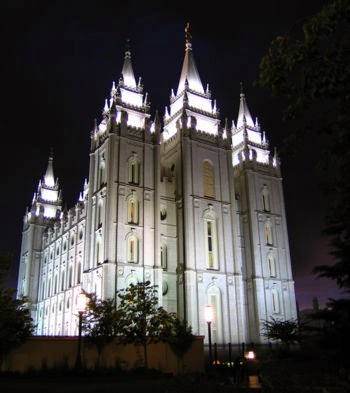
Salt Lake Temple
Eternal marriage is the crowning covenant for those who seek eternal life, since bringing to pass the "immortality and eternal life of man" is contingent upon the creation of the mortal body by a man and a woman. Marriages are "solemnized" in temples. We call it "sealing," implying an eternal welding link forged by priesthood authority that binds families together forever. Death may intervene and temporary partings may ensue, but life continues even after death, and love never ends. "In the celestial glory there are three heavens or degrees. And in order to obtain the highest, a man must enter into this order of the priesthood [meaning the new and everlasting covenant of marriage]; And if he does not, he cannot obtain it. He may enter into the other, but that is the end of his kingdom; he cannot have an increase." (D&C 131:1-4).

Said the Lord: "Except a man and his wife enter into an everlasting covenant and be married for eternity, while in this probation, by the power and authority of the Holy Priesthood, they will cease to increase when they die; that is, they will not have any children after the resurrection. But those who are married by the power and authority of the priesthood in this life, and continue without committing the sin against the Holy Ghost, will continue to increase and have children in the celestial glory." (D&C 132:22-25). Eternal lives indicates the right of a worthy man and woman to enjoy "the continuation of the seeds," the everlasting perpetuation of the family unit. (TPJS, 300-301; emphasis mine).

We started by stating God is no respecter of persons, implying explicitly there is no "cap" in eternity upon the number of saved beings. The design of God's "great plan of happiness" is to save all who will be saved in compliance with the requirement to repent. With the Mormons it is an article of our faith: "We believe that through the Atonement of Christ, all mankind may be saved, by obedience to the laws and ordinances of the Gospel." (Articles of Faith 1:3; emphasis mine). Again, when the Lord says "all" He means "all".

No person was promised eternal life in our premortal spirit state on an unconditional basis, and conversely, none was condemned forever as an irretrievable reprobate either. (Mormon Doctrine, 2nd ed., 238). Lehi declared to his son Jacob, "Salvation is free" (2 Nephi 2:4). The plan of salvation turns on mercy, and His purposes are available and accessible to all without restriction. Nephi taught: ". . .the Lord God worketh not in darkness." Further, "He doeth not any thing save it be for the benefit of the world; for he loveth the world, even that he layeth down his own life that he may draw all men unto him. Wherefore, he commandeth none that they shall not partake of his salvation." Nephi declared: "Hath he commanded any that they should not partake of his salvation? Behold I say unto you, Nay; but he hath given it free for all men; and he hath commanded his people that they should persuade all men to repentance." (2 Nephi 26:23-24, 27). Mormon missionaries, totaling some 85,000, now dot the globe proclaiming these truths. I encourage everyone who hasn't yet to invite them into your homes to learn more.

We learn in the scriptures about a "strait gate" and a "narrow way" which lead to eternal life. "Strait is the gate, and narrow the way that leadeth unto the exaltation and the continuation of the lives, and few there be that find it, because ye receive me not in the world neither do ye know me." On the other hand, "broad is the gate, and wide the way that leadeth to the deaths; and many there are that go in thereat, because they receive me not, neither do they abide in my law." (D&C 132:22, 25; see also Matthew 7:13-14).

In relation to the world's population, perhaps Mormons will forever be a minority, and "few" among the masses of humanity of 7 billion in the world today, but there is room for optimism in these verses. Many of our spirit brothers and sisters, perhaps a number approaching infinity, will be saved. Think of all the children who died before the age of accountability, perhaps billions of little ones from the days of Adam to the time of the Millennium. Add to that billions who never had the opportunity to hear the gospel message in mortality, but who afterwards received the glad tidings in the spirit world prior to their resurrection. Don't forget the innumerable hosts who qualified for exaltation from Enoch's city, from Melchizedek's Salem, or from the "golden era" of the Nephites after the resurrected Lord's visit to the Americas, as cited in The Book of Mormon. Continue adding the billions of children who will be born during the Millennium, a time when disease and death are non-existent. (D&C 45:58). Think about all who will yet live when Earth is "renewed" and paradisiacal glory reigns. Can you begin to catch a glimpse of the number of saved beings in eternity? God, our Eternal Father in Heaven, who is the Author of the plan of salvation will save many more than our finite minds can imagine.

As Mormons, we are a patient lot, and we accept salvation and exaltation as a process over time. We align ourselves in this life to the degree we can with eternal verities we accept and know to be true. We accept our imperfections and those of others, while simultaneously doing all we can to become sanctified and holy in this life and encouraging one another to do the same. Learning to forgive others freely is to learn the attributes of godliness in this life, since each of us falls short of perfection in mortality and stands in need of forgiveness ourselves. Gaining salvation and attaining perfection is a lengthy process that certainly must transcend time and space in this life and continue beyond the grave. (See D&C 93:19).

I cherish and commend to you these words of Elder Bruce R. McConkie to college students at BYU:

Elder Bruce R. McConkie
"We do not work out our salvation in a moment; it doesn't come to us in an instant, suddenly. Gaining salvation is a process. Paul says, 'Work out your salvation with fear and trembling' (Philippians 2:12). To some members of the Church who had been baptized and who were on the course leading to eternal life, he said, 'Now is our salvation nearer than when we believed' (Romans 13:11). That is, 'We have made some progress along the straight and narrow path. We are going forward, and if we continue in that direction, eternal life will be our everlasting reward. . .'

"We say that a man has to be born again, meaning that he has to die as pertaining to the unrighteous things in the world. Paul said, 'Crucify the old man of sin and come forth in a newness of life' (Romans 6:6). We are born again when we die as pertaining to unrighteousness and when we live as pertaining to the things of the Spirit. But that doesn't happen in an instant, suddenly. That also is a process. Being born again is a gradual thing, except in a few isolated instances that are so miraculous that they get written up in the scriptures. As far as the generality of the members of the Church are concerned, we are born again by degrees, and we are born again to added light and added knowledge and added desires for righteousness as we keep the commandments. . .

"So it is with the plan of salvation. We have to become perfect to be saved in the celestial kingdom. But nobody becomes perfect in this life. Only the Lord Jesus attained that state, and he had an advantage that none of us has. He was the Son of God, and he came into this life with a spiritual capacity and a talent and an inheritance that exceeded beyond all comprehension what any of the rest of us was born with. Our revelations say that he was like unto God in the premortal life and he was, under the Father, the creator of worlds without number. That Holy Being was the Holy One of Israel anciently and he was the Sinless One in mortality. This shows that we can strive and go forward toward that goal, but no other mortal - not the greatest prophets nor the mightiest apostles nor any of the righteous saints of any of the ages - has ever been perfect, but we must become perfect to gain a celestial inheritance. As it is with being born again. and as it is with sanctifying our souls, so becoming perfect in Christ is a process. . .

"As members of the Church, if we chart a course leading to eternal life; if we begin the processes of spiritual rebirth, and are going in the right direction; if we chart a course of sanctifying our souls, and degree by degree are going in that direction; and if we chart a course of becoming perfect. and, step by step and phase by phase, are perfecting our souls by overcoming the world, then it is absolutely guaranteed - there is no question whatever about it - we shall gain eternal life. Even though we have spiritual rebirth ahead of us, perfection ahead of us, the full degree of sanctification ahead of us, if we chart a course and follow it to the best of our ability in this life, then when we go out of this life we'll continue in exactly that same course. We'll no longer be subject to the passions and the appetites of the flesh. We will have passed successfully the tests of this mortal probation and in due course we'll get the fulness of our Father's kingdom - and that means eternal life in his everlasting presence.

"The Prophet told us that there are many things that people have to do, even after the grave, to work out their salvation. We're not going to be perfect the minute we die. (TPJS, 189; see also, Doctrines of Salvation, 1:61). But if we've charted a course, if our desires are right, if our appetites are curtailed and bridled, and if we believe in the Lord and are doing to the very best of our abilities what we ought to do. We'll go on to everlasting salvation, which is the fulness of eternal reward in our Father's kingdom."

Elder McConkie then observed: "I think we ought to have hope; I think we ought to have rejoicing." ("Jesus Christ and Him Crucified," 1976 Brigham Young University Devotional Speeches of the Year, 398-401; also see, "The Seven Deadly Heresies," 1980 Brigham Young University Devotional Speeches of the Year, 78-79; Conference Report, October 1976, 158-59, emphasis mine above).

We have hope to rejoice for those who will yet forsake the ways of the world, enter the gate of baptism and walk along the strait and narrow path with the Holy Ghost as their guide, whether in this life or in the next. It is always better the sooner we can embrace truth and live accordingly. I take great comfort in knowing there will be "an innumerable company" of the just (see D&C 76:67; 138:12), who do so.

Our Lord declared, ". . .he who doeth the works of righteousness shall receive his reward, even peace in this world, and eternal life in the world to come." (D&C 59:23). Centuries ago, Isaiah wrote: "And the work of righteousness shall be peace; and the effect of righteousness quietness and assurance for ever" (Isaiah 32:17). Though we pass through "hard things" in mortality, we can know peace in this life "which passeth all understanding" (Philippians 4:7). We can come time through all the tests and trials, taught the Prophet Joseph, to a point where we have made our callings and elections sure. (TPJS, 149-51). For these the day of judgment has been advanced and blessings associated with the glories of the celestial kingdom are assured. They receive what the Prophet Joseph called "the more sure word of prophecy," which the Lord explained to him, "means a man's knowing that he is sealed up unto eternal life, by revelation and the spirit of prophecy, through the power of the Holy Priest hood. It is impossible for a man to be saved in ignorance." (D&C 131:5-6).

President Marion G. Romney
Though it is true, as President Marion G. Romney observed, that "the fulness of eternal life is not attainable in mortality, . . .the peace which is its harbinger and which comes as a result of making one's calling and election sure is attainable in this life." (Conference Report, October 1965, 20).

The Prophet Joseph extended this invitation: "I would exhort you to go on and continue to call upon God until you make your calling and election sure for yourselves, by obtaining this more sure word of prophecy, and wait patiently for the promise until you obtain it." (TPJS, 299; see also Mosiah 18:8-9; D&C 14:7; 53:7; 2 Nephi 31:20; Mosiah 5:15). Remember, "But blessed are they who are faithful and endure, whether in life or in death, for they shall inherit eternal life." (D&C 50:5; emphasis mine).

I conclude with these words from Elder Bruce R. McConkie at the funeral of Elder S. Dilworth Young:

"If we die in the faith, that is the same thing as saying that our calling and election has been made sure and that we will go on to eternal reward hereafter. As far as faithful members of the Church are concerned, they have charted a course leading to eternal life. This life is the time that is appointed as a probationary estate for men to prepare to meet God, and as far as faithful people are concerned, if they are in the line of their duty, if they are doing what they ought to do, although they may not have been perfect in this sphere, their probation is ended. Now there will be some probation for some other people hereafter. But for the faithful saints of God, now is the time and the day, and their probation is ended with their death, and they will not thereafter depart from the path. It is true as the Prophet Joseph Smith said, that there are many things that have to be done 'even beyond the grave' to work out our salvation, but we'll stay in the course and we will not alter from it, if we have been true and faithful in this life." (From an address at the funeral service for Elder S. Dilworth Young, 13 July 1981, typescript, 5; emphasis mine).

Of course there is life after death! That includes life after death for EVERYONE. In this life we choose the quality of our life after death, through the exercise of our agency in obedience to God's commandments. For those of us who are living in mortality, we must exercise faith in the Lord Jesus Christ as our Savior and Redeemer, repent of our sins, recognizing He has already redeemed us from sin and death, enter the waters of baptism and be baptized by those authorized servants holding the priesthood, and receive the gift of the Holy Ghost by the laying on of hands by those in authority.

Then throughout our mortal probation we endure in those principles and ordinances in order to claim the blessings of salvation and exaltation.

Sunday, January 6, 2013

The Winter Inversion and Warmth and Light

Pine Valley
We live at 7333 feet above sea level in the Uinta Range of the Wasatch Mountains. Far below in the Salt Lake Valley at about 4400 feet, cold winter air laden with pollutants is trapped and temperatures plummet when the high pressure is aloft. However, yesterday we were basking in the warmth of the sun at 45 degrees, while the valley below was in the frigid 20s. 

The analogy is an apt one in today's political climate. We have concluded perhaps the most bitter and divisive presidential election anyone can remember. Mitt Romney was savaged and made to look like someone who could never be considered for high office, when in fact he may have been the most qualified candidate for the presidency ever put forward by either party. You can debate that point if you wish, but the brutal non-stop attacks on him would certainly have made anyone think twice before considering a vote for him. Despite the ugly accusations, he lost by a narrow margin. The recriminations have ended, and no one will be able to blame the Mormon Church for the state of our politics. Probably a good outcome for the Church and its members, many of whom withheld their votes for Romney. 

In the aftermath of the 2012 election, I have been reminded of a passage of scripture: "Old things are done away, and all things have become new." (3 Nephi 12:47). 

That passage, of course, has reference to the Savior's teaching in the "Sermon at the Temple," similar to the teaching He gave in the Sermon on the Mount in Galilee. He was referring to Himself as being the fulfillment of the Old Testament Law of Moses, and He taught the old law had now been replaced by His atonement, the event the law had only typified before it was accomplished. 

I began thinking about how trapped and paralyzed we are in the political chill of living at lower elevations. If anything, this election plumbed new depths of debauchery and depravity. It seems we have become frozen and polarized as a nation in our thinking about politics. Indeed, Washington D.C. seems paralyzed and inept at best. We have a president who is so inept he refuses to negotiate with Congress over pressing fiscal matters facing us as a nation. 

In the middle of the night on New Year's Day last week, the Senate passed a bill dubbed "The Taxpayer Relief Act of 2012." The bill was distributed to Senators at 1:36 a.m., they were given six minutes to read the 153 page bill, then the vote roll call began.

Similarly in the House two nights later, it passed without an open floor debate, an amendment, or so much as a whimper of protest. In fact, the bill provided for a tax increase on an estimated 77 per cent of Americans. Yes, some Bush-era tax cuts were made permanent and rates were fixed on those making less than $400,000 (single) and $450,000 (married), but in the way the bill was passed in the middle of the night, a bill hammered out by chiefly two individuals, Senate Minority Leader Mitch McConnell and Vice President Joe Biden, the process left much to be desired. And after all the bickering in the run up to the procrastinated settlement, President Obama flew out of town to resume his Hawaiian vacation without signing the bill. He left the formality to his auto-pen.


Senator Mike Lee (R-UT)
Our system of government is broken, some say irreparably. Senator Mike Lee (R-UT) offered an explanation for his "no" vote on the measure in an op-ed piece that appeared in the Washington Examiner. Orrin Hatch, senior senator from Utah, and one who will never have to face the referendum of voters ever again, was the only member of the Utah delegation who voted "yes." Even Democrat Congressman Jim Matheson, ever so cautious about upsetting conservatives in Utah, voted "no." One of Obama's critics has come up with at least 50 impeachable offenses so far (he's still counting). There are others, including newly-elected Texas Senator Ted Cruz who contend Obama's doing nothing more than broadcasting scare tactics about defaulting on the national debt if he doesn't get a rubber stamp from Congress to increase the debt limit. We have more than enough revenue coming in to service the debt. It costs about $30-40 billion per month to service the debt with over $200 billion per month in tax revenues.  

So as I looked back to scripture in that same chapter for direction and compared it to the Biblical account in Matthew, I spent some time with the Beatitudes in the same sermon. If the goal in life is to become more like our Savior, Jesus Christ, we have an unfailing glimpse into His character. What if we adopted the inspiration in our public discourse that reflects what we read in the Beatitudes? I know it's impossible to comprehend we might find such character reflected in government officials, but I can dream. 
President Harold B. Lee

President Harold B. Lee observed, "In His Sermon on the Mount the Master has given us somewhat of a revelation of His own character, which was perfect, or what might be said to be 'an autobiography, every syllable of which He had written down in deeds,' and in so doing has given us a blueprint for our own lives." (Stand Ye in Holy Places [1974], 342). 

Our need to rely upon God in our civil discourse in this country has never been more acute than it is right now, yet we see those in government who are doing everything humanly possible to disavow and disengage from any religious influence. People of good will everywhere, regardless of their affiliation with a certain denomination, must never fail to point to the Judeo-Christian model of self-governance if we are to preserve our heritage as Americans. We know, if we learned anything from Mitt Romney's candidacy, that there are increasing numbers of people inclined to seek and value good leadership even if they lost a close election this time around. Leadership is most often lacking because of arrogance and the false meme that government can take care of every social ill that besets us. Humility is always in style, especially as the severity of our extremity becomes more apparent.
President Gordon B. Hinckley

President Gordon B. Hinckley said, "Meekness implies a spirit of gratitude as opposed to an attitude of self-sufficiency, an acknowledgment of a greater power beyond oneself, a recognition of God, and an acceptance of his commandments." ("With All Thy Getting Get Understanding," Ensign, August 1988, 3-4). 

There may always be fewer of us who can remember and still infuse the vision of America in our youth, but don't discount the rising number of young people in this country who are more inclined toward good and right principles than ever before. Regardless of the comparatively small numbers in the ranks we can all remember the Savior's teaching about being "the salt of the earth." 

Elder Bruce R. McConkie taught, "Among the ancient Hebrews salt. . . was used as a preservative, in seasoning food, and in all animal sacrifices. (Leviticus 2:13; Ezekiel 43:24; Mark 9:49-50). So essential was it to the sacrificial ordinance that it was the symbol of the covenant made between God and His people in connection with that sacred performance. (Leviticus 2:13; Numbers 18:19; 2 Chronicles 13:5).
Elder Bruce R. McConkie

"Accordingly, our Lord's statement, made first to the Jews and then to that other great body of Hebrews, the Nephites, that they had power 'to be the salt of the earth,' takes on great significance. . . They had power, in other words, to be the seasoning, savoring, preserving influence in the world, the influence which would bring peace and blessings to all others." (Mormon Doctrine, 2nd edition [1966], 667-68). 

This is now mostly self-talk to remind myself what it's like living at the Ranch in clear, crisp air where the sun shines and warms the house even on the coldest of days down in the murky valleys below. We must continue to hold the high ground. We must stand with Christ, His Church, and His teachings. Those teachings include the Beatitudes to help us govern ourselves. In the very next verse after He tells us the old things are done away, He reminds us, "Therefore, I would that ye should be perfect even as I, or your Father who is in heaven is perfect." (3 Nephi 12:48). 

The quest for perfection is a lifetime ambition, not to be confused with New Years resolutions made and forgotten. Those were what Mary Poppins referred to as "pie crust" promises - easily made, easily broken." He really means to make us perfect in Him. (See Moroni 10:32-33.) It is not merely ethereal theological gas, this matter of perfection. We can become perfect in our faith in HIS perfection. When we do, we are "sanctified in Christ by the shedding of the blood of Christ, which is in the covenant of the Father unto the remission of your sins, that ye become holy, without spot." 

Each of us can model perfect faith in Jesus Christ, our Redeemer. It was Thomas Carlyle who reminded us, "Every noble work is at first impossible." 

Influence for good will continue to be felt among those who take the higher ground. It's people like Mike Lee in government who will make a difference with the support of people of good will who are serious about preserving our way of life in America under the glorious banner of the Constitution. The struggle ahead will be long and arduous. I predict Mike's influence will be as one consistent and resolute voice in the wilderness of sanity and reason, pleading with Americans to stay true to the principles of sound government and Constitutional principles. As the years ahead unfold we may be assured others will join him. 

How can I be so bold in asserting that? I live in the thin air of the winter above the inversion where the sun is warm and the truth is more easily discerned, and, like Billy Graham, I've remained an optimist. I've read the last chapter of the Bible and I know how this all turns out - we win.