Showing posts with label john adams. Show all posts

Saturday, January 18, 2014

The Old Morality

I admit it freely - I am a cultural laggard. When you ask me to name a current pop icon in any venue, I am stumped for an answer. My idea of cutting edge entertainment these days is Michael Buble, and he's a throwback to Frank Sinatra.

I watch a lot of old movies these days with my dear wife. TCM is our very favorite cable channel. That's Turner Classic Movies for the uninitiated. During the Christmas holidays we watched sappy, emotionally-charged melodramas on the Hallmark Channel, so predictable it felt like a cookie-cutter script factory was hard at work behind the scenes. Because I now own one, I was stunned to observe how many of the heroes in those movies also drove the Toyota Prius. So maybe at least in that one respect I can qualify as an "early adopter" of a cutting edge technology. But to give you some idea of the real me, the last movie we saw in a theater was "Saving Mr. Banks". I'm not ashamed to admit I shed tears watching Emma Thompson's portrayal of the stiff upper lipped Englishwoman, P.L. Travers (she was really Australian), who brought the character of Mary Poppins to life in her books. So cutting edge, right?

I offer this background to illustrate why I am dragging my feet on same-sex marriage initiatives that will be wending their way through the courts for as far as the eye can see into the future. I have tried to make clear in previous posts to this page that I am intimately familiar with the personal struggles of people with same-sex attractions. Though I am not a pop culture progressive liberal-minded individual, I am also not a homophobic bigot either. I have empathy for those who are confused by this issue.

My purpose today is to state the stark contrasts I see in the way the debate keeps playing out - legal activists pitted against (sometimes) self-righteous moralists. While those who would lobby for legal rights in the courts have made their arguments based primarily upon an "equal rights" and "equal protection" Constitutional platform, and that sounds perfectly legitimate in many minds, what has gone missing and is completely obscured is the inefficiency of the legal system to rule in matters with a moral component as religiously charged as homosexuality. Those who take the moral side, arguing that homosexuality is sin, fail to recognize the legal courts and the courts of public opinion have never been the place for making the moral argument stick. Morality is something quite separate and apart from legal machinations, and we would do well to keep them distinctly separate.

When I was a boy I remember a weak argument I always made with my Mother. I would say, citing some cool new thing "everyone" was doing, "But Mom, everybody's got one, or is doing it, or is going to it, or is (fill in the blank)." To which she would invariably respond, "David, just because everyone is doing it doesn't make it right." Ah, the indispensable wisdom of Mom.

America is now on the precipice of slipping off its perch as a moral beacon for the world. Some would argue America never was moral and never should be judged on that basis. Very well, have it your way if you wish. However, our early Founders spoke about the need for Americans to remain a moral people, because only a moral people could stand a chance of self-governance. They set an admirable, though not flawless, example for us to follow. At their core, however, these were remarkable men who acknowledged the right to freedom was granted by an all-wise Providence who was the Lawgiver. I have written extensively in many past blog posts about them. Moral agency was enthroned in the founding documents as the means through which freedom won in such a bloody enterprise as the Revolutionary War could be maintained. It was from God we gleaned our rights as free men, they told us, and from no other source. They argued freedom could not be obtained in any other way and from any other fountainhead.

Fast forward to 2014. God's laws have never changed. Policies, practices, procedures and politics have changed. Many of the practices of the past, while legal, were never moral. Slavery is one. Alcohol is another. Nazism and Adolf Hitler flourished in Germany before World War II in an environment legally permitting their existence. Cigarettes are legal, but all of these stand on weak ground when making a moral judgment. Apartheid in South Africa was legal until Nelson Mandela challenged the law with a more well-defined moral argument. Walter Williams correctly observed, "Legality, alone, cannot be the talisman of moral people." He also argues that private immorality (homosexuality) cannot suddenly somehow become moral just because it is openly practiced collectively and gains widespread acceptance. None of those facts change the underlying core reality it is morally wrong. Does the fact that marijuana has been declared legal in some states change smoking it into a moral activity merely because the courts have ruled it is legal and people now line up at a retail outlet to purchase it instead of in some back alley? Does same sex marriage, permitted in some states as legal, now alter the moral requirement of God?

Indeed, all those things are always in transition. Just because Obamacare is the law of the land today, is it morally defensible to fund it with the most massive theft of personal wealth ever attempted by economic redistribution? I hope Richard Lugar (former Republican Senator from Indiana) is right. The fundamental moral principles upon which America was founded are anchored in the bedrock principle of moral agency - the freedom to make moral judgments for the benefit of individuals and the whole society.

The moral law of sexual purity before and during marriage remains valid. The Church cannot condone immorality in any form it takes. Because we are all sinners and come short of the mark, Christ's atonement cleanses those who purify themselves in His perfection. (Moroni 10:32-33). The leaders of the Church, while sympathetic to the struggles of those with same-sex attraction, are not empowered nor authorized to alter the moral law upon which the plan of salvation rests, and in The Family: A Proclamation to the World (1995), they made the eternal law explicit and understandable. Gender differences are foreordained and were in place in our pre-existent unembodied spirits, just as they are in our mortal bodies now, and will be in our disembodied spirits awaiting our resurrected bodies hereafter. Neither can the leaders of the Church give a free pass to this supposed "protected class" of sinners over that imaginary "unprotected class." We are all sinners. All are subject to the principle of repentance. None is exempt. No One. So plain is that straight-forward declaration, it would seem, no one reading it could possibly misunderstand. The gospel of Jesus Christ is true.

But the debate rages on, even among those in the Church who should know better. I would suggest there is little that can be done in the courtroom of popular opinion or within the courthouse to alter wrong-headed thinking on this topic. The moral agency to make errors in judgment is also part of the plan of salvation. The latter-day reality has come when homosexuality is as rampant and acceptable as it was in the days of Sodom and Gomorrah, and one can only speculate on how wicked the world must become before it is ultimately cleansed by fire.

The old morality is still the new morality and it is chiseled in stone. It has never changed. The requirements for happiness here and hereafter will never change. But don't be one of those who is beguiled by the siren call of immorality disguised as acceptance and tolerance at the expense of your own moral convictions. You hold fast to what you know is true, even if you lose badly in the court of public opinion.

Elder Dallin H. Oaks
Elder Dallin H. Oaks framed this debate very well in his last General Conference sermon, entitled "No Other Gods":

"There are many political and social pressures for legal and policy changes to establish behaviors contrary to God’s decrees about sexual morality and contrary to the eternal nature and purposes of marriage and childbearing. These pressures have already authorized same-gender marriages in various states and nations. Other pressures would confuse gender or homogenize those differences between men and women that are essential to accomplish God’s great plan of happiness.

"Our understanding of God’s plan and His doctrine gives us an eternal perspective that does not allow us to condone such behaviors or to find justification in the laws that permit them. And, unlike other organizations that can change their policies and even their doctrines, our policies are determined by the truths God has identified as unchangeable.

"Our twelfth article of faith states our belief in being subject to civil authority and “in obeying, honoring, and sustaining the law.” But man’s laws cannot make moral what God has declared immoral. Commitment to our highest priority — to love and serve God — requires that we look to His law for our standard of behavior. For example, we remain under divine command not to commit adultery or fornication even when those acts are no longer crimes under the laws of the states or countries where we reside. Similarly, laws legalizing so-called “same-sex marriage” do not change God’s law of marriage or His commandments and our standards concerning it. We remain under covenant to love God and keep His commandments and to refrain from serving other gods and priorities — even those becoming popular in our particular time and place." (emphasis mine).

If you are living the moral law of chastity, I would predict you will never have the peace you seek in hoping the world will someday turn to righteousness because you believe the way you do in your heart of hearts. As in the days of Noah, the wicked will cling steadfastly to their wickedness and will be in denial until the floods of anger flow freely and they seek, too late, to be admitted into the sanctuary of the ark. In that day the flood took them into the spirit world where they could finally be in a place to learn the truths of the gospel.

In the latter days, when we live upon the earth, the unquenchable fire of destruction will also overtake the world, and the cleansing will be just as widespread, "equal rights" and "equal protection under the law" handed down by the suborned courts notwithstanding.

Saturday, February 19, 2011

A Calf's Tail

"So I said to Barack, I knew Abe Lincoln, and you ain't no Abe Lincoln!"
On this Presidents Day weekend, language used by politicians is worthy of comment.

We used to observe Lincoln's birthday on February 12th and then Washington's on the 22nd. Wouldn't you know it was the commercialization of their birthdays that prompted a change? Led by automobile dealers in the late 1980s, their need for a long weekend in which to hold a sale is what eventually produced "Presidents Day." It splits the goalposts between Lincoln's and Washington's birthdays and gives us three days and a shopping weekend mid-winter. Now it's not just those two we cite, but every president.

President Bill Clinton
I'm always fascinated with what presidents say and have said. Perhaps the most famous use of language and how it could be parsed was Bill Clinton's lamentable, "I did not have sexual relations with that woman." Or when questioned under oath, his "That depends on what your definition of 'is' is." I'm almost certain Bill Clinton said some things that are far more astute than those two statements, but they will forever be attached to him as the most memorable.

Jimmy Carter had a memorable quote along those lines long before Bill Clinton acted upon his thoughts and temptations, however. Carter once gave an interview for Playboy Magazine, in which he famously said, "I've looked on many women with lust. I've committed adultery in my heart many times. God knows I will do this and forgives me."
President Jimmy Carter

No matter what their political enemies may say, most U.S. Presidents have an abiding love for this country, its heritage and its values. Carter underscores that idea with this statement: "The experience of democracy is like the experience of life itself -- always changing, infinite in its variety, sometimes turbulent and all the more valuable for having been tested by adversity."

Three years into his failed presidency he was on national television giving what later came to be known as his "Crisis in Confidence" or "malaise" speech in which he said, "I promised you a President who is not isolated from the people, who feels your pain, and who shares your dreams and who draws his strength and his wisdom from you."

Then along came Ronald Reagan who asked voters a simple question, "Are you better off today than you were four years ago?" They went for Reagan in a landslide election a year later in 1980.

Lincoln Memorial, Washington D.C.
There's a story attributed to Abraham Lincoln, when he was faced with some thorny issues. He would ask his opponent who thought a question could be settled with a twist of language or a slight abuse of power, "How many legs would a dog have, if we called the dog’s tail, a leg?" Confident of simple math, Lincoln's opponent would respond, "Five,” to which Lincoln would respond, "No, calling a dog’s tail a leg, doesn’t make it a leg.”

The genesis of that story is interesting. Because it has been so widely quoted, most have assumed the use of the dog in the metaphor is accurate, but I found a source this morning that is the most credible I've seen in print. This source contends beginning on page 241, continuing into page 242, that the animal was actually a calf and not a dog.

Here's the source for the quote: Reminiscences of Abraham Lincoln by distinguished men of his time / collected and edited by Allen Thorndike Rice (1853-1889). New York: Harper & Brothers Publishers, 1909. The University of Michigan has the entire text on-line, in the Collected Works of Abraham Lincoln, an on-line source whose whole text is searchable.

President George Washington
George Washington, hailed as the Father of our Country by his peers, and fully aware that every move he made was being logged into the history books for future generations, observed, "I walk on untrodden ground. There is scarcely any part of my conduct which may not hereafter be drawn into precedent."

Knowing there would have been no agreement on the Constitution without leaving the question of slavery untouched and having to pragmatically kick the question down the road for another generation of Americans to deal with, Washington lamented:  "I can only say that there is not a man living who wishes more sincerely than I do to see a plan adopted for the abolition of slavery."

President Ronald W. Reagan
Ronald Reagan, recently confirmed once again by American citizens (as he has been for the last twelve years in eight different polls) as the "greatest president in U.S. history," left many memorable quotes in the history books. This is one of my favorites: "Above all, we must realize that no arsenal, or no weapon in the arsenals of the world, is so formidable as the will and moral courage of free men and women. It is a weapon our adversaries in today's world do not have."

Reagan recognized, as few ever have, where the horsepower behind America's economic engine comes from: "Entrepreneurs and their small enterprises are responsible for almost all the economic growth in the United States."

Ronald Reagan was always warning about the fragility of our heritage as free people: "Freedom is never more than one generation away from extinction. We didn't pass it to our children in the bloodstream. It must be fought for, protected, and handed on for them to do the same."

Reagan was the people's president. He had an uncanny ability to tap into their psyche and he routinely used his sense of humor to poke fun at the politicians we love to hate. This is only one of his many gems:  "It has been said that politics is the second oldest profession. I have learned that it bears a striking resemblance to the first."

President John Adams
Readers of this page will understand my affection for John Adams, who said, "Abuse of words has been the great instrument of sophistry and chicanery, of party, faction, and division of society."

In his defense argument of the soldiers involved in the Boston Massacre in 1770, where his clients were acquitted, Adams famously observed, "Facts are stubborn things; and whatever may be our wishes, our inclinations, or the dictates of our passions, they cannot alter the state of facts and evidence."

To all the bloggers in our enlightened age, Adams would say, "Let us tenderly and kindly cherish, therefore, the means of knowledge. Let us dare to read, think, speak, and write."

Like most of the founders, John Adams had a reverence and a complete awareness of what they were creating in the American experiment. Lest we forget in our day, he reminds us, "I always consider the settlement of America with reverence and wonder, as the opening of a grand scene and design in providence, for the illumination of the ignorant and the emancipation of the slavish part of mankind all over the earth."

President George W. Bush
In more recent years as the politicians have sparred, criticized and lampooned (get ready, it's coming again soon in the run up to the 2012 election), it was refreshing to hear George W. Bush stand down: "I just didn't want to get out there anymore; I didn't want to get back into what I call 'the swamp.' And the other reason why is I don't think it's good for the presidency for a former president to be opining about his successor. President Obama's got plenty of critics - and I'm just not gonna be one."

President John F. Kennedy was inspirational in so many ways. As a young man I loved reading his Profiles in Courage compilation. He reminds us, "A nation which has forgotten the quality of courage which in the past has been brought to public life is not as likely to insist upon or regard that quality in its chosen leaders today - and in fact we have forgotten."

President John F. Kennedy
It was Kennedy who offered the unforgettable line in his first inaugural, "And so, my fellow Americans, ask not what your country can do for you; ask what you can do for your country."

Kennedy is credited with "breaking through" the unspoken barrier of religious affiliation as a litmus test for presidential candidates when he asserted, "I am not the Catholic candidate for President. I am the Democratic Party's candidate for President, who happens also to be a Catholic."

No matter what your political affiliation or persuasion might be, you can rest assured of one thing: Presidents of the United States of America generally do what they believe in their hearts is the best course for America. Recently, Bill O'Reilly, the number one rated cable talker in America these days, interviewed both former President George W. Bush and current President Barack Obama. He came away with the surprising conclusion that each man sincerely believed he was right, even though their policies could not be more diametrically opposed.

O'Reilly observed:

"But what happens when a person's conviction is wrong? There is no question that Saddam Hussein could have been destroyed by other means. Surely the world is a better place without him, but would most Americans support the Iraq invasion if we could do it all over? I don't think so. In hindsight, the Iraq situation should have been handled by the Air Force and Navy. Saddam's regime could have been strangled without so much American blood.

President Barack Obama
"Things are a bit murkier on the economic front. Since the Obama administration has been in power, the feds have spent an astounding seven trillion dollars. This has left the United States vulnerable in the world marketplace because we need to borrow so much money from nations like China. The massive $14 trillion debt has now become as big a threat as the economic meltdown of three years ago. No matter how you frame the issue, federal spending must be cut back, and Mr. Obama has to know this. But, like Mr. Bush, the president does not regret his controversial policies."

So let's remember the calf's tail when it comes to measuring "truthiness" from politicians on this Presidents Day honoring not just Lincoln and Washington. Just because Bush or Obama calls a calf's tail a leg, doesn't make it a leg after all.

Sometimes the statements politicians write onto the parchment of time must age a bit to be fully understood and appreciated. We celebrated the 100th birthday of Ronald Reagan recently. During his presidency he was anything but beloved. People were scared to death about this "cowboy" who had his finger on the trigger of nuclear weapons and didn't seem shy about pulling it as he took on the "Evil Empire." But the one thing he had going for him was his authenticity. He connected with people, even Mikhail Gorbachev eventually. We had to have a bit of perspective as Americans before we embraced Reagan and fully credited him with the end of the Cold War.

Only time and experience will tell the whole "tale" with accuracy.

In the meantime, let us give a wide berth to political "truth" in the here and now and wait upon history to make its judgments someday.

Wednesday, August 18, 2010

Political Discourse

Much has been made in recent years of the rancor and bitterness between the two political parties in America. 

George W. Bush promised to reach across the aisle and unite the parties as he had done in Texas while he was governor.  It was much more difficult than he imagined, though some unity was achieved as a result of the country uniting in dramatic fashion for a season following 9/11.  How sad that the precipitating event was the only thing that seemed to drive us together into common ground.  Absent war, attacks from foreign powers on our soil, and a complete economic meltdown, can it ever be achieved again?

Barack Obama also pledged to do the same when he went to Washington in 2009.  Instead of unity, Obama has cast aside every single attempt at uniting and healing the political divide.  He has shoved a political agenda down the throats of unwilling and seemingly unwitting Americans at every turn for eighteen months of total legislative domination.  Neither succeeded in uniting anything except the bitter forces of opposition against themselves.

In point of fact, the political discourse from its founding has always been filled with vitriol and accusations, whether with or without merit.

Don't be too alarmed when people say they wish there weren't so much hatred.  We are polarized as a country, and there is little doubt about it.  Just imagine what the discourse must have been over the slavery issues before, during and after the Civil War. 

Abraham Lincoln, icon that he is today, was villified and publicly attacked again and again during his presidency.  It was merciless and unrelenting.  It seemed he could do nothing right back then.  Today he sits enshrined forevermore in a monument in Washington D.C. befitting the enormity of his transformative powers to bridge the political divide.  It was no small feat. 

Will we ever see it again?  We came close in the aftermath of the 9/11 attacks.  Now we are bitterly divided again.  The miracle was short-lived to be sure.

All of this has reminded me of the conditions I've read about in the election of 1800, when John Adams, the sitting President was opposed by his Vice President, Thomas Jefferson.  The spirit of party that Jefferson had warned against had taken root and was entrenched in the runup to that election battle.  It was different in those days because the discourse was waged primarily by proxies, and rarely by the candidates themselves.

In Federalist pamphlets and newspapers, Jefferson was decried as a hopeless visionary, a weakling, an intriguer intoxicated with French philosophy, more a Frenchman than an American, and therefore a bad man.  He was accused of favoring states' rights over the Union, charged with infidelity to the Constitution, called a spendthrift and libertine.  In truth, he kept careful notes of his expenditures, but always throughout his life spent more than he brought in, eventually at death owing $100,000 more than the value of his assets. 

In contrast, at death the ever-frugal Adams and his wife Abigail had amassed an estate valued at $100,000.  No one ever faulted Adams as a spendthrift.  Instead, he was seen as a penny-pinching miser and skinflint.

One New York newspaper assured its readers that a Jefferson election would mean civil war.  It was said "the refuse of Europe" would flood the country and threaten the life of "all who love order, peace, virtue, and religion."  Does that sound remotely familiar in today's headlines?

Most amplified of all the charges against Jefferson were the assertions that he was an atheist.  Not only was Jefferson a godless man, the assertions went, he mocked the Christian faith.  The rumors in New England were so absurd that people were hiding family Bibles until the election was over, fearing they would be summarily rounded up and burned if he were elected.  Even Martha Washington was persuaded all this was true, when she told a visiting clergyman she thought Jefferson "one of the most detestable of mankind."

Stories were spread about Jefferson's personal immorality.  The whisper campaign included lumping Jefferson with all southern slave masters who were known to cohabit with their slave women.

Conversely, John Adams didn't fare much better in the campaigning of personal destruction, indicating these smears we witness today are not a modern invention.  Adams was excoriated as a monarchist, more British than American, and therefore a bad man just like Jefferson.  Remember, these were the two diligent and valiant servants of freedom's cause who were dispatched as diplomats to Europe at the same time as Benjamin Franklin.  Neither received much gratitude at the time for their prodigious efforts.

Adams was routinely ridiculed in public as old, addled and toothless.  Truth was that by the time he died at age 91, Adams really had lost nearly all his teeth, but the image was useful to his critics who called him a pacifist.

Timothy Pickering spread the rumor that to secure his reelection Adams had struck a corrupt bargain with the Republicans.  Another story affirmed the bargain had been struck with Jefferson himself.  The kernel of the story was that Adams would throw the election Jefferson's way and then serve as the Vice President.

Adams was also accused of consorting with four mistresses in London.  Nothing could have been further from the truth.  When the "news" reached Adams that he had ordered General Pinckney to London to procure the services of the four pretty mistresses, two for Pinckney and two for himself, Adams was amused.  "I do declare upon my honor," he wrote to William Tudor, "if this is true General Pinckney has kept them all for himself and cheated me out of my two."

That wasn't the worst of it.  Many charges against Adams included that he was insane.  It went on and on -- if Jefferson was a Jacobin, a shameless southern libertine, and a "howling" atheist, Adams was a Tory, a vain Yankee scold, and, if truth be known, "quite mad."

It's almost hysterical looking back through the lens of history.  By the Republicans Adams was accused as a warmonger, and berated by the High Federalists as fainthearted in the face of the French.

Jefferson had so distanced himself from Adams as the Vice President that he could be held accountable for nothing in the Adams administration that disappointed, displeased, or infuriated anyone.  Adams got blamed for everything as a result -- new taxes, the Alien and Sedition Acts, the standing army, and a host of other "menaces," or so said Philadelphia's leading newspaper, the Aurora.

The unfair contrasts didn't end there.  Jefferson, the Virginia aristocrat and slave master who lived in a style fit for a prince, as removed from his fellow citizens and their lives as it was possible to be, was hailed as the apostle of liberty, the "Man of the People."  Adams, the former farmer's son who despised slavery and practiced the kind of personal economy and plain living commonly upheld as the American way, was scorned as an aristocrat who, if he could, would enslave the common people just like King George III had done.  Amazing!

It was an old story for Adams in that 1800 election.  He had suffered abuse before from the Jefferson Republicans, but more painful to him personally were the highly personal attacks from the Hamilton Federalists.  Alexander Hamilton threw his political weight into the contest in open opposition to Adams.

In the flurry of scathing criticism, innuendo, slander and falsehoods, with war with the French looming as Adams and his peace commission to France were hard at work to avert another war, there was one gleaming tribute to Adams in the Washington Federalist that more closely typified his life's work:

"Bred in the old school of politics, his principles are founded on the experience of ages, and bid defiance to French flippancies and modern crudities. . . Always great, and though sometimes alone, all weak and personal motives were forgotten in public energy and the security of the sacred liberties of his country. . .  Deeply versed in legal lore, profoundly skilled in political science; joined to the advantage of forty years' unceasing engagement in the turbulent and triumphant scenes, both at home and in Europe, which have marked our history; learned in the language and arts of diplomacy; more conversant with the views, jealousies, resources, and intrigues of Great Britain, France and Holland than any other American; alike aloof to flattery and vulgar ambition, as above all undue control [he has as]. . . his sole object. . . the present freedom and independence of his country and its future glory.  On this solid basis he has attempted to raise a monument of his honest fame."

On Saturday, November 22, 1800, Congress convened for the first time in a joint session in the unfinished Capitol building, and John Adams delivered what he surely knew would be his last speech as President.  He said in part,

"It would be unbecoming the representatives of this nation to assemble for the first time in this solemn temple without looking up to the Supreme Ruler of the universe, and imploring his blessing.
"May this territory be the residence of virtue and happiness!  In this city may that piety and virtue, that wisdom and magnanimity, that constancy and self-government, which adorned the great character whose name it bears, be forever held in veneration!  Here, and throughout our country, may simple manners, pure morals, and true religion flourish forever!"

Despite the bitter political divide of his day, despite the withering criticism and rancor, bitterness and vitriol directed at him personally, John Adams found a way to rise above it all and to speak those conciliatory words before a joint session of a bitterly divided Congress.  What we need today are more noble patriots like John Adams. 

The ensuing years would see Jefferson and Adams reunited in abundant correspondence on a host of history-preserving topics, a happy consequence of noble statesmen rising above the political divide that had separated them earlier.

Adams was sixty-five when he stepped down after that 1800 election, Jefferson a comparatively youthful fifty-seven years old when he assumed the presidency. 

Fate would unite them again in death.  Both died on the same day, July 4th, 1826, true patriots each, a fitting end to a lifetime of devotion to honor, country and freedom.  Their legacy is ours if we will claim it for our own.  Like all politicians, neither was perfect, both had flaws, but neither retreated in their duty.

I know this will come off as idealistic and overly optimistic, but it won't sound unlike the conciliatory note sounded by John Adams in his farewell speech.  If men in public life endowed with the public trust could rise above political differences and bitter discourse then, surely they can do it again in our day.

Let us pray for that happy result without another 9/11.

Saturday, August 7, 2010

Personal Righteousness, Key to Governing America


This summer, I've been re-reading John Adams, the brilliant biography by Pulitzer Prize winner David McCullough.  This time, I've found refuge and relief from the current idiocy coming out of Washington.  I commend the book to all of you who may be having similar thoughts about current events.  It will do wonders to calm your troubled hearts in the tumult of opinions and the war of words.

If it weren't so true, the attached cartoon would be funnier.  There was no attempt to spell out every contingency that would arise in America when the writers of the Declaration of Independence and the Constitution of the United States laid it all out in writing.  Such was never their intent.  Instead, they relied upon the moral purity of the people who would come after them.  Yes, moral purity.

Thomas Jefferson
Thomas Jefferson, holding the pen that wrote the Declaration of Independence, later wrote:  "Experience hath shewn, that even under the best forms of government those entrusted with power have, in time, and by slow operations, perverted it into tyranny."  Despite that awareness, Jefferson also said, "I have no fear that the result of our experiment will be that men may be trusted to govern themselves without a master."  He also affirmed:  "I know of no safe depository of the ultimate powers of the society but the people themselves; and if we think them not enlightened enough to exercise their control with a wholesome discretion, the remedy is not to take it from them but to inform their discretion."

The founders, while they attempted to set up a government intentionally designed to separate and divide power into three branches and were wary of the Constitution's broad definitions, nevertheless trusted in the moral compass of the people to guide themselves.  They believed the majority would ultimately get it right, and made it possible to self-correct errors in judgment.  The representative republic was to be "renewable" every two years in electing every single member of the House of Representatives and one-third of the Senate to make it unalterably responsive to the will of the people. 

It was the people, the majority of Americans, in whom the founders believed and in whom they reposed all the power of the government.  If the people abdicated that power through indifference or wickedness, then even the founders could not help them.

The first inhabitants of this continent, the Jaredites, were warned

And the Lord would not suffer that they should stop beyond the sea in the wilderness, but he would that they should come forth even unto the land of promise, which was choice above all other lands, which the Lord God had preserved for a righteous people.
And he had sworn in his wrath unto the brother of Jared, that whoso should possess this land of promise, from that time henceforth and forever, should serve him, the true and only God, or they should be swept off when the fulness of his wrath should come upon them.
And now, we can behold the decrees of God concerning this land, that it is a land of promise; and whatsoever nation shall possess it shall serve God, or they shall be swept off when the fulness of his wrath shall come upon them. And the fulness of his wrath cometh upon them when they are ripened in iniquity.
For behold, this is a land which is choice above all other lands; wherefore he that doth possess it shall serve God or shall be swept off; for it is the everlasting decree of God. And it is not until the fulness of iniquity among the children of the land, that they are swept off.
And this cometh unto you, O ye Gentiles, that ye may know the decrees of God — that ye may repent, and not continue in your iniquities until the fulness come, that ye may not bring down the fulness of the wrath of God upon you as the inhabitants of the land have hitherto done.
Behold, this is a choice land, and whatsoever nation shall possess it shall be free from bondage, and from captivity, and from all other nations under heaven, if they will but serve the God of the land, who is Jesus Christ, who hath been manifested by the things which we have written.  (Ether 2:8-12).

Personal Righteousness of Founders

John Adams
Adams was a paragon of virtue.  Never was there a moment in his life where integrity, honesty and virtue took a holiday.  He and Abigail were separated by the devotion of Adams to the cause of freedom.  He spent ten years in Europe as ambassador in Paris, the Netherlands, then eventually England when the Revolutionary War ended.  Abigail, except for a brief respite years later, stayed home and managed their farm property.  Imagine being the first diplomat representing America in the court of King George III, the object of the very tyranny villified in the Declaration.  But undaunted by the task, John Adams presented himself before the King and the "special relationship" between our two nations commenced thereafter because of the foundation laid by John Adams.

Allow me this one snippet from David McCullough, recalling the righteous influence of one man, John Adams, on the Continental Congress debate advocating independence:

To Jefferson, Adams was "not graceful nor elegant, nor remarkably fluent," but spoke "with a power of thought and expression that moved us from our seats." Recalling the moment long afterward, Adams would say he had been carried out of himself, " 'carried out in spirit,' as enthusiastic preachers sometimes express themselves." To Richard Stockton, one of the delegates from New Jersey, Adams was "the Atlas" of the hour, "the man to whom the country is most indebted for the great measure of independency. . . He it was who sustained the debate, and by the force of his reasoning demonstrated not only the justice, but the expediency of the measure."

George Washington
The letters between Abigail and John are a priceless written history of the personal sacrifice they and others like them made for our freedom.  Often three months at sea, often lost at sea or dumped overboard to avoid spies and traitors, those letters that remain are a treasure trove of the historical record tracing our struggle as a nation to be free from the oppression of the monarchy.  And it was Abigail who lamented that succeeding generations would never be able to calculate the price they paid in sacrifice.  We owe everything we enjoy today to them.

George Washington was not a great military leader by all accounts.  In fact, he was a poor soldier.  Like Adams and Jefferson he thought of himself first and foremost as a farmer.  To a man they all longed to be free of the burden of governance and to return to the farm.  But he was a leader with rare skills and talents who inspired others to greater heights in the depths of their despair.  His gifts, like those of Adams, relied upon his personal righteousness.

Civil War

Yes, Jefferson owned slaves, and so did Washington, a common practice among Virginians who harvested many hundreds of acres. Adams abhorred the practice as a "northerner" from Massachusetts, and it was a topic both men avoided in their extensive correspondence. The founders purposefully left untouched and unaddressed the issue of slavery. It festered and cankered from within America for almost a hundred years thereafter.

Later there was a long lapse of communication between Adams and Jefferson. While he served as Vice-President under Adams, Jefferson avoided him altogether because of political differences. Jefferson eventually prevailed in the next election and succeeded Adams in the presidency.

It would take a Civil War to work out the differences between slaves and their masters, and it is impossible now to impose our twenty-first century judgments on those conditions.  Even later, before the Civil War began, the slavery issue was front burner hot in Missouri when the Mormons who favored abolition moved in with majority-threatening numbers.  We all know how that chapter in Mormon history ended.

"They govern themselves"

The fundamental premise of the founders seems to be the same as Joseph Smith, when he famously said, "I teach them correct principles, and they govern themselves."  (John Taylor first told the story in November 1851, in the Millennial Star 13:22, 339, then later in JD 10:49). 

Concerning government: Some years ago, in Nauvoo, a gentleman in my hearing, a member of the Legislature, asked Joseph Smith how it was that he was enabled to govern so many people, and to preserve such perfect order; remarking at the same time that it was impossible for them to do it anywhere else. Mr. Smith remarked that it was very easy to do that. "How?" responded the gentleman; "to us it is very difficult." Mr. Smith replied, "I teach them correct principles, and they govern themselves."

The American "experiment" in self-government has always been a rollicking rough ride since its inception.  It has never been easy, nor has it ever been free of controversy and strife.  In fact, one of the most interesting parts of McCullough's book documents the scathing attacks against both Adams and Jefferson, when they opposed one another in the nomination for the presidency when Washington retired in 1800.  I'll save that piece for a later post.

Joseph Smith, candidate for U.S. President

Joseph Smith, himself, would put forward his declared candidacy for the presidency of the United States in 1844.  At the time of his assassination in Carthage Jail he was sending missionaries out not only to declare the gospel, but also to advance his name and the cause of the saints in the upcoming election.  He was seeking redress from an indifferent federal government to the plight of the saints who had been exterminated or expelled from Missouri.

From his "temple prison" while incarcerated in Liberty Jail, Joseph Smith wrote a long epistle to the Church members who themselves were suffering.  Parts of the letter are canonized as Sections 121, 122, and 123 of the Doctrine and Covenants.  But even before that epistle, here is what Joseph Smith believed about the Constitution and man's futile attempts to rise to the standards of righteousness it imposed:

The Constitution of our country formed by the Fathers of liberty. Peace and good order in society. Love to God, and good will to man. All good and wholesome laws, virtue and truth above all things, and aristarchy, live forever! But woe to tyrants, mobs, aristocracy, anarchy, and toryism, and all those who invent or seek our unrighteous and vexatious law suits, under the pretext and color of law, or office, either religious or political. Exalt the standard of Democracy! Down with that of priestcraft, and let all the people say Amen! that the blood of our fathers may not cry from the ground against us. Sacred is the memory of that blood which bought for us our liberty.  (TPJS, 117).

Here is a principle also, which we are bound to be exercised with, that is, in common with all men, such as governments, and laws, and regulations in the civil concerns of life. This principle guarantees to all parties, sects, and denominations, and classes of religion, equal, coherent, and indefeasible rights; they are things that pertain to this life; therefore all are alike interested; they make our responsibilities one towards another in matters of corruptible things, while the former principles do not destroy the latter, but bind us stronger, and make our responsibilities not only one to another, but unto God also. Hence we say, that the Constitution of the United States is a glorious standard; it is founded in the wisdom of God. It is a heavenly banner; it is to all those who are privileged with the sweets of liberty, like the cooling shades and refreshing waters of a great rock in a thirsty and weary land. It is like a great tree under whose branches men from every clime can be shielded from the burning rays of the sun.
We, brethren, are deprived of the protection of its glorious principles, by the cruelty of the cruel, by those who only look for the time being, for pasturage like the beasts of the field, only to fill themselves; and forget that the "Mormons," as well as the Presbyterians, and those of every other class and description, have equal rights to partake of the fruits of the great tree of our national liberty. But notwithstanding we see what we see, and feel what we feel, and know what we know, yet that fruit is no less precious and delicious to our taste; we cannot be weaned from the milk, neither can we be driven from the breast; neither will we deny our religion because of the hand of oppression; but we will hold on until death.
We say that God is true; that the Constitution of the United States is true; that the Bible is true; that the Book of Mormon is true; that the Book of Covenants is true; that Christ is true; that the ministering angels sent forth from God are true, and that we know that we have an house not made with hands eternal in the heavens, whose builder and maker is God; a consolation which our oppressors cannot feel, when fortune, or fate, shall lay its iron hand on them as it has on us. Now, we ask, what is man? Remember, brethren, that time and chance happen to all men.  (TPJS, 147-8).

It is one of the first principles of my life, and one that I have cultivated from my childhood, having been taught it by my father, to allow every one the liberty of conscience. I am the greatest advocate of the Constitution of the United States there is on the earth. In my feelings I am always ready to die for the protection of the weak and oppressed in their just rights. The only fault I find with the Constitution is, it is not broad enough to cover the whole ground.
Although it provides that all men shall enjoy religious freedom, yet it does not provide the manner by which that freedom can be preserved, nor for the punishment of Government officers who refuse to protect the people in their religious rights, or punish those mobs, states, or communities who interfere with the rights of the people on account of their religion. Its sentiments are good, but it provides no means of enforcing them. It has but this one fault. Under its provision, a man or a people who are able to protect themselves can get along well enough; but those who have the misfortune to be weak or unpopular are left to the merciless rage of popular fury.
The Constitution should contain a provision that every officer of the Government who should neglect or refuse to extend the protection guaranteed in the Constitution should be subject to capital punishment; and then the president of the United States would not say, "Your cause is just, but I can do nothing for you," a governor issue exterminating orders, or judges say, "The men ought to have the protection of law, but it won't please the mob; the men must die, anyhow, to satisfy the clamor of the rabble; they must be hung, or Missouri be damned to all eternity." Executive writs could be issued when they ought to be, and not be made instruments of cruelty to oppress the innocent, and persecute men whose religion is unpopular.  (TPJS, 326-7).

Powers not delegated to the states or reserved from the states are constitutional. The Constitution acknowledges that the people have all power not reserved to itself. I. . . comprehend heaven, earth and hell, to bring forth knowledge that shall cover up all lawyers, doctors and other big bodies. This is the doctrine of the Constitution, so help me God. The Constitution is not law to us, but it makes provision for us whereby we can make laws. Where it provides that no one shall be hindered from worshiping God according to his own conscience, is a law. No legislature can enact a law to prohibit it. The Constitution provides to regulate bodies of men and not individuals.  (TPJS, 279).

As a Church and a people it behooves us to be wise, and to seek to know the will of God, and then be willing to do it; for "blessed is he that heareth the word of the Lord, and keepeth it," say the Scriptures. "Watch and pray always," says our Savior, "that ye may be accounted worthy to escape the things that are to come on the earth, and to stand before the Son of Man." If Enoch, Abraham, Moses, and the children of Israel, and all God's people were saved by keeping the commandments of God, we, if saved at all, shall be saved upon the same principle. As God governed Abraham, Isaac and Jacob as families, and the children of Israel as a nation; so we, as a Church, must be under His guidance if we are prospered, preserved and sustained. Our only confidence can be in God; our only wisdom obtained from Him; and He alone must be our protector and safeguard, spiritually and temporally, or we fall.
We have been chastened by the hand of God heretofore for not obeying His commands, although we never violated any human law, or transgressed any human precept; yet we have treated lightly His commands, and departed from His ordinances, and the Lord has chastened us sore, and we have felt His arm and kissed the rod; let us be wise in time to come and ever remember that "to obey is better than sacrifice, and to hearken than the fat of rams."  (TPJS, 253).

On the day he died in Carthage Jail, Joseph Smith said:

Thursday, A.M. — June 27, 1844. —

Said Joseph, "Our lives have already become jeopardized by revealing the wicked and bloodthirsty purposes of our enemies; and for the future we must cease to do so. All we have said about them is truth, but it is not always wise to relate all the truth. Even Jesus, the Son of God, had to refrain from doing so, and had to restrain His feelings many times for the safety of Himself and His followers, and had to conceal the righteous purposes of His heart in relation to many things pertaining to His Father's kingdom. When still a boy He had all the intelligence necessary to enable Him to rule and govern the kingdom of the Jews, and could reason with the wisest and most profound doctors of law and divinity, and make their theories and practice to appear like folly compared with the wisdom He possessed; but He was a boy only, and lacked physical strength even to defend His own person; and was subject to cold, to hunger and to death. So it is with the Church of Jesus Christ of Latter-day Saints; we have the revelation of Jesus, and the knowledge within us is sufficient to organize a righteous government upon the earth, and to give universal peace to all mankind, if they would receive it, but we lack the physical strength, as did our Savior when a child, to defend our principles, and we have of necessity to be afflicted, persecuted and smitten, and to bear it patiently until Jacob is of age, then he will take care of himself."  (TPJS, 392).

And so we return to the original premise -- can we govern ourselves a little longer based upon the principles of personal righteousness and reliance upon God?  Time will tell. . .

When Egypt was under the superintendence of Joseph it prospered, because he was taught of God; when they oppressed the Israelites, destruction came upon them. When the children of Israel were chosen with Moses at their head, they were to be a peculiar people, among whom God should place His name; their motto was: "The Lord is our lawgiver; the Lord is our Judge; the Lord is our King; and He shall reign over us." While in this state they might truly say, "Happy is that people, whose God is the Lord." Their government was a theocracy; they had God to make their laws, and men chosen by Him to administer them; He was their God, and they were His people. Moses received the word of the Lord from God Himself; he was the mouth of God to Aaron, and Aaron taught the people, in both civil and ecclesiastical affairs; they were both one, there was no distinction; so will it be when the purposes of God shall be accomplished: when "the Lord shall be King over the whole earth" and "Jerusalem His throne." "The law shall go forth from Zion, and the word of the Lord from Jerusalem."

Universal Peace to Come from God

This is the only thing that can bring about the "restitution of all things spoken of by all the holy Prophets since the world was" — "the dispensation of the fullness of times, when God shall gather together all things in one." Other attempts to promote universal peace and happiness in the human family have proved abortive; every effort has failed; every plan and design has fallen to the ground; it needs the wisdom of God, the intelligence of God, and the power of God to accomplish this. The world has had a fair trial for six thousand years; the Lord will try the seventh thousand Himself; "He whose right it is, will possess the kingdom, and reign until He has put all things under His feet;" iniquity will hide its hoary head, Satan will be bound, and the works of darkness destroyed; righteousness will be put to the line, and judgment to the plummet, and "he that fears the Lord will alone be exalted in that day." To bring about this state of things, there must of necessity be great confusion among the nations of the earth; "distress of nations with perplexity." Am I asked what is the cause of the present distress? I would answer, "Shall there be evil in a city and the Lord hath not done it?"

Earth Now Groaning Under Corruption

The earth is groaning under corruption, oppression, tyranny and bloodshed; and God is coming out of His hiding place, as He said He would do, to vex the nations of the earth. Daniel, in his vision, saw convulsion upon convulsion; he "beheld till the thrones were cast down, and the Ancient of Days did sit;" and one was brought before him like unto the Son of Man; and all nations, kindred, tongues, and peoples, did serve and obey Him. It is for us to be righteous, that we may be wise and understand; for none of the wicked shall understand; but the wise shall understand, and they that turn many to righteousness shall shine as the stars for ever and ever.  (TPJS, 252-3).

Sunday, July 4, 2010

Thomas Jefferson, Author of July 4th

If you haven't read David McCullough's monumental biography, John Adams, pick up a copy -- it's a must read.

A repost from The Wall Street Journal, July 2, 2010.  It's no secret -- I'm a big fan of Peggy Noonan:


A Cold Man's Warm Words

Jefferson's tender lament didn't make it into the Declaration.
By PEGGY NOONAN.

The tenderest words in American political history were cut from the document they were to have graced.

It was July 1, 2 ,3 and 4, 1776, in the State House in Philadelphia. America was being born. The Continental Congress was reviewing and editing the language of the proposed Declaration of Independence and Thomas Jefferson, its primary author, was suffering the death of a thousand cuts.

The tensions over slavery had been wrenching, terrible, and were resolved by brute calculation: to damn or outlaw it now would break fragile consensus, halt all momentum, and stop the creation of the United States. References to the slave trade were omitted, but the founders were not stupid men, and surely they knew their young nation would have its date with destiny; surely they heard in their silence the guns of Fort Sumter.

Still, in the end, the Congress would not produce only an act of the most enormous human and political significance, the creation of America, it would provide history with one of the few instances in which a work of true literary genius was produced, in essence, by committee. (The writing of the King James Bible is another.)

The beginning of the Declaration had a calm stateliness that signaled, subtly, that something huge is happening:

"When in the Course of human events it becomes necessary for one people to dissolve the political bands which have connected them with another, and to assume among the powers of the earth, the separate and equal station to which the Laws of Nature and of Nature's God entitle them, a decent respect to the opinions of mankind requires that they should declare the causes which impel them to separate."

This gave a tone of moral modesty to an act, revolution, that is not a modest one. And it was an interesting modesty, expressing respect for the opinion of the world while assuming the whole world was watching. In time it would be. But that phrase, "a decent respect to the opinions of mankind" is still a marker, a reminder: We began with respect. America always gets in trouble when we forget that.

The second paragraph will, literally, live forever in the history of man. It still catches the throat:

"We hold these truths to be self-evident, that all men are created equal, that they are endowed by their Creator with certain unalienable Rights, that among these are Life, Liberty, and the pursuit of Happiness.—That to secure these rights, Governments are instituted among Men, deriving their just powers from the consent of the governed."

What followed was a list of grievances that made the case for separation from the mother country, and this part was fiery. Jefferson was a cold man who wrote with great feeling. He trained his eyes on the depredations of King George III: "He has plundered our seas, ravaged our coasts, burnt our towns. . . . He is at this time transporting large Armies of foreign Mercenaries to compete the work of death, desolation and tyranny . . ."

Members of the Congress read and reread, and the cutting commenced. Sometimes they cooled Jefferson down. He wrote that the king "suffered the administration of justice totally to cease in some of these states." They made it simpler: "He has obstructed the Administration of Justice."

"For Thomas Jefferson it became a painful ordeal, as change after change was called for and approximately a quarter of what he had written was cut entirely." I quote from the historian David McCullough's John Adams, as I did last year at this time, because everything's there.

Jefferson looked on in silence. Mr. McCullough notes that there is no record that he uttered a word in protest or in defense of what he'd written. Benjamin Franklin, sitting nearby, comforted him: Edits often reduce things to their essence, don't fret. It was similar to the wisdom Scott Fitzgerald shared with the promising young novelist Thomas Wolfe 150 years later: Writers bleed over every cut, but at the end they don't miss what was removed, don't worry.

"Of more than eighty changes in Jefferson's draft during the time Congress deliberated, most were minor and served to improve it," writes Mr. McCullough. But one cut near the end was substantial, and its removal wounded Jefferson, who was right to be wounded, for some of those words should have stayed.

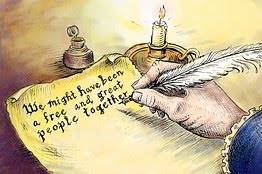
Jefferson had, in his bill of particulars against the king, taken a moment to incriminate the English people themselves — "our British brethren" — for allowing their king and Parliament to send over to America not only "soldiers of our own blood" but "foreign Mercenaries to invade and destroy us." This, he said, was at the heart of the tragedy of separation. "These facts have given the last stab to agonizing affection, and manly spirit bids us renounce forever" our old friends and brothers. "We must endeavor to forget our former love for them."

Well. Talk of love was a little much for the delegates. Love was not on their mind. The entire section was removed.

And so were the words that came next. But they should not have been, for they are the tenderest words.

Poignantly, with a plaintive sound, Jefferson addresses and gives voice to the human pain of parting: "We might have been a free and great people together."

What loss there is in those words, what humanity, and what realism, too.

"To write is to think, and to write well is to think well," David McCullough once said in conversation. Jefferson was thinking of the abrupt end of old ties, of self-defining ties, and, I suspect, that the pain of this had to be acknowledged. It is one thing to declare the case for freedom, and to make a fiery denunciation of abusive, autocratic and high-handed governance. But it is another thing, and an equally important one, to acknowledge the human implications of the break. These were our friends, our old relations; we were leaving them, ending the particular facts of our long relationship forever. We would feel it. Seventeen seventy-six was the beginning of a dream. But it was the end of one too. "We might have been a free and great people together."

It hurt Thomas Jefferson to see these words removed from his great document. And we know something about how he viewed his life, his own essence and meaning, from the words he directed that would, a half-century after 1776, be cut onto his tombstone. The first word after his name is "Author."

America and Britain did become great and free peoples together, and apart, bound by a special relationship our political leaders don't often speak of and should never let fade. You can't have enough old friends. There was the strange war of 1812, declared by America and waged here by England, which reinvaded, and burned our White House and Capitol. That was rude of them. But they got their heads handed to them in New Orleans and left, never to return as an army.

Even 1812 gave us something beautiful and tender. There was a bombardment at Fort McHenry. A young lawyer and writer was watching, Francis Scott Key. He knew his country was imperiled. He watched the long night in hopes the fort had not fallen. And he saw it — the rocket's red glare, the bombs bursting in air, gave proof through the night that our flag was still there.

And so to all writers (would-be, occasional and professional) and all editors too, down through our history: Happy 234th Independence Day. And to our British cousins: Nice growing old with you.