Showing posts with label gordon b. hinckley. Show all posts

Thursday, March 12, 2026

"Grandpa, What Does The War In Iran Mean To Us?"

All my grandchildren have a stake in the answer to this question, so I will attempt it here. 

On February 28, 2026, the world as we know it changed forever. A coalition of U.S. and Israeli forces dropped a deluge of smart bombs targeted at the Islamic leadership. For forty-seven years their reign of terror in the Middle East had been allowed to perpetuate itself, virtually unopposed in pursuit of nuclear weapon technology aimed specifically at the United States and Israel. There were attempts at appeasement along the way, but their intent was to buy time and never to make peace. Instead, the annihilation of these superpowers was their ideology, and under the guise of “religion” they claimed Allah had sanctioned it. 

Well, the world has seen religious zealots before, but they never seem to resemble peacemakers. True religion, however, TRUE religion has at its core the pursuit of peace. As I write today, I am remembering all the recent addresses by General Authorities in the last six months that proclaimed peace, peacemakers and the gospel of Jesus Christ as the antidote for wars worldwide. 

Netanyahu and Trump

We live in the days of President Donald J. Trump, the POTUS who has been going about the business of stopping wars worldwide by the elimination of dictators, despots and hellions the world over since he took office for the second time in his life. 

He and Benjamin Netanyahu, the Prime Minister of Israel, perceived the threat from Iran was escalating. They took action without giving any advance warning, wiping out the internal leadership of 49 key Islamists who had been the core command structure. The intelligence gathering was fostered by internal sources that pinpointed their secret gathering place and time where the first bombs struck with unerring accuracy. 

From there the campaign expanded to include other strategic targets nationwide and continues today. Iran is home to some 90 million people, and this development was so stunning that residents took to the streets throughout the country. They would have sought safety in bomb shelters typically, but this time they were celebrating in the streets, once the news of what was happening spread quickly. They invested immediately their confidence in the overwhelming force that had been imposed against their hated dictators. 

This is indeed a striking development in the future not only of Iran, but in my judgment signals the opening of the major gathering of the lost tribes of Israel who will now be introduced in this new generation to the fullness of the gospel. There was a mission for The Church of Jesus Christ of Latter-day Saints that was forced to close after the overthrow of the Shah of Iran all those years ago. Our missionaries were withdrawn. 

Now in all likelihood that mission will reopen when hostilities settle and the freedom of the people is restored. They have been starved for the truth, and will welcome our missionaries and the message of the restored gospel, if it is allowed to proceed under a new Iranian government in the days ahead. I am impressed as I write these words today that we may very well see members of our family deployed there as part of that effort. 

Do I believe this hastens the day of the Second Coming? Well, certainly, we are a day closer, but I can tell you this much whenever I am asked this question (as recently as yesterday by my old partner Steve Harris): Keep your eye on Jerusalem and Jackson County, Missouri, as temples continue to be built worldwide. Those two centers of influence will one day have temples built prior to the Second Coming of the Savior. 

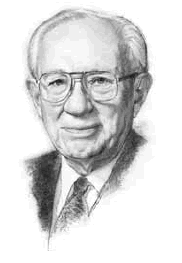
I saw a quote from President Gordon B. Hinckley that has been making rounds on social media this week that seems apropos: 

President Hinckley was a key player in the leadership of the Church for his entire life. He often showed up in the Parleys Sixth Ward, when I was in the bishopric and he was visiting his daughter Virginia and her husband Jim Pearce, and their children. He was Grandfather Lee’s traveling companion along with their wives, when they visited the Holy Land together. I considered him a dear friend, and he spoke at my mother’s funeral in 2000. I commend his counsel to each of you. 

There is no need to feel any anxiety among yourselves, my dearest posterity. I am undertaking my estate planning process these days, and I am proceeding as if life in Pine Valley will go on long after I am dead and buried beside my dear companion Patsy. 

Live your lives as though you are prepared to stand before your Savior in a coming day, sooner or later. That is how you prepare yourselves for the Second Coming. I believe all those people who once stood in my wedding reception line in 1969, have already had their own personal Second Coming, and in the due course of time so will I. 

Events on the earth will continue to unfold in sometimes shocking and eventual developments that may appear to be jarring and unsettling on their surface, but take heart - these are mere preparatory steps in the gradual unfolding of the promised day when the Savior will return trailing clouds of glory. 

Second Coming of Jesus Christ

I will continue to prepare by living my covenants I have made in the temple. Those covenants are capped with my sacred sealing covenants with Patsy. I know she lives on in the spirit world, and is there waiting to greet me with open arms once again. That reality guides me and prompts me in all that I am doing today to prepare myself for her company. I know she will be anxious to give me the guided tour when we are reunited. 


Saturday, February 28, 2015

Faith in God's Timing

Elder Neal A. Maxwell once said, "Faith in God includes faith in His timing."

Our newest grand-daughter, Vivienne, has been the latest object of our family faith in recent weeks. Her mother and father, Heidi and Jake, are exercising extraordinary faith in God's timing right now. Heidi, in her candid expressions on their blog will admit waiting in faith upon the timing of God just flat out "sucks" sometimes. Vivi is now at 31 weeks and making slow but steady progress. We celebrate every new day with her and we continue to pray for good timing.

So it is for all of us, if we are as honest as Heidi. So much of the rhythms of our lives seem to contradict what we would choose for ourselves. Life could be so much more convenient if things unfolded the way we intended on our own terms. But many things happen to disrupt our flow.

Think about what life would be like if we lived a third-world country where we were under constant threat of death by decapitation at the hands of some random radical terrorist. I can't imagine living under those conditions, yet many do, and certainly they would choose something different if they could.

We live in a day when assaults on freedom of religion abound. When the living Apostles raise a warning voice, as Elder Jeffrey R. Holland did this week, and when legislatures craft new legislation designed to make any and all forms of bigotry against religion illegal, we know the Constitution's guarantees for freedom of religion are being eroded.

There are those who live lengthy lives into their nineties, and their quality of life slowly erodes until the end. Day by day their ability to do even the simplest tasks is compromised. Their faith in God is challenged as they wonder aloud, "How much longer, Lord?"

Observing the wickedness of these last days, many ask how much longer the Lord can delay His Second Coming. Is there something in the timing of the Lord that needs to be corrected, we wonder?

The marvelous atonement of Christ covers all these contingencies. This month's lessons for the youth in Sunday School are devoted to the topic of the atonement. It is hard for young people, and even adults, to realize, accept and believe there is nothing His suffering did not contemplate. Sometimes, we feel our suffering is somehow warranted because we know our lives are less than perfect and we reason our suffering must be the just desserts the universe is meting out to us for our dereliction. It is so sad for me to witness people who deny the power of Christ to heal "even this" in their lives, but I understand their doubts. The sure antidote is living long enough to develop the faith in His timing.

Until we are confronted with the realities of evil in our lives and think about having to rely upon the merits of Christ's perfection, seldom does our faith in His timing come into effect. What if our relatives who strayed from the path in mortality really can accept the gospel, seek the ordinances, and have the chance to put themselves on an equal footing with others who were faithful?

We heard yet another testimony from a visiting Area Seventy, Elder Lynn Summerhays at a recent stake conference, that faithful parents can exercise sufficient faith in the Lord's timing that their children will someday return to them. Parents cannot compromise the moral agency of their wayward children by compelling their observance of gospel principles, but they can influence their children through their own faithful and consistent choices. Where else, Elder Summerhays asked, will they go? They will go home to their faithful parents and the warmth of the fire of their faith when every other option expires. Is that not an example of having faith not only in the atonement, but also in the timing of the atonement? I believe that is what Elder Maxwell was telling us.

As I think about Heidi and Jake, I believe I understand the longing of their hearts when it comes to better timing. They would have chosen a full-term pregnancy without any complications at delivery, and a swift exit from the hospital with a healthy baby in arms and a one-time journey home to begin raising their little third-born daughter.

When it comes to me, I would have chosen a successful completion to my working life with enough retirement money to choose something more useful, perhaps, than extending my working life as I take the long ride into the sunset. Timing was everything, and the timing of a world-wide economic meltdown was very inconvenient.

Sometimes callings to serve in the Church seem to come at a time that is anything but convenient. I have often been amazed to see the demands put upon young couples who are establishing themselves in careers, working diligently in the Church and answering the demands of all their children that seem all-consuming.

President Gordon B. Hinckley
The timing in all these circumstances routinely requires super faith, it seems. I loved President Gordon B. Hinckley's infectious optimism:

It isn’t as bad as you sometimes think it is.
It all works out. Don’t worry.
I say that to myself every morning.
It will all work out.
Put your trust in God,
and move forward with faith
and confidence in the future.
The Lord will not forsake us.
He will not forsake us.
If we will put our trust in Him,
if we will pray to Him,
if we will live worthy of His blessings,
He will hear our prayers.

From the funeral program for Marjorie Pay Hinckley, April 10, 2004; see also “Latter-day Counsel,” Ensign, October 2000, 73.

Sunday, January 6, 2013

The Winter Inversion and Warmth and Light

Pine Valley
We live at 7333 feet above sea level in the Uinta Range of the Wasatch Mountains. Far below in the Salt Lake Valley at about 4400 feet, cold winter air laden with pollutants is trapped and temperatures plummet when the high pressure is aloft. However, yesterday we were basking in the warmth of the sun at 45 degrees, while the valley below was in the frigid 20s. 

The analogy is an apt one in today's political climate. We have concluded perhaps the most bitter and divisive presidential election anyone can remember. Mitt Romney was savaged and made to look like someone who could never be considered for high office, when in fact he may have been the most qualified candidate for the presidency ever put forward by either party. You can debate that point if you wish, but the brutal non-stop attacks on him would certainly have made anyone think twice before considering a vote for him. Despite the ugly accusations, he lost by a narrow margin. The recriminations have ended, and no one will be able to blame the Mormon Church for the state of our politics. Probably a good outcome for the Church and its members, many of whom withheld their votes for Romney. 

In the aftermath of the 2012 election, I have been reminded of a passage of scripture: "Old things are done away, and all things have become new." (3 Nephi 12:47). 

That passage, of course, has reference to the Savior's teaching in the "Sermon at the Temple," similar to the teaching He gave in the Sermon on the Mount in Galilee. He was referring to Himself as being the fulfillment of the Old Testament Law of Moses, and He taught the old law had now been replaced by His atonement, the event the law had only typified before it was accomplished. 

I began thinking about how trapped and paralyzed we are in the political chill of living at lower elevations. If anything, this election plumbed new depths of debauchery and depravity. It seems we have become frozen and polarized as a nation in our thinking about politics. Indeed, Washington D.C. seems paralyzed and inept at best. We have a president who is so inept he refuses to negotiate with Congress over pressing fiscal matters facing us as a nation. 

In the middle of the night on New Year's Day last week, the Senate passed a bill dubbed "The Taxpayer Relief Act of 2012." The bill was distributed to Senators at 1:36 a.m., they were given six minutes to read the 153 page bill, then the vote roll call began.

Similarly in the House two nights later, it passed without an open floor debate, an amendment, or so much as a whimper of protest. In fact, the bill provided for a tax increase on an estimated 77 per cent of Americans. Yes, some Bush-era tax cuts were made permanent and rates were fixed on those making less than $400,000 (single) and $450,000 (married), but in the way the bill was passed in the middle of the night, a bill hammered out by chiefly two individuals, Senate Minority Leader Mitch McConnell and Vice President Joe Biden, the process left much to be desired. And after all the bickering in the run up to the procrastinated settlement, President Obama flew out of town to resume his Hawaiian vacation without signing the bill. He left the formality to his auto-pen.


Senator Mike Lee (R-UT)
Our system of government is broken, some say irreparably. Senator Mike Lee (R-UT) offered an explanation for his "no" vote on the measure in an op-ed piece that appeared in the Washington Examiner. Orrin Hatch, senior senator from Utah, and one who will never have to face the referendum of voters ever again, was the only member of the Utah delegation who voted "yes." Even Democrat Congressman Jim Matheson, ever so cautious about upsetting conservatives in Utah, voted "no." One of Obama's critics has come up with at least 50 impeachable offenses so far (he's still counting). There are others, including newly-elected Texas Senator Ted Cruz who contend Obama's doing nothing more than broadcasting scare tactics about defaulting on the national debt if he doesn't get a rubber stamp from Congress to increase the debt limit. We have more than enough revenue coming in to service the debt. It costs about $30-40 billion per month to service the debt with over $200 billion per month in tax revenues.  

So as I looked back to scripture in that same chapter for direction and compared it to the Biblical account in Matthew, I spent some time with the Beatitudes in the same sermon. If the goal in life is to become more like our Savior, Jesus Christ, we have an unfailing glimpse into His character. What if we adopted the inspiration in our public discourse that reflects what we read in the Beatitudes? I know it's impossible to comprehend we might find such character reflected in government officials, but I can dream. 
President Harold B. Lee

President Harold B. Lee observed, "In His Sermon on the Mount the Master has given us somewhat of a revelation of His own character, which was perfect, or what might be said to be 'an autobiography, every syllable of which He had written down in deeds,' and in so doing has given us a blueprint for our own lives." (Stand Ye in Holy Places [1974], 342). 

Our need to rely upon God in our civil discourse in this country has never been more acute than it is right now, yet we see those in government who are doing everything humanly possible to disavow and disengage from any religious influence. People of good will everywhere, regardless of their affiliation with a certain denomination, must never fail to point to the Judeo-Christian model of self-governance if we are to preserve our heritage as Americans. We know, if we learned anything from Mitt Romney's candidacy, that there are increasing numbers of people inclined to seek and value good leadership even if they lost a close election this time around. Leadership is most often lacking because of arrogance and the false meme that government can take care of every social ill that besets us. Humility is always in style, especially as the severity of our extremity becomes more apparent.
President Gordon B. Hinckley

President Gordon B. Hinckley said, "Meekness implies a spirit of gratitude as opposed to an attitude of self-sufficiency, an acknowledgment of a greater power beyond oneself, a recognition of God, and an acceptance of his commandments." ("With All Thy Getting Get Understanding," Ensign, August 1988, 3-4). 

There may always be fewer of us who can remember and still infuse the vision of America in our youth, but don't discount the rising number of young people in this country who are more inclined toward good and right principles than ever before. Regardless of the comparatively small numbers in the ranks we can all remember the Savior's teaching about being "the salt of the earth." 

Elder Bruce R. McConkie taught, "Among the ancient Hebrews salt. . . was used as a preservative, in seasoning food, and in all animal sacrifices. (Leviticus 2:13; Ezekiel 43:24; Mark 9:49-50). So essential was it to the sacrificial ordinance that it was the symbol of the covenant made between God and His people in connection with that sacred performance. (Leviticus 2:13; Numbers 18:19; 2 Chronicles 13:5).
Elder Bruce R. McConkie

"Accordingly, our Lord's statement, made first to the Jews and then to that other great body of Hebrews, the Nephites, that they had power 'to be the salt of the earth,' takes on great significance. . . They had power, in other words, to be the seasoning, savoring, preserving influence in the world, the influence which would bring peace and blessings to all others." (Mormon Doctrine, 2nd edition [1966], 667-68). 

This is now mostly self-talk to remind myself what it's like living at the Ranch in clear, crisp air where the sun shines and warms the house even on the coldest of days down in the murky valleys below. We must continue to hold the high ground. We must stand with Christ, His Church, and His teachings. Those teachings include the Beatitudes to help us govern ourselves. In the very next verse after He tells us the old things are done away, He reminds us, "Therefore, I would that ye should be perfect even as I, or your Father who is in heaven is perfect." (3 Nephi 12:48). 

The quest for perfection is a lifetime ambition, not to be confused with New Years resolutions made and forgotten. Those were what Mary Poppins referred to as "pie crust" promises - easily made, easily broken." He really means to make us perfect in Him. (See Moroni 10:32-33.) It is not merely ethereal theological gas, this matter of perfection. We can become perfect in our faith in HIS perfection. When we do, we are "sanctified in Christ by the shedding of the blood of Christ, which is in the covenant of the Father unto the remission of your sins, that ye become holy, without spot." 

Each of us can model perfect faith in Jesus Christ, our Redeemer. It was Thomas Carlyle who reminded us, "Every noble work is at first impossible." 

Influence for good will continue to be felt among those who take the higher ground. It's people like Mike Lee in government who will make a difference with the support of people of good will who are serious about preserving our way of life in America under the glorious banner of the Constitution. The struggle ahead will be long and arduous. I predict Mike's influence will be as one consistent and resolute voice in the wilderness of sanity and reason, pleading with Americans to stay true to the principles of sound government and Constitutional principles. As the years ahead unfold we may be assured others will join him. 

How can I be so bold in asserting that? I live in the thin air of the winter above the inversion where the sun is warm and the truth is more easily discerned, and, like Billy Graham, I've remained an optimist. I've read the last chapter of the Bible and I know how this all turns out - we win.

Sunday, May 6, 2012

The Mormons and Life After Death


This morning I taught the gospel doctrine class. The scripture block we covered was Mosiah 12 - 17. It's the story of Abinadi, preserved by the hand of his only convert, Alma, one of the corrupt high priests in wicked King Noah's court.

I told the story popularized by President Gordon B. Hinckley about the impact of one convert baptism. We send missionaries all over the world for two years, and sometimes many of them return from that experience having made only one convert. Missionary work is not easy. It harvests one convert at a time. It's slow work, but it rewarding work. Here's President Hinckley's story:

Elder Charles A. Callis
“You don’t know how much good you can do; you can’t foresee the results of the effort you put in. Years ago, President Charles A. Callis, then a member of the Quorum of the Twelve, but who previously was president of the Southern States Mission for twenty-five years, told me this story. He said that he had a missionary in the southern [United States] who came in to get his release at the conclusion of his mission. His mission president said to him, ‘Have you had a good mission?’

“He said, ‘No.’

“‘How is that?’

“‘Well, I haven’t had any results from my work. I have wasted my time and my father’s money. It’s been a waste of time.’

“Brother Callis said, ‘Haven’t you baptized anyone?’

“He said, ‘I baptized only one person during the two years that I have been here. That was a twelve-year-old boy up in the back hollows of Tennessee.’

“He went home with a sense of failure. Brother Callis said, ‘I decided to follow that boy who had been baptized. I wanted to know what became of him. …

“… ‘I followed him through the years. He became the Sunday School Superintendent, and he eventually became the branch president. He married. He moved off the little tenant farm on which he and his parents before him had lived and got a piece of ground of his own and made it fruitful. He became the district president. He sold that piece of ground in Tennessee and moved to Idaho and bought a farm along the Snake River and prospered there. His children grew. They went on missions. They came home. They had children of their own who went on missions.’

“Brother Callis continued, ‘I’ve just spent a week up in Idaho looking up every member of that family that I could find and talking to them about their missionary service. I discovered that, as the result of the baptism of that one little boy in the back hollows of Tennessee by a missionary who thought he had failed, more than 1,100 people have come into the Church.’

President Gordon B. Hinckley
“You never can foretell the consequences of your work, my beloved brethren and sisters, when you serve as missionaries” (Teachings of Gordon B. Hinckley [1997], 360–61).

* * *

At Sunday dinner this afternoon, we were discussing our lesson, and Patsy's 90 year-old mother Peggy commented, "I remember Elder Callis." She went on to talk about many of her associated memories of others, including President Heber J. Grant's death coinciding with the death of President Franklin D. Roosevelt, and how memorable it was to her. Both died within weeks of each other in 1945. That prompted a memory of a story I had heard my Grandfather, President Harold B. Lee, tell about the death of Elder Charles A. Callis.

The Quorum of the Twelve, about 1944, next to the Salt Lake Temple. Seated: The Quorum of the Twelve, about 1944, next to the Salt Lake Temple. Seated: George Albert Smith (quorum president), George F. Richards, Joseph Fielding Smith, Stephen L Richards, John A. Widtsoe, Joseph F. Merrill; standing: Charles A. Callis, Albert E. Bowen, Harold B. Lee, Spencer W. Kimball, Ezra Taft Benson, Mark E. Petersen (newest member).
Elder Charles A. Callis had presided over the Southern States Mission for over twenty-five years prior to his being called to the Council of the Twelve and was virtually "sainted" in the hearts of Church members living there. The assignment to create the first stake of the Church in the South had been long contemplated in 1946, but was reserved for Elder Callis to perform when his failing health permitted him to travel. At the beginning of 1947 Elder Lee was assigned to accompany this mighty Apostle and on January 11 the Lees departed for Jacksonville, Florida.

Elder Callis arrived in Florida a day ahead of the Lees to clear up a personal matter with a dear friend. Once this was taken care of, Elder Callis told Elder Lee, his junior companion, that he was willing to leave the details of organizing the stake in his hands. In the course of the interviews, however, some difference of opinion arose concerning whether Orlando and some of the other mission branches should be included in the new stake. Differing from Elder Lee and some of the local priesthood leaders, Elder Callis was insisting that Orlando, Florida, ought to be included.

Eleven years later Elder Lee used this experience to teach an important characteristic of prayer to seminary teachers of the Church. He recalled:

When Mission President Heber Meeks and President Douberly from the Orlando Florida Branch and I all disagreed, it worried President Callis. That was always a rather serious situation to me, too, to not be in agreement with Brother Callis. He was a man of strong, vigorous, and powerful thinking.

He said finally, "I will have to sleep on this." With that statement he dismissed me. The next morning he called me into his room, and as he pulled his chair close alongside mine, he said to me with an impressiveness which I shall never forget, "Last night I talked with God, and he has given me to understand that you are right and I am wrong." (From an advanced course in theology at Brigham Young University, July 6, 1956.)

As they concluded their interviews they overheard the choir practicing in the chapel. When the choir began singing the hymn "O My Father," Elder Callis broke into tears, and said to the brethren, "Take care of your wives; I haven't and she's gone." His emotions were close to the surface, and it became apparent to those who were with him that he was preparing for the end of his life. He ordered a room in the church fitted up as a bedroom, and he insisted upon spending two nights alone in that room. He told the brethren that everywhere he went he saw Sister Callis. Elder Lee wrote:

I had the impression, and so expressed myself to Sister Jenkins, that Brother Callis wanted to die and had wished it could take place in that room, by himself. He had us drive him to the old chapel and to the home where his twin sons were born and died. He seemed to be reliving these experiences for the last time.

Members of the Church came to Jacksonville, Florida, from as far away as Miami and Charleston, South Carolina, with 789 in attendance at the morning session and 1,043 present for the afternoon session of the history-making event. The spirit of prophecy was upon Elder Callis as he presided at the conference, all the time very near his departed loved ones to whom he made frequent reference.

A Perfect Parting

After the announcement of the new stake presidency in the Sunday morning session, Elder Callis seemed to have suffered a mild heart attack, but grew stronger during the day. He spoke with great emotion to the Saints he loved and paid tribute to Sister Callis, declaring that she and others who had labored as missionaries in the South were in attendance at their meeting that day. He prophesied that there would be other stakes organized in the South, and that eventually a temple would be built there that the younger members of the stake would live to see. The fulfillment of his prophecy came on June 1-4, 1983, with the dedication of the first temple to be constructed in the South, in Atlanta, Georgia.

After setting apart sixty-four ward and stake officers, the visiting authorities were guests for dinner at the home of Brother and Sister O. H. Hawkins. The Lees left at 9:00 p.m. for St. Augustine, where they spent the night. Elder Callis, in excellent spirits that night, requested his host, Brother Hawkins, to retell a famous fight story. Later in the evening he asked Brother Hawkins to arrange for his return trip to Salt Lake City the next day.

The following day, driving toward Miami, Elder and Sister Lee were stopped by a highway patrolman who informed them that he had a death message for them. They learned then that Elder Callis had died suddenly the night before of a heart attack.

Elder Lee reported the death immediately to President David O. McKay in Salt Lake City, advising him that the Saints in the South were desirous of holding services in Jacksonville for their beloved leader, before the Lees left with his body for Utah. Elder Lee cleared the proposal with President George Albert Smith, and memorial services were delayed in Salt Lake City until after funeral services were concluded in Florida.

Twelve years later, while teaching a group of student leaders, Elder Lee drew on an experience he had at Elder Callis's funeral to illustrate the importance of praying for each other:

I was the one to conduct Brother Callis's funeral service in Florida. It was a sorrowful trail that I had followed. I loved Brother Callis. My heart was tender. In the quiet of my hotel room I shed some tears; I tried to prepare. Finally the day came. It was Thursday, January 23, 1947. The funeral was to start at 10:00 a.m. in the Jacksonville Ward Chapel.

Speakers were President D Homer Yarn. President of tile Georgia District; A. E. Jenkins, senior member of the high council and dear friend of Elder Callis; President Heber Meeks, president of the Southern States Mission; and myself.

As the first two speakers concluded it was now about a quarter to eleven, and as the song was being rendered, before the president of the mission and I then were to conclude the service. a Western Union messenger arrived with a telegram for me. When I opened it, it was a message from the First Presidency requesting that I read it at the service. I arose to read it and I suddenly found myself overwhelmed with some kind of a great feeling that I couldn't quite understand. It wasn't sorrow. because I had conquered that in those two days preceding. And then I began to think, "This is Thursday." What was it that I felt? Suddenly when that telegram came it was as though I was just as close to the Council of the Twelve and the Presidency as though they had walked in and taken their seats on the stand behind me. Up to that time I had felt so much alone, with such a heavy responsibility. Twelve o'clock in Florida meant it was 10:00 a.m. in Salt Lake City, and knowing the way the Council meeting is held, at 10:45 a.m. every member of the Twelve and the First Presidency would be dressed in temple clothing surrounding an altar in the place nearest to heaven on earth. And I said. "Now I know what is happening. They have offered a prayer for me. and this is the answer. I am receiving the answer of the prayers of the First Presidency and the Twelve."

When I returned home, my first question to President George F. Richards was: "Brother Richards. in your temple meeting last Thursday do you remember whether or not at the prayer at the altar there was a prayer offered for me particularly?" He thought a moment and said: "Yes, Brother McKay led us. And he prayed that the Lord would bless you down there all alone so that you would feel the strength of the Presidency and the Council of the Twelve to be with you." I said: "I received it in one of the most dramatic experiences of my life."

I was taught by that experience how important it is to receive the prayers of the faithful.

Elder Lee entered this final comment in his journal about a sacred moment at the conclusion of the services for Brother Callis in Jacksonville: "As the services ended and I went to Brother Callis's room in the Church to get my hat, I seemed to hear him say to me, 'Well done, son, well done' - and I felt satisfied."

On January 28, 1947, a funeral service was held in the Salt Lake Tabernacle for this powerful missionary-Apostle so revered in the South. Nearly four thousand persons attended, despite a snowstorm. At the following Thursday meeting with the Quorum of the Twelve, Elder Lee voiced Elder Callis's opinion that other stakes in the mission should be created, rather than further dividing the mission. He then repeated in the presence of the First Presidency the prophecy made by Elder Callis that other stakes, and one day a temple, would grace the Southern States.

At the meeting of the Twelve on April 24, 1947 it was decided to organize two new stakes from the missions, one centering at Columbia, South Carolina, which partially fulfilled the prophecy, and another one at Spokane, Washington. (Harold B. Lee, Prophet and Seer, L. Brent Goates, 205-09).

* * *

My re-telling of that story prompted more memories from Peggy, who was reminiscing about many of the contemporaries of Elder Callis. She recalled the friendship of Elder Melvin J. Ballard, a member of the Quorum of the Twelve and the father of present-day Apostle, Elder M. Russell Ballard and President Edward J. Wood, who served many years as the President of the Cardston Alberta Temple. There are few readers of this page who would know Edward J. Wood, so I include a brief biography here:

Edward was called on three missions to Samoa. One as mission president at only 30 years old. During his first mission at 25 because of his knowledge of the Samoan language he was asked by the mission president to write a series of 12 gospel pamphlets in the Samoan tongue. In 1901 when only 35 years old he was called to Alberta Canada to take charge of the Cardston Co-op. In 1903 while only 37 he was called to be the president of the Alberta Stake covering a vast area. This office he held for 39 years. He spearheaded the building of the Cardston Tabernacle started in 1904 and completed in 1912. He spearheaded the Cardston Temple which was started in 1913 and dedicated ten years later in 1923. He was called as the first temple president the calling he held for 25 years at the same time being the Stake President. He officiated at every session. His Stake had the highest attendance and other activity in the Church for a number of years. He was Alberta Stake Patriarch for 9 years afterwards. He worked under the direction of a number of prophets including John Taylor, Wilford Woodruff, Lorenzo snow, Joseph F. Smith, Heber J. Grant, George Albert Smith, and David O McKay.

Death of His Oldest Son

Glen was President Wood's oldest son was 39 years old and Bishop of nearby Glenwood. In his earlier years, like his father before him, he also had been a missionary to Samoa. President Wood writes:

Glen came in to the hospital with a carbuncle on his neck causing blood poisoning and he is very sick.

“June: Glen kept getting worse. We called three other Doctors from Lethbridge at different times to help our local doctors Mulloy and Braton, Drs. Roy, Campbell and Fowler, but he didn’t respond to any treatment and the whole Stake and especially Glenwood and our Temple workers fasted, but all to no avail — he passed away very peacefully Thursday at 5:00a.m., June 8th. Lala, Mary Ann and I had been at his bedside nearly all the time but he seemed better, and we left Forest, Dale, Vi and Glen Nielson to be with him and to our great sorrow and surprise he left us. He seemed to know from the first he would not recover. He told me that he and I were in the sealing room in our Temple where I officiated, and that a ‘messenger’ told me he could not be healed. He told me in native Samoan he was going on ‘a malaga fou’ — a new journey. He told me several times that Frank Smith [Edward and Mary Ann’s son-in-law, decease husband of Fern] and others had been to see him and at the last he told the boys not to delay him — he had to go.

“I’m quite satisfied that often when brothers and sisters are called from this sphere of action to pass into eternity, it is to respond to a call that’s made for them to fill in the spirit world. Our son, Glen, was taken sick. Nothing very serious we thought, but we got him to the hospital and we all went down and administered to him, he finally told me the next morning, ‘Now, Father, you don’t need to worry at all about me. I’m never going back to the ranch anymore.’ I had spoken to him about it — he had charge of the stock and family interests — and I was wondering if he wanted to [tell me about the ranch]. He told me not to expect him to return to the ranch because he was called to go to the spirit world to visit in the part of the spirit world where the Samoans were now staying; that he was called on a mission to go and visit them; that he wouldn’t get better; and for me to go home and tell his mother and others of the family. So we left and the next morning, he felt worse. The doctor said it looked like his condition had turned into blood poisoning and it was a very serious case. As I was standing at the foot of the bed in the hospital, with the doctor, he started talking native [Samoan], and he was talking to native people just like he was on the island. The doctor said to me, ‘He’s kind of delirious.’ I said, ‘That isn’t delirious to him. He’s talking in the Samoan language where he labored between three and four years among the natives.’ So he finally quit talking to them and talked to us and told me to get his things ready and have the folks come down and say good-bye to him because he was to leave and take up his mission in the spirit world with those Samoan people who had visited him. So the next day he passed away and it was quiet testimony to all of us that our passing out of this life into the spirit world is the next [step], at least it was in his case. Sure enough, he just sat up and shook hands with us and said good-bye and went back down on his cot, turned over and went into a deep sleep. And that was his death.”

* * *

That story prompted another recollection from Peggy, something to do with the passing of Elder Melvin J. Ballard that was linked to President Wood and the Cardston Temple. I did a little research at the table with my iphone and discovered her memory is still pretty sharp. Here's what I found:

The last time apostle Melvin J. Ballard attended an Alberta Stake Conference he was greeted by Mary Ann Wood [Edward's wife] and he replied, “I am glad to see you too, and you’ll never see me again.” Sister Wood, who was deaf but could read lips very well, wondered if she was going to die. In the temple the Apostle spoke for twenty minutes. Mrs. Wood heard every word and told him how wonderful it was to hear him speak. He answered, “That is very good, and you’ll never hear me again.” After the conference was over there was much contemplation as to the meaning of the Apostle’s words to Mary Ann. Sometime later in the temple, President Wood said he saw in a vision a group of people in the Celestial Room. He asked, “Who are you waiting for?” They replied, “Brother Ballard.” “He is not here,” replied the President. He said that as he then turned around, “Brother Ballard came through the veil in his temple robes.” President Wood interpreted this vision to mean that Apostle Ballard’s kindred dead were waiting in the temple for him to join them, for this happened on the day of Brother Ballard’s death. (Melvin S. Tagg, The Life of Edward James Wood Church Patriot, an unpublished Master’s thesis, Brigham Young University, 1959, 111).

Saturday, November 19, 2011

Signs of the Times and the Second Coming of Jesus Christ

by Harry Anderson

Every year the course curriculum in the Church calls for these two lessons. I've taught both numerous times in my life in the Church. What never seems to disappoint whenever these topics come up is the number of Latter-day Saints who are clueless in their comments. Words like, "The Second Coming could happen any day." Or another favorite: "If we are more righteous, we will hasten the day." Or, "All the signs have been fulfilled, it's just a matter of how much longer the Lord waits."

These days I normally sit back and take it all in. I've all but given up trying to re-position the conversations back to the scriptures. It's just not helpful to the teacher.

Because we've been travelling around to various wards for events involving grandchildren, no one will guess the ward of which I speak here. The instructor opened the Gospel Principles manual, cited the lesson title, then closed that book and opened Bruce R. McConkie's Mormon Doctrine, and proceeded to read the 51 signs of the times cited therein by the author. He got to number 19 before the time expired.

The pattern continues, much to my dismay. A few weeks ago, same experience. Topic: The Postmortal Spirit World. Approach: Cite the lesson topic, then turn to Duane Crowther and someone (a non-member of the Church), who claimed to have been to the spirit world and back. Amazing.

Only one single scripture was cited in last week's lesson on the Signs of the Second Coming, so let us begin there: "And unto you it shall be given to know the signs of the times, and the signs of the coming of the Son of Man;" (D&C 68:11).

It would have been nice just to get the context of that one isolated verse, but it wasn't to be. The context is that the verse of scripture cited was a revelation given through the Prophet Joseph Smith while the Church was still in its infancy (November 1831) -- only eighteen months after it was organized. It was a call for "all the faithful elders of my church" to be involved in missionary work. It was a clarion call to "Go ye into all the world, preach the gospel to every creature, acting in the authority which I have given you, baptizing in the name of the Father, and of the Son, and of the Holy Ghost. And he that believeth and is baptized shall be saved, and he that believeth not shall be damned. And he that believeth shall be blest with signs following, even as it is written." (D&C 68:8-10).

The "signs following" spoken of here include the signs that follow all believers in Jesus Christ -- they emulate the teachings and works of the Savior in their daily walk in discipleship. Those are perhaps the most compelling signs of the times: The miracle of the change of one heart at a time in the midst of all the wickedness is routinely undervalued.

Despite all the wickedness in the world today there are people who believe in Jesus Christ as their Savior, and they not only talk the talk, but they walk the walk. Make no mistake, it is a daily struggle to walk in the footsteps of Jesus. It is a daily walk in faith that He was who He said He was -- the Redeemer of Israel who is mighty to save because He alone atoned for our sins. Believing that, His disciples today mirror His image in their countenance. The evidence of the existence of His disciples is everywhere. That's a sign of the times you can take to the bank.

The sequel lesson tomorrow, "The Second Coming of Christ," is the one I get to teach. From the moment Christ was taken up into heaven in the company of many witnesses on the Mount of Olives forty days after He was resurrected, speculation about the timing of His return has abounded. The expectation was chiseled into granite by two angels standing beside the Apostles who queried, "Ye men of Galilee, why stand ye gazing up into heaven? this same Jesus, which is taken up from you into heaven, shall so come in like manner as ye have seen him go." (Acts 1:11). All through sacred writings since that moment the anticipation has been that at any moment He could return.

Many years ago I spotted a bumper sticker: "Jesus is coming and he's pissed." It was a six-word memoir before they were even in vogue. The righteous will welcome Him, the wicked will tremble in fear. A Great and a Dreadful Day. Another six-word anomaly.

The lesson tomorrow suggests He will do five specific things when He comes again:

by Del Parson
1. He will cleanse the earth. Whenever something bad happens, people immediately jump to the conclusion that the Savior's return is imminent. I've written before about the reaction to 9/11. Many in our community thought it was the trigger for the much-anticipated Battle of Armageddon. He will come in great power and great glory. There will be no mistaking His identity this time. He will be clothed in garments of red, suggesting He trod the wine press alone, drenched in His own blood for the sins of mankind. (D&C 101:24-25; 133:42-62, also given in November, 1831): "And the Lord shall be red in his apparel, and his garments like him that treadeth in the wine-vat. And so great shall be the glory of his presence that the sun shall hide his face in shame, and the moon shall withhold its light, and the stars shall be hurled from their places. And his voice shall be heard: I have trodden the wine-press alone, and have brought judgment upon all people; and none were with me; And I have trampled them in my fury, and I did tread upon them in mine anger, and their blood have I sprinkled upon my garments, and stained all my raiment; for this was the day of vengeance which was in my heart." While artists continue to represent the Savior in white (see above), the scriptures are clear. When He comes again His garments will be stained with the blood of the wicked instead of His own as they were in Gethsemane. (See D&C 19:16-19). "The end of the world," is interpreted to be the "destruction of the wicked." (See JS-M 1:4).

2. He will judge His people. The separation of the sheep from the goats, as foretold in Matthew 25:31-46 and D&C 63:54 will occur. The time for dithering and fence sitting will come to an end in an instant. The separation between the righteous and the wicked will be complete, judgment will be rendered. The same thing happens when we die and go through the veil -- a partial judgment between light and dark, good and evil, and righteousness and wickedness. (See Alma 40:11-14). I suspect the anticipation for the Second Coming on this side of the veil might be akin to the anticipation of the resurrection on the other side. (D&C 138:50). In the destruction, some of the righteous will perish right along with the wicked, suggesting that how we live our lives determines our eternal inheritance, not the timing or whether or not we survive destruction that is coming. (See TPJS, 162).

3. He will usher in the Millennium. For 1,000 years after His Second Coming, Jesus Christ will come to reign upon planet Earth. Those who are alive on the Earth at the time of His coming will be "caught up" (meaning resurrected) to meet Him at His coming. This event is what is described as the "morning of the first resurrection" in sacred places. (See D&C 88:96, a revelation given the day after Christmas, 1832, known as the "olive leaf. . . plucked from the Tree of Paradise, the Lord's message of peace to us"). It is really a continuation of the general resurrection that happened when He became the "first fruits" of the resurrection during his meridian ministry. Then those who have died and been faithful during their mortal probation between the time of His resurrection and the Second Coming, those who have become heirs of the highest degree of the Celestial Kingdom, will also be "caught up" to meet Him at His coming. In other words, the morning of the first resurrection will be here.

President Brigham Young
President Brigham Young captured the essence of what will be happening during the Millennium in these words:

In the Millennium, when the Kingdom of God is established on the earth in power, glory and perfection, and the reign of wickedness that has so long prevailed is subdued, the Saints of God will have the privilege of building their temples, and of entering into them, becoming, as it were, pillars in the temples of God [see Revelation 3:12], and they will officiate for their dead. Then we will see our friends come up, and perhaps some that we have been acquainted with here. If we ask who will stand at the head of the resurrection in this last dispensation, the answer is — Joseph Smith, Junior, the Prophet of God. He is the man who will be resurrected and receive the keys of the resurrection, and he will seal this authority upon others, and they will hunt up their friends and resurrect them when they shall have been officiated for, and bring them up. And we will have revelations to know our forefathers clear back to Father Adam and Mother Eve, and we will enter into the temples of God and officiate for them. Then man will be sealed to man until the chain is made perfect back to Adam, so that there will be a perfect chain of Priesthood from Adam to the winding-up scene. (Discourses of Brigham Young, 116).

4. He will complete the First Resurrection. As we mentioned above, there is a specific order to resurrection. The faithful come forth from the graves first. (See D&C 88:97-98). The wicked who are destroyed at His coming remain in their graves until the end of the Millennium. Why? So they may have every possible opportunity to accept and embrace the gospel of Jesus Christ and to repent fully of their sins. It is the merciful part of "the great plan of happiness." The keys of resurrection will be in the hands of faithful patriarchal heads to each family. Who more than they would want to allow for every chance for their posterity to accept and embrace the gospel? All of our Heavenly Father's children will be given ample chances to see things as they really are, and to pierce the fogs of deception that have held them bound. This quote from Gospel Principles (p. 260) sums up:

"After Jesus Christ rose from the dead, other righteous people who had died were also resurrected. They appeared in Jerusalem and also on the American continent. (See Matthew 27:52–53; 3 Nephi 23:9–10).This was the beginning of the First Resurrection. Some people have been resurrected since then. Those who already have been resurrected and those who will be resurrected at the time of His coming will all inherit the glory of the celestial kingdom (see D&C 76:50–70).

"After the resurrection of those who will inherit celestial glory, another group will be resurrected: those who will receive a terrestrial glory. [I suggest the word "after" is when they are "ready" and not before, perhaps also as long as at the end of the Millennium, having settled their eternal station in their own minds and their righteous fathers before them having done all they could to affect the outcome in love, persuasion and long-suffering]. When all these people have been resurrected, the First Resurrection will be completed.

"The wicked who are living at the time of the Second Coming of the Lord will be destroyed in the flesh. They, along with the wicked who are already dead, will have to wait until the last resurrection. All of the remaining dead will rise to meet God. They will either inherit the telestial kingdom or be cast into outer darkness with Satan (see D&C 76:32–33, 81–112, emphasis mine)."

5. He will take His rightful place as King of heaven and earth. The "intrigues between the nations," all the "wars and rumors of wars" were all foreseen in a revelation on Christmas Day, 1832, known as D&C 87. We learn "with the sword and by bloodshed the inhabitants of the earth shall mourn; and with famine and plague, and earthquake, and the thunder of heaven, and the fierce and vivid lightning also, shall the inhabitants of the earth be made to feel the wrath, and indignation, and chastening hand of an Almighty God, until the consumption decreed hath made a full end of all nations." (Emphasis mine). It is a worthy goal to pray for "peace on earth," but there will be no peace on earth until He comes again. Peace has been taken from the earth because of the unrighteous exercise of moral agency among the inhabitants. When Christ comes again He will come in triumphant glory to rule and reign, a complete reversal of His first birth in an obscure manger in Bethlehem. He will come this time as "Lord of lords, and King of kings." The epic words of Handel's Messiah, taken from Revelation 17:14, will finally be fulfilled: "Wonderful, Counselor, The mighty God, The everlasting Father, The Prince of Peace." (Isaiah 9:6).

It is almost a "rite of passage" for members of the Church to speculate on the timing of the Second Coming. I know it was a passion of mine at one point in my life. When one is immersed in the study of the Word, it seems events could be accelerated and timing could be imminent. However, age, experience and hopefully some acquired wisdom along the way tempers such pursuits about timetables. I know I have been tempered in my life.

President Boyd K. Packer
We need look no further than the most recent General Conference to the words of the chief Apostle today, President Boyd K. Packer, for a clue about the timing of the Second Coming. Said he,

Sometimes you might be tempted to think as I did from time to time in my youth: “The way things are going, the world’s going to be over with. The end of the world is going to come before I get to where I should be.” Not so! You can look forward to doing it right — getting married, having a family, seeing your children and grandchildren, maybe even great-grandchildren. ("Counsel to Youth," Boyd K. Packer).

I would add one more valuable perspective for your consideration from President Lorenzo Snow, who stood in the Tabernacle over 100 years ago to open the 70th Annual General Conference. It was the first conference after the turn of the century in 1900, and it culminated a period of great trial and tribulation for the Church. Total Church membership then was approaching 300,000, with the majority of those members living in Utah.

President Lorenzo Snow
On Friday, April 6, 1900, President Snow said: “The Lord has prospered us amazingly, and we are doing large things at the present time. . .  Now that we are approaching our seventy-first year, the Lord expects that we will do something — something that will cause the nations to marvel, as what we have done has caused them already to wonder.”

Then this thought-provoking statement: “Now, Latter-day Saints, how is it with us? We have received the Gospel. We have received the kingdom of God, established on the earth. We have had trouble; we have been persecuted. We were driven from Ohio; we were driven from Missouri; we were driven from Nauvoo; and once we were driven for a time from this beautiful city. Many have lost thousands of dollars; lost their homes and all they had, and some of the brethren have seen their wives and children lay down their lives because of the hardships they had to experience. . . The people have looked with astonishment at the willingness of the Latter-day Saints to suffer these things. Why do we do this? . . . What is it that enables us to endure these persecutions and still rejoice?”

President Snow then answered his own question. I suggest his answer still reverberates in the hearts of all true disciples over 100 years later: “It is because we have had revelations from the Almighty; because He has spoken to us in our souls and has given to us the Holy Ghost. . .  This Church will stand, because it is upon a firm basis. It is not from man; it is not from the study of the New Testament or the Old Testament; it is not the result of the learning that we received in colleges nor seminaries, but it has come directly from the Lord. The Lord has shown it to us by the revealing principle of the Holy Spirit of light and every man can receive this same spirit.” (Conference Report, April 1900, 2–3, emphasis mine).

President Gordon B. Hinckley
President Gordon B. Hinckley, while touring the missions and stakes in Africa, made this assertion in 1998: "It isn't who we are and where we live. It is our attitude, our love and testimony, our faith and our conviction that make a difference in turning membership in this great and sacred Church."

He said that the membership [of the Church] will grow, "where there are now hundreds, there will be thousands, there will be tens of thousands. This gospel is true; it will spread over the earth.

"With 10 million members we've only begun. We've barely scratched the surface of what will come. I haven't the slightest doubt of that." (As reported 02/28/98 by John L. Hart, Church News staff writer, emphasis mine).

The take away from today's post? I hope it is this: You have time to live your lives in faith and anticipation for the Second Coming in the spirit of hope. There is still much to do before that day comes. So much, in fact, that it is a very long list of unfulfilled events waiting to transpire as we build Zion together.

Mormon eschatology is (or should be) clearly defined in our minds with no uncertainty.

Sunday, February 13, 2011

Blacks and the Priesthood

Much has been made over the years of the Church's stance of withholding priesthood blessings from the Blacks. I have been asked by many people why Harold B. Lee was so "obstinate" in his opposition about extending those blessings. That's a perception that is wholly inaccurate. What is accurate is that we are led by living prophets imbued with the spirit of revelation from the Lord Jesus Christ, who lives and directs the decisions made in the Church.

I have written about this topic before, but it seems there are never enough words to fully describe the times. Many who would revise the history of the sixties if they could will not now admit that racism was an ugly and unrelenting chapter in American history, and the Church was routinely singled out and thrown into the political witches' brew as a stereotypical example of it. For me, however, it was always a matter of pending revelation rather than policy, anchored in my belief in living prophets.

President Harold B. Lee
President Harold B. Lee said it this way: "Now I want to impress this upon you. Someone has said it this way, and I believe it to be absolutely true: 'That person is not truly converted until he sees the power of God resting upon the leaders of this church, and until it goes down into his heart like fire.' Until the members of this church have that conviction that they are being led in the right way, and they have a conviction that these men of God are men who are inspired and have been properly appointed by the hand of God, they are not truly converted." ("The Strength of the Priesthood," Ensign, July 1972, 102).

A year later he would say: "And so I come to you today, with no shadow of doubting in my mind that I know the reality of the person who is presiding over this church, our Lord and Master, Jesus Christ. I know that he is. I know that he is closer to us than many times we have any idea. They are not an absentee Father and Lord. They are concerned about us, helping to prepare us for the advent of the Savior, whose coming certainly isn’t too far away because of the signs that are becoming apparent." ("Stand Ye in Holy Places," Ensign 1973, 121).

Many members of the Church, and especially those outside the Church who are prone to accepting criticism directed at the Brethren, fail to understand a basic principle of how the Church is governed. The decision making among Apostles does not work as it does in business. One Apostle does not "lobby" a position and seek to gather votes among his peers on the "Board of Directors" until he has enough of the majority to work his will. The living Apostles move forward together as one body unanimously, including the Quorum of the Twelve and the First Presidency, or not at all. Of necessity and by design decision making among the Brethren is often slow, deliberative, thorough, and comes through individual revelation one by one until there is perfect harmony and unity.

We have no finer illustration of this process than in the revelation that extended the priesthood blessings to the Blacks universally and without any restrictions. We may rest assured for those reasons, as they wait upon the Lord for inspiration to move ahead, mistakes are seldom made.

Discussions among the Twelve and the First Presidency about the extension of the priesthood blessings dated back into the early days of President David O. McKay's administration, and continued in earnest among the Brethren until the inspiration finally distilled upon President Spencer W. Kimball, who was sustained by all his brethren in the revelation that eventually came.

President Spencer W. Kimball
Harold B. Lee's personal copies of his scriptures are filled with transcribed minutes of meetings among the Twelve and the First Presidency on this topic. It was a topic with which he was intimately familiar, sensitive and, it appears from the number of entries, all-consuming. Toward the end of his life, credible death threats against him became a growing concern and prompted the beefing up of Church security. He felt as President Kimball did, who said, "I told the Lord if it wasn't right, if He didn't want this change to come into the Church, that I would be true to it all the rest of my life and I'd fight the world against it. I would be loyal and true to the program if that's what He wanted." (Quoted by Edward L. Kimball in This People, Summer 1988, 22).

For President Lee and for President Kimball, it was not a matter of "if" -- only "when" -- the Lord would give His revelatory sanction to lift the ban. President Lee waited upon the Lord, believing the matter was out of his hands, as the Church's critics continued their withering attacks against him and the Church. Despite what others outside that circle of living Apostles have said about it, rest assured the principals involved got it right, precisely at the time the Church and the Blacks were prepared to receive those priesthood blessings.

President David O. McKay
President McKay had first become aware of the growing concern in South Africa, then Brazil. It was a matter over which the Brethren had pondered for many, many years. Under President Kimball's administration near 10,000 faithful native Africans had joined the Church in several separate congregations as the fulness of the gospel began to illuminate that benighted continent. Each hoped and prayed they may someday receive the priesthood. But like their leaders in Salt Lake City, they were compelled to wait patiently upon the Lord for that day to come.

I have always loved the way it was described by Elder Bruce R. McConkie and President Gordon B. Hinckley, but President Boyd K. Packer also published his version in this way:

President Boyd K. Packer
At the same time the LDS edition of the scriptures was being prepared for publication another matter was weighing heavily upon the soul of one of the Lord's great watchmen, President Spencer W. Kimball. Other latter-day prophets had wrestled with the same dilemma: that of obeying the divine command to preach the gospel to every kindred, tongue, and people, while being keenly aware that, because of race, some of those people were denied the full blessings of the gospel -- that is, denied the priesthood and the temple ordinances. Thus these prophets had pleaded mightily with the Lord for answers to the problem, and none of them more intensely than President Kimball. Yet always the Spirit had indicated that the time had not yet come.

Now this prophet, small in physical stature but a spiritual giant, wrestled again, seeking and pleading in behalf of the faithful among all priesthood-denied people. Not only did he struggle, seek, and plead, but his brethren in the highest councils of the Church did so as well.

One day, during the Thursday temple meeting with his Counselors and the Twelve, President Kimball, who was pondering that matter, discussed it with his brethren. When it was Elder Packer's turn to speak, he read a scripture: "Verily, verily, I say unto you, that when I give a commandment to any of the sons of men to do a work unto my name, and those sons of men go with all their might and with all they have to perform that work, and cease not their diligence, and their enemies come upon them and hinder them from performing that work, behold, it behooveth me to require that work no more at the hands of those sons of men, but to accept of their offerings" (D&C 124:49).

A few days later President Kimball asked Brother Packer where he would be the next Saturday. Elder Packer told him he would be speaking Friday evening at the Dixie College baccalaureate but would return by plane early on Saturday.

"Will you come to my office?" the President asked.

"Of course," Elder Packer responded.

Upon his return about one o'clock on Saturday, Brother Packer went directly to the Church Office Building. The security officer on duty said that the President was at home and wished Elder Packer to call as soon as he came into the building.

Reaching President Kimball by phone, Elder Packer offered, "I'll come right up."

"No, I'll come down and meet you."

Arriving shortly after this, the President entered his office. Elder Packer recalls his saying that he had "this thing" on his mind and wanted to talk about it. "There was no need to explain what this thing was," Elder Packer recalled. "We both knew how it was weighing upon him.

"He handed me his scriptures and said he'd like me to read to him from the revelations. So we started with the one from D&C 124:49 that I had read in the temple. For a couple of hours we just moved back and forth through the Doctrine and Covenants, the Book of Mormon, and the Pearl of Great Price, and then talked about what we read.

"The spirit of revelation seemed to be brooding upon the prophet that day. He asked me, assuming that the revelation was to come, how it might best be announced to the Church, and asked that I put something in writing. This I did and handed it to him a day or two later. He had asked one or two of the others to do the same."

On Thursday, 8 June 1978, in the Salt Lake Temple, the revelation was reaffirmed when the First Presidency and the Twelve approved the announcement that was to go out to the world. It was further reaffirmed in the temple on 9 June 1978 by all of the General Authorities available. They too unanimously approved the announcement.

The long-sought pronouncement that "all worthy male members of the Church may be ordained to the priesthood without regard for race or color" had become official. (Doctrine and Covenants, Official Declaration-2, 293-94).

On 30 September 1978, at general conference, the assembled Saints voted unanimously to sustain the motion. (Ibid.)

Those of the Lord's watchmen who were present at those historic times will recall and have borne witness to the Spirit of revelation that attended them, and each has expressed gratitude for being part of the momentous experience. And none of the Twelve was more grateful for that day than Elder Boyd K. Packer. (Boyd K. Packer: A Watchman on the Tower, Lucille C. Tate, 225-27, emphasis mine).

Elder Bruce R. McConkie
Elder Bruce R. McConkie, who had earlier stated categorically that the Blacks would never receive the priesthood in this life, and was prepared to defend that position "until the day I die," would then say after the revelation came:

There are statements in our literature by the early brethren that we have interpreted to mean that the Negroes would not receive the priesthood in mortality. I have said the same things, and people write me letters and say, "You said such and such, and how is it now that we do such and such?" And all I can say to that is that it is time disbelieving people repented and got in line and believed in a living, modern prophet. Forget everything that I have said, or what President Brigham Young or President George Q. Cannon or whosoever has said in days past, that is contrary to the present revelation. We spoke with a limited understanding and without the light and knowledge that now has come into the world.

We get our truth and our light line upon line and precept upon precept. We have now had added a new flood of intelligence and light on this particular subject, and it erases all the darkness and all the views and all the thoughts of the past. They don't matter any more.

It doesn't make a particle of difference what anybody ever said about the Negro matter before the first day of June 1978. It is a new day and a new arrangement, and the Lord has now given the revelation that sheds light out into the world on this subject. (Priesthood, 131-32, emphasis mine).

Elder McConkie bore his testimony of that sacred occasion as follows:

The Spirit of the Lord rested mightily upon us all; we felt something akin to what happened on the day of Pentecost and at the dedication of the Kirtland Temple. From the midst of eternity, the voice of God, conveyed by the power of the Spirit, spoke to his prophet. The message was that the time had now come to offer the fulness of the everlasting gospel, including celestial marriage, and the priesthood, and the blessings of the temple, to all men, without reference to race or color, solely on the basis of personal worthiness. And we all heard the same voice, received the same message, and became personal witnesses that the word received was the mind and will and voice of the Lord. . . .

In the days that followed the receipt of the new revelation, President Kimball and President Ezra Taft Benson — the senior and most spiritually experienced ones among us — both said, expressing the feelings of us all, that neither of them had ever experienced anything of such spiritual magnitude and power as was poured out upon the Presidency and the Twelve that day in the upper room in the house of the Lord. And of it I say: It is true; I was there; I heard the voice; and the Lord be praised that it has come to pass in our day. ("The New Revelation on Priesthood," in Priesthood, Salt Lake City, Deseret Book, 1981, 128).

President Gordon B. Hinckley
President Gordon B. Hinckley also was present that glorious day. In a talk given May 15, 1988, in a Churchwide fireside commemorating the restoration of the priesthood, he spoke movingly about the experience. Said he:

The Spirit of God was there. And by the power of the Holy Ghost there came to [President Kimball] an assurance that the thing for which he prayed was right, that the time had come, and that now the wondrous blessings of the priesthood should be extended to worthy men everywhere regardless of lineage. Every man in that circle, by the power of the Holy Ghost, knew the same thing. It was a quiet and sublime occasion. There was not the sound "as of a rushing mighty wind," there were not "cloven tongues like as of fire" (Acts 2:2-3) as there had been on the Day of Pentecost. But there was a Pentecostal spirit, for the Holy Ghost was present. No voice audible to our physical ears was heard. But the voice of the Spirit whispered with certainty into our minds and our very souls. (Ensign, October 1988, 70).

When one reads those accounts, it seems reasonable that we may glimpse into the culminating process of many, many years as the living Apostles wrestled mightily and waited patiently upon the Lord for the time to come. Premature attempts would have worked the will of men in opposition to the manifest will of the Father and the Son. Through the long years of waiting, the voice was heard that day. It was the voice of the Spirit, inaudible to physical ears but indelibly imprinted into the minds and souls of those present. It was with them as with the Nephite prophet Enos, who recorded: "And while I was thus struggling in the spirit, behold, the voice of the Lord came into my mind." (Enos 1:10). It is also clear that the event had a profound, lasting effect on all those involved.

Said President Hinckley: "Not one of us who was present on that occasion was ever quite the same after that."

And I would add, none of us was either.