In the realm of big WHOPPERS, we may never again see the likes of Barack Hussein Obama. Not only are his lies already garnering "famous" status, at least one observer here, Jonah Goldberg, maintains his lies will achieve INFAMOUS status. If you hadn't guessed, the topic is one dear to my heart - Obamacare. It's stunning now that there is simply nowhere to run and hide from the facts as they are emerging. Of course, that assumes there's anyone left who actually cares about FACTS anymore.
This POTUS may become a lame duck quicker than any two-term president in history.
Friday, November 1, 2013


Saturday, October 26, 2013
Who Started the Welfare Program?
Regular visitors to this page will know my identity as the eldest grandson of President Harold B. Lee. From time to time I am asked to contribute insight and commentary on his history, as I was last week in our ward gospel doctrine class.
The lesson was on the origins of the Church Welfare Program. Whenever these infrequent invitations pop up, I go back and take a fresh look at what I know about Harold B. Lee. Each time I do it I feel as though I have a personal "visit" with him. It all feels so familiar and comfortable. His spirit and his gentle reminders to me are omnipresent.
This time as I reviewed the origins of the Welfare Program through his writings I had a fresh perspective.
Harold B. Lee was thirty-one years old when he was called as the President of the Pioneer Stake. There were six stakes in Salt Lake City at the time. The year was 1930, and the full impact of the Great Depression was being felt by the members of his stake. It was eighty-three years ago today on October 26th, when the stake was reorganized. A few days before that, he was invited to come to the office of President Rudger Clawson. He describes it this way:
"On the Friday preceding the quarterly conference, I was called to the office of President Rudger Clawson, where I was told by President Clawson and Elder George Albert Smith that I had been chosen by the First Presidency and the Twelve as the new president of Pioneer Stake. I told them I would much prefer working as a counselor to Brother Hyde, and was bluntly told by George Albert Smith that I had been invited to meet with them, not to tell them what should be done, but to find out if I was willing to do what the Lord wanted me to do. There followed a discussion on the selection of my counselors. Again I was told when I asked if they had any suggestions on that, 'We have suggestions, but we are not going to tell you - that is your responsibility. If you are guided by the Spirit of the Lord, you will choose those whom we have in mind.'" (Harold B. Lee, Prophet & Seer, L. Brent Goates, Bookcraft, Salt Lake City, Utah, 1985, 88).
He describes how difficult the decision was in choosing his counselors:
"I retired that night, or rather early morning, to a fitful sleep, about three o'clock in the morning, after earnest prayer for guidance. During the few hours I tried to sleep it would seem that I had chosen two counselors and was trying to hold council meetings with them. Disagreements, obstacles, and misunderstandings would arise, and I would awake with a start to realize that my first choices were wrong. This process was repeated with ten or twelve of my brethren until, when morning came, I was certain the Lord had guided me to choose Charles S. Hyde and Paul C. Child as my counselors. When I announced to the Brethren my decision the next morning, they smiled their approval. The men whom they had desired had been selected.
"On the Saturday night following our conference priesthood convention, I went for a long ride with Brother Hyde, who was many years my senior in age and experience, and informed him of the proposed change and of my desire for him to be my first counselor. It was like a thunderbolt to him, and he deferred his answer until he could think it over and talk with President Clawson the next day. Paul C. Child had been my bishop in the Poplar Grove Ward for seven years, and he was not aware of his selection until his name was placed before the conference." (ibid., 88-89).
Harold B. Lee recorded in his journal that by 1933, out of their stake population of 7,300, there were over 4,800 who were "wholly dependent upon outside agencies" for a livelihood. The national jobless rate became a shocking 24.9 percent. Out of a work force of 51,132,000, approximately 12,830,000 were unemployed. As a stake presidency much of their time was spent in prayerful supplication over what to do about their stressful conditions.
Almost immediately in the fall months of 1930, they had gone to work to do what they could to alleviate the problems of the unemployed.
"An employment committee in each ward, consisting of a member of the bishopric and the chairman of the welfare committees of the Melchizedek Priesthood quorums and the Relief Society welfare workers, kept in touch with the available male and female workers. Directed by Fred J. Heath of the stake central committee, workers from all wards were assigned to farm and industrial projects, which were organized from Provo on the south to Layton on the north.
"Workers were told that for their services the stake would undertake to see that food and fuel and shelter for themselves and their families would be provided fully. Hundreds of tons of produce soon began to roll in-peaches, tomatoes, fruits, vegetables, and meats. Relief Society women were organized and two canning machines were purchased for their own use. After exhausting all surplus bottles in the area through a 'drive,' we purchased ten to twenty thousand cans from the American Can Company at 1.5 cents each.
"After supplying our families and stocking our storehouse, we were able to sell considerable surplus to outside people.
"The storehouse was known as the Pioneer Stake bishop's storehouse and the bishops of our eleven wards were organized into an executive committee, with Bishop Joseph H. McPhie of the 25th Ward as chairman. They were instructed to meet regularly and to manage and initiate the policies of the storehouse. The First Presidency, after hearing our plan, agreed to permit withdrawals from the tithes to supplement the food received from our own efforts. With these funds we purchased at wholesale prices butter, eggs, flour, sugar, coal, etc., to provide a wide variety of foodstuffs for our people." (ibid., 94-96).
Harold B. Lee was often asked, "Who started the Welfare Program?" In 1958, speaking at a regional welfare meeting, this is what he would say repeatedly in answer:
"Everywhere I went people were always asking questions. They asked, 'Who started the welfare program?' I have always answered, and do today, 'The Lord started it.' Many asked how the welfare program was getting along — and that got to be such a monotonous question that everywhere I was being asked how the welfare program was going — and I used to say, 'Just as fine as the bishops of this church make it go, and no better.'" (Teachings of Harold B Lee, Clyde J. Williams, editor, Bookcraft, Salt Lake City, Utah, 1996, 304).
There are perhaps a thousand more details in the history that are all well-documented, but many years later looking back, Elder Lee offered this more valuable insight in a magazine article entitled, "Are You Ready for Christmas?" It was published in the Improvement Era in December, 1968.
"One Christmas (I believe it was the first one during my presidency), our small daughters quickly opened their Christmas morning gifts and soon dashed over to show their little friends the new dolls and other gifts. Shortly they returned home, both in tears.
"'What in the world is the matter?" we asked.
Sobbing, they said: 'Our friends did not have any Christmas. Santa Claus did not come to their home.'
"All too late we remembered that just across the street was a family whose father was not a member of the Church, although the children were, and the mother passively so; he had been out of work, and we had forgotten. Our Christmas was spoiled.
"We sent for those children and tried to divide what we had in an attempt to make up for our lack of thoughtfulness, but it was too late. Christmas dinner that day did not taste very good to me. I was unhappy. I realized that upon my shoulders rested the welfare of the people of the stake.
"We made a survey and were startled to discover that 4,800 of our membership were either wholly or partially dependent — the heads of families did not have steady employment.
"There were no government make-work projects in those days. We had only ourselves to look to. Church finances were declining. We were told that we couldn't expect much help from the general funds of the Church. Thus, it was in this same condition that we approached another Christmas season.
"We knew that we had about one thousand children under ten years of age for whom, without someone to help them, there would be no Christmas.
"We started to prepare. We found a second floor over an old store on Pierpont Street. We gathered toys, some of which were broken, and for a month or two before Christmas, fathers and mothers were there. Some arrived early or stayed late to make something special for their own little ones.
"That was the spirit of Christmas giving — one only had to step inside the door of that workshop to see and feel it. Our goal was to see that none of the children would be without a Christmas.
"There was to be Christmas dinner in all the homes of the 4,800 who, without help, wouldn't have Christmas dinner. Nuts, candy, oranges, a roast, and all that went with it would be their Christmas menu.
"It so happened that I was then one of the city commissioners. On the day before Christmas that year we had had a heavy snowstorm, and I had been out all night with the crews getting the streets cleared, knowing that I would be blamed if any of my men fell down on the job. I had then gone home to change my clothes to go to the office.
"As I started back to town, I saw a little boy on the roadside, hitchhiking. He stood in the biting cold, with no coat, no gloves, no overshoes. I stopped, and he climbed into the car beside me.
"'Son,' I asked, 'are you ready for Christmas?'
"'Oh, golly, mister, we aren't going to have any Christmas at our home. Daddy died three months ago and left Mamma and me and a little brother and sister.'
"Three children, each under ten!
"'Where are you going, son?'
"'I am going up to a free picture show.'
"'I turned up the heat in my car and said, 'Now, give me your name and address.'
"Further conversation revealed that they were not members of the Church.
"'Somebody will come to your home; you won't be forgotten. Now, you have a good time today — it's Christmas Eve.'
"That night I asked each bishop to go with his delivery men and see that each family was cared for, and to report back to me.
"While waiting for the last bishop to report, I painfully remembered something. In my haste to see that all my duties at work and my responsibilities in the Church were taken care of, I had forgotten the boy in my car and the promise that I had made.
"When the last bishop reported, I asked, 'Bishop, have you enough left to visit one more family?'
"'Yes, we have,' he replied.
"I told him the story and gave him the address.
"A little later he called to say that that family too had received some well-filled baskets. Christmas Eve was over at last, and I went to bed.
"As I awoke that Christmas morning, I said in my heart, 'God grant that I will never let another year pass, but that I, as a leader, will truly know my people. I will know their needs. I will be conscious of the ones who need my leadership most.
"My carelessness had meant suffering the first year because I did not know my people. But now I had resolved never again to overlook the needs of those around me." (ibid., 322-24, emphasis mine).
I heard Harold B. Lee give many sermons while I was a young man growing up. I was twenty-five years old and married with two children when he died, so I knew his heart, mind and soul as well as anyone could. Whenever he spoke about the Welfare Program, he invariably turned to these verses:
For it is expedient that I, the Lord, should make every man accountable, as a steward over earthly blessings, which I have made and prepared for my creatures.
I, the Lord, stretched out the heavens, and built the earth, my very handiwork; and all things therein are mine.
And it is my purpose to provide for my saints, for all things are mine.
But it must needs be done in mine own way; and behold this is the way that I, the Lord, have decreed to provide for my saints, that the poor shall be exalted, in that the rich are made low.
For the earth is full, and there is enough and to spare; yea, I prepared all things, and have given unto the children of men to be agents unto themselves.
Therefore, if any man shall take of the abundance which I have made, and impart not his portion, according to the law of my gospel, unto the poor and the needy, he shall, with the wicked, lift up his eyes in hell, being in torment. (D&C 104:13-18, emphasis mine).
In his own words as recently as last week, Harold B. Lee gave me valuable insights into how he believed the Welfare Program started. Boiled down to its essence, I concluded the Welfare Program started because of the need of some little girls who lived across the street who didn't have Christmas that year. It stemmed not from his organizational genius or his brilliant mind, but rather from his "carelessness," which then led to seeking inspiration with his valued counselors on how to address the overwhelming basic needs of his stake members.
The answers then flowed in the form of revelation from God over a period of years. Those revelations translated into action in the Pioneer Stake, then his implementation church-wide in the years that followed under the direction of the First Presidency and the Twelve Apostles.
The principles haven't changed much in the years since. The goal of Church Welfare is to eradicate the dole - getting something for nothing. When people who need help are willing to work as they are able, self-reliance and self-worth are re-enthroned until they are able to stand on their own once again without assistance. The assistance they receive is only designed to be temporary, and their needs are provided by the bishops in the wards in which they reside. Sometimes those needs become perpetual due to poor health and other extenuating circumstances, and the good bishops of this Church are taught to seek out the people within their ward boundaries who need assistance and then to give it freely as required.
The bishop has at his disposal funds donated by members of his ward in the form of "fast offerings." Once a month we fast for twenty-four hours and donate the equivalent cost of those meals or substantially more for those who are in a position to do it. It's all voluntary, it's the Lord's way of providing for His saints and all His children, and there is no government program involved. Today those funds are commoditized for distribution worldwide whenever and wherever disasters strike.
It's a timely lesson for the world in which we now live in America, overwhelmed, it seems, with government interventions as far as the eye can see. All of that giving is mandated in the form of tax collection, and the misuse of those tax revenues is plain for anyone with eyes to see. Seldom do those tax monies reach the intended recipients without the government extracting a sizable portion. The Lord's way is to render help voluntarily.
If Harold B. Lee could see little children in need in his day and with scarce resources inspire a whole generation to find a way to bless the lives of others around them without government intervention, surely we can do it today out of our abundance.
The lesson was on the origins of the Church Welfare Program. Whenever these infrequent invitations pop up, I go back and take a fresh look at what I know about Harold B. Lee. Each time I do it I feel as though I have a personal "visit" with him. It all feels so familiar and comfortable. His spirit and his gentle reminders to me are omnipresent.
This time as I reviewed the origins of the Welfare Program through his writings I had a fresh perspective.
 |
| President Harold B. Lee, 1930 |
"On the Friday preceding the quarterly conference, I was called to the office of President Rudger Clawson, where I was told by President Clawson and Elder George Albert Smith that I had been chosen by the First Presidency and the Twelve as the new president of Pioneer Stake. I told them I would much prefer working as a counselor to Brother Hyde, and was bluntly told by George Albert Smith that I had been invited to meet with them, not to tell them what should be done, but to find out if I was willing to do what the Lord wanted me to do. There followed a discussion on the selection of my counselors. Again I was told when I asked if they had any suggestions on that, 'We have suggestions, but we are not going to tell you - that is your responsibility. If you are guided by the Spirit of the Lord, you will choose those whom we have in mind.'" (Harold B. Lee, Prophet & Seer, L. Brent Goates, Bookcraft, Salt Lake City, Utah, 1985, 88).
He describes how difficult the decision was in choosing his counselors:
"I retired that night, or rather early morning, to a fitful sleep, about three o'clock in the morning, after earnest prayer for guidance. During the few hours I tried to sleep it would seem that I had chosen two counselors and was trying to hold council meetings with them. Disagreements, obstacles, and misunderstandings would arise, and I would awake with a start to realize that my first choices were wrong. This process was repeated with ten or twelve of my brethren until, when morning came, I was certain the Lord had guided me to choose Charles S. Hyde and Paul C. Child as my counselors. When I announced to the Brethren my decision the next morning, they smiled their approval. The men whom they had desired had been selected.
"On the Saturday night following our conference priesthood convention, I went for a long ride with Brother Hyde, who was many years my senior in age and experience, and informed him of the proposed change and of my desire for him to be my first counselor. It was like a thunderbolt to him, and he deferred his answer until he could think it over and talk with President Clawson the next day. Paul C. Child had been my bishop in the Poplar Grove Ward for seven years, and he was not aware of his selection until his name was placed before the conference." (ibid., 88-89).
Harold B. Lee recorded in his journal that by 1933, out of their stake population of 7,300, there were over 4,800 who were "wholly dependent upon outside agencies" for a livelihood. The national jobless rate became a shocking 24.9 percent. Out of a work force of 51,132,000, approximately 12,830,000 were unemployed. As a stake presidency much of their time was spent in prayerful supplication over what to do about their stressful conditions.
Almost immediately in the fall months of 1930, they had gone to work to do what they could to alleviate the problems of the unemployed.
"An employment committee in each ward, consisting of a member of the bishopric and the chairman of the welfare committees of the Melchizedek Priesthood quorums and the Relief Society welfare workers, kept in touch with the available male and female workers. Directed by Fred J. Heath of the stake central committee, workers from all wards were assigned to farm and industrial projects, which were organized from Provo on the south to Layton on the north.
"Workers were told that for their services the stake would undertake to see that food and fuel and shelter for themselves and their families would be provided fully. Hundreds of tons of produce soon began to roll in-peaches, tomatoes, fruits, vegetables, and meats. Relief Society women were organized and two canning machines were purchased for their own use. After exhausting all surplus bottles in the area through a 'drive,' we purchased ten to twenty thousand cans from the American Can Company at 1.5 cents each.
"After supplying our families and stocking our storehouse, we were able to sell considerable surplus to outside people.
"The storehouse was known as the Pioneer Stake bishop's storehouse and the bishops of our eleven wards were organized into an executive committee, with Bishop Joseph H. McPhie of the 25th Ward as chairman. They were instructed to meet regularly and to manage and initiate the policies of the storehouse. The First Presidency, after hearing our plan, agreed to permit withdrawals from the tithes to supplement the food received from our own efforts. With these funds we purchased at wholesale prices butter, eggs, flour, sugar, coal, etc., to provide a wide variety of foodstuffs for our people." (ibid., 94-96).
Harold B. Lee was often asked, "Who started the Welfare Program?" In 1958, speaking at a regional welfare meeting, this is what he would say repeatedly in answer:
"Everywhere I went people were always asking questions. They asked, 'Who started the welfare program?' I have always answered, and do today, 'The Lord started it.' Many asked how the welfare program was getting along — and that got to be such a monotonous question that everywhere I was being asked how the welfare program was going — and I used to say, 'Just as fine as the bishops of this church make it go, and no better.'" (Teachings of Harold B Lee, Clyde J. Williams, editor, Bookcraft, Salt Lake City, Utah, 1996, 304).
There are perhaps a thousand more details in the history that are all well-documented, but many years later looking back, Elder Lee offered this more valuable insight in a magazine article entitled, "Are You Ready for Christmas?" It was published in the Improvement Era in December, 1968.
"One Christmas (I believe it was the first one during my presidency), our small daughters quickly opened their Christmas morning gifts and soon dashed over to show their little friends the new dolls and other gifts. Shortly they returned home, both in tears.
"'What in the world is the matter?" we asked.
Sobbing, they said: 'Our friends did not have any Christmas. Santa Claus did not come to their home.'
"All too late we remembered that just across the street was a family whose father was not a member of the Church, although the children were, and the mother passively so; he had been out of work, and we had forgotten. Our Christmas was spoiled.
"We sent for those children and tried to divide what we had in an attempt to make up for our lack of thoughtfulness, but it was too late. Christmas dinner that day did not taste very good to me. I was unhappy. I realized that upon my shoulders rested the welfare of the people of the stake.
"We made a survey and were startled to discover that 4,800 of our membership were either wholly or partially dependent — the heads of families did not have steady employment.
"There were no government make-work projects in those days. We had only ourselves to look to. Church finances were declining. We were told that we couldn't expect much help from the general funds of the Church. Thus, it was in this same condition that we approached another Christmas season.
"We knew that we had about one thousand children under ten years of age for whom, without someone to help them, there would be no Christmas.
"We started to prepare. We found a second floor over an old store on Pierpont Street. We gathered toys, some of which were broken, and for a month or two before Christmas, fathers and mothers were there. Some arrived early or stayed late to make something special for their own little ones.
"That was the spirit of Christmas giving — one only had to step inside the door of that workshop to see and feel it. Our goal was to see that none of the children would be without a Christmas.
"There was to be Christmas dinner in all the homes of the 4,800 who, without help, wouldn't have Christmas dinner. Nuts, candy, oranges, a roast, and all that went with it would be their Christmas menu.
"It so happened that I was then one of the city commissioners. On the day before Christmas that year we had had a heavy snowstorm, and I had been out all night with the crews getting the streets cleared, knowing that I would be blamed if any of my men fell down on the job. I had then gone home to change my clothes to go to the office.
"As I started back to town, I saw a little boy on the roadside, hitchhiking. He stood in the biting cold, with no coat, no gloves, no overshoes. I stopped, and he climbed into the car beside me.
"'Son,' I asked, 'are you ready for Christmas?'
"'Oh, golly, mister, we aren't going to have any Christmas at our home. Daddy died three months ago and left Mamma and me and a little brother and sister.'
"Three children, each under ten!
"'Where are you going, son?'
"'I am going up to a free picture show.'
"'I turned up the heat in my car and said, 'Now, give me your name and address.'
"Further conversation revealed that they were not members of the Church.
"'Somebody will come to your home; you won't be forgotten. Now, you have a good time today — it's Christmas Eve.'
"That night I asked each bishop to go with his delivery men and see that each family was cared for, and to report back to me.
"While waiting for the last bishop to report, I painfully remembered something. In my haste to see that all my duties at work and my responsibilities in the Church were taken care of, I had forgotten the boy in my car and the promise that I had made.
"When the last bishop reported, I asked, 'Bishop, have you enough left to visit one more family?'
"'Yes, we have,' he replied.
"I told him the story and gave him the address.
"A little later he called to say that that family too had received some well-filled baskets. Christmas Eve was over at last, and I went to bed.
"As I awoke that Christmas morning, I said in my heart, 'God grant that I will never let another year pass, but that I, as a leader, will truly know my people. I will know their needs. I will be conscious of the ones who need my leadership most.
"My carelessness had meant suffering the first year because I did not know my people. But now I had resolved never again to overlook the needs of those around me." (ibid., 322-24, emphasis mine).
I heard Harold B. Lee give many sermons while I was a young man growing up. I was twenty-five years old and married with two children when he died, so I knew his heart, mind and soul as well as anyone could. Whenever he spoke about the Welfare Program, he invariably turned to these verses:
For it is expedient that I, the Lord, should make every man accountable, as a steward over earthly blessings, which I have made and prepared for my creatures.
I, the Lord, stretched out the heavens, and built the earth, my very handiwork; and all things therein are mine.
And it is my purpose to provide for my saints, for all things are mine.
But it must needs be done in mine own way; and behold this is the way that I, the Lord, have decreed to provide for my saints, that the poor shall be exalted, in that the rich are made low.
For the earth is full, and there is enough and to spare; yea, I prepared all things, and have given unto the children of men to be agents unto themselves.
Therefore, if any man shall take of the abundance which I have made, and impart not his portion, according to the law of my gospel, unto the poor and the needy, he shall, with the wicked, lift up his eyes in hell, being in torment. (D&C 104:13-18, emphasis mine).
In his own words as recently as last week, Harold B. Lee gave me valuable insights into how he believed the Welfare Program started. Boiled down to its essence, I concluded the Welfare Program started because of the need of some little girls who lived across the street who didn't have Christmas that year. It stemmed not from his organizational genius or his brilliant mind, but rather from his "carelessness," which then led to seeking inspiration with his valued counselors on how to address the overwhelming basic needs of his stake members.
 |
| Anthon H. Lund, Heber J. Grant, Charles W. Penrose First Presidency, 1930 |
The principles haven't changed much in the years since. The goal of Church Welfare is to eradicate the dole - getting something for nothing. When people who need help are willing to work as they are able, self-reliance and self-worth are re-enthroned until they are able to stand on their own once again without assistance. The assistance they receive is only designed to be temporary, and their needs are provided by the bishops in the wards in which they reside. Sometimes those needs become perpetual due to poor health and other extenuating circumstances, and the good bishops of this Church are taught to seek out the people within their ward boundaries who need assistance and then to give it freely as required.
The bishop has at his disposal funds donated by members of his ward in the form of "fast offerings." Once a month we fast for twenty-four hours and donate the equivalent cost of those meals or substantially more for those who are in a position to do it. It's all voluntary, it's the Lord's way of providing for His saints and all His children, and there is no government program involved. Today those funds are commoditized for distribution worldwide whenever and wherever disasters strike.
It's a timely lesson for the world in which we now live in America, overwhelmed, it seems, with government interventions as far as the eye can see. All of that giving is mandated in the form of tax collection, and the misuse of those tax revenues is plain for anyone with eyes to see. Seldom do those tax monies reach the intended recipients without the government extracting a sizable portion. The Lord's way is to render help voluntarily.
If Harold B. Lee could see little children in need in his day and with scarce resources inspire a whole generation to find a way to bless the lives of others around them without government intervention, surely we can do it today out of our abundance.
Thursday, October 24, 2013
Fixing the Blame for Obamacare's Train Wreck
Neil Cavuto at Fox News finally has the guts ON AIR to take it to Barack Obama and fix the blame squarely on his shoulders for this fiasco known as Obamacare. It's classic. . .
And. . . it's "fair and balanced." They report, you decide.
And. . . it's "fair and balanced." They report, you decide.
Thursday, October 17, 2013
Tyranny and "Kick the Can Down the Road"

So last night, once again we hear the leaders of Congress use words like, "Masterful," "historic agreement," and the self-adulation seems to know no bounds.
Instead, I ask you how this is anything different than the same ol' same ol' we've been seeing from our elected officials. There is nothing new here, nothing to be happy about. We have two polarized positions well-illustrated by the cartoon above. One contingent wants to raise the debt ceiling to avoid default on America's public debt (nothing more than a political red herring, I might add). The other polarized and continuously losing position is to turn off the spending faucet. And who wins? The status quo statists from both parties, who continue to "compromise" around spending more and more in perpetuity with seemingly no end in sight.
We have not seen a long-term budget passed out of Congress since before Barack Obama took office over five years ago. The government is funded instead in a series of "continuing resolutions" to keep the doors open. The devastating result is that there is never a serious effort to confront and solve the automatic payments now baked into the budget for all the entitlement programs that have been escalating since The New Deal days of FDR. The progressives have partnered and compromised drop by drop, year by year, with Republicans only too anxious to perpetuate the government solutions as a way to solve everything.
Someone asked me last night, "So what do you think of Mike Lee now?" knowing I had supported him and worked diligently to get him elected. My response was, "I love the man for standing on his correct principles despite the fact he never had enough votes to swing anyone to his point of view."
We have a unique political reality in Utah. Because it's a one-party state (reddest in the nation), Lee has a unique opportunity to take a principled stand. My guess is he's a Republican in name only. In his heart of hearts he leans more libertarian, just like me, Ted Cruz and Rand Paul. He reflects my values, my hopes and dreams for America one day coming to her senses and putting to an end once and for all the unsustainable idiotic fiscal path we are running down at breakneck speed. I hope he succeeds. Like him, I say, "Damn the inbound political torpedoes, full speed ahead."
Warren Buffet minced no words this week in Washington: "We have spent 237 years since 1776 building a reputation as the most wonderful country on earth, and one that's entrusted with having the reserve currency of the world. . . That is being put in jeopardy now and it could be destroyed in a little while. A great reputation is like virginity. It can preserved, but it can't be restored."
"The whole idea of a debt limit is a terrible, terrible mistake. If you're going to spend more than you take in, what are you going to do except raise the debt limit? So it becomes this political weapon of mass destruction. It really is like a nuclear bomb. It's something that maybe you talk about but never dream of using."
Mike Lee, Ted Cruz and Rand Paul are scary smart. Politicians cut from the old cloth they are not, however. They will always and forever remain a marginalized minority voice in the U.S. Senate unless and until Americans recognize the alternative they are offering and embrace it. The imposition of fiscal discipline is not a popularly accepted position to advocate, however. Low information voters abound in America today. They would rather have their government-subsidized bread and circuses. And Mitt Romney was about right when he pegged that number at around 47% of the population in America.
We often lament about the political divisions in America today, but it is totally reminiscent of the debates that Americans were having for years in the run-up to the war no one in the Colonies wanted - the Revolutionary War. Check your history books. It was not popular to attack the tyranny of King George back then. It is not popular now either. How does America impeach the first POTUS of African-American heritage, though his excesses are egregious? That's a battle NO ONE wants, and so the degradation of America continues unabated on his multi-tasking agenda. Whenever the choice is between cleverly-disguised tyranny and freedom, one would think it would be an easy choice, right?
 |
| Thomas Paine |
Instead, even before we were Americans, people then were concerned more about their own welfare, their crops in the ground that needed tending and cultivating. We need to be reminded every day how we began this great nation. The phrase, "These are the times that try men's souls. The summer soldier and the sunshine patriot will, in this crisis, shrink from the service of their country; but he that stands by it now, deserves the love and thanks of man and woman" originated with the pen of Thomas Paine. Those words first published as The Crisis that had followed his famous Common Sense served as an influential rallying cry against the British King. The debate raged in the Colonies for 17 long years in the run-up to putting the patriot rebels in one room who would affix their signatures to the Declaration of Independence.
Here's the practical reality: Nothing in our current crisis will change until there are enough votes in the Senate, and the veto-proof signature of a POTUS in the White House.
Even without the votes in their pockets, Cruz, Lee and Paul are to be commended for their principled stand. The statists, those who defend the status quo of big government solutions from both parties, who continue to compromise for more and more spending had better beware. Mitch McConnell (R-KY), the Senate Minority Leader, took home $2 Billion in funding for a dam in Kentucky, his home state, in this "historic deal" last night. He's up for re-election next year. That is a blatant confirmation of business as usual politics - "You give me this, I'll give you that." And neither side ever advocates for a serious debate about long-term consequences.
We DON'T need to cut off ALL spending at the pockets IMMEDIATELY. All we need is to develop a spending plan that creates a gradual downward slope in the debt-to-GDP ratio over the next 8 - 10 years. Does that really sound "radical" or "extremist?" NOT doing something like that is extremist.
The mid-term elections in 2014 shape up as a chance to garner more votes for the people's representatives in government who can begin to address the long-term funding problems we face as a nation. The current participants who remain at the throttles must be deposed at the ballot box. Will it happen? Another poll last week declared 60% were ready to toss out their current representatives. That number came in at 78% in a similar Rasmussen poll.How will that public opinion shift between now and then? Recently, 51% of those polled consider themselves "moderate" and "in the middle" of politics, none of whom say they identify with EITHER political party.
Let's conclude with more from Thomas Paine: "Tyranny, like hell, is not easily conquered; yet we have this consolation with us, that the harder the conflict, the more glorious the triumph. What we obtain too cheap, we esteem too lightly: it is dearness only that gives every thing its value. Heaven knows how to put a proper price upon its goods; and it would be strange indeed if so celestial an article as FREEDOM should not be highly rated. Britain [insert Obama as the despised tyrant], with an army to enforce her tyranny [insert IRS, NSA], has declared that she has a right (not only to TAX) but 'to BIND us in ALL CASES WHATSOEVER' and if being bound in that manner, is not slavery, then is there not such a thing as slavery upon earth. Even the expression is impious; for so unlimited a power can belong only to God."
 |
| Senator Mike Lee (R-UT) |
"Some say we shouldn’t have fought because we couldn’t win. But this country wasn’t built by fighting only when victory was certain. In fact, some of the most important victories in our history were the result of fighting battles against significant odds.
"And even if victory seemed difficult or impossible, that wouldn’t excuse me or anyone else from doing the right thing. Avoiding difficult battles is how we ended up in this mess – $17 trillion in debt, out-of-control spending, a broken entitlement system, a tax code no one understands – all because Washington is willing to act only when there is guaranteed political gain.
"When the avoidance of political risk becomes our dominant motivation, only the Washington establishment wins. And the American people lose."
Ask yourself, "Who fought honorably for liberty?" I suspect deep in the heart of Mike Lee beats a rhythm in unison with Thomas Paine. All other pretenders should be banished forever from the public trust. If only American voters had the history lessons before them. . .
IF ONLY
Wednesday, October 9, 2013
Political Quote of the Day
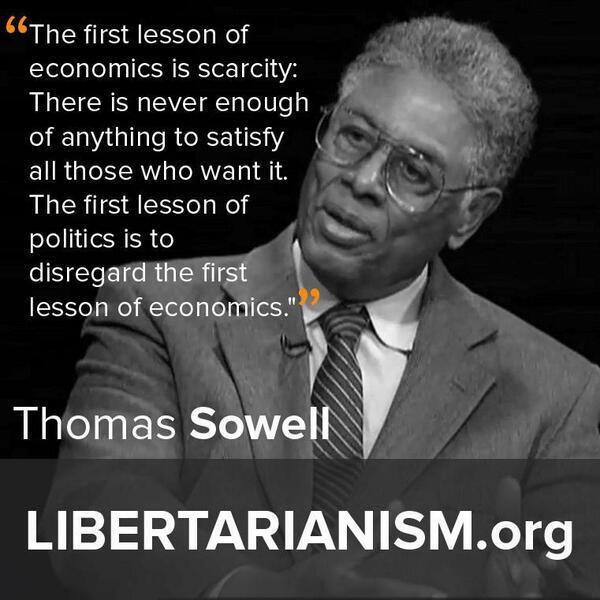
This caught my eye today en route to something else. Right now the political class in Washington is convinced on one side there is no limit to spending to get what it thinks it needs and wants.
On the other side are folks who are attempting to live by a principled and disciplined fiscal policy.
And by the way, I'm not making that assessment based on Republicans and Democrats. I'm differentiating between status quo spenders from both parties and the growing class of Libertarians who are trying to return us to spending sanity as a nation. That's no easy task now.
One can only wonder which side will prevail.
Moody's, the credit worthiness analysts, issued a memo today to lay aside any fears that the government might default if President Obama doesn't get his way with raising the debt ceiling. These comments basically confirm most of what you're hearing is nothing more than the usual political rhetoric. My takeaway from their memo is, "Mr. President, shut up and manage the government, just don't spend more than you take in." Haven't we been saying that to our POTUS all along?
Quoting from the memo: "We believe the government would continue to pay interest and principal on its debt even in the event that the debt limit is not raised, leaving its creditworthiness intact. The debt limit restricts government expenditures to the amount of its incoming revenues; it does not prohibit the government from servicing its debt. There is no direct connection between the debt limit (actually the exhaustion of the Treasury’s extraordinary measures to raise funds) and a default."
The memo offers a starkly different view of the consequences of congressional inaction on the debt limit than is held by the White House, many policymakers and other financial analysts. During a press conference at the White House Tuesday, Obama said missing the Oct. 17 deadline would invite “economic chaos.”
The Moody’s memo goes on to argue that the situation is actually much less serious than in 2011, when the nation last faced a pitched battle over the debt limit.
“The budget deficit was considerably larger in 2011 than it is currently, so the magnitude of the necessary spending cuts needed after 17 October is lower now than it was then,” the memo says.
Now hear this, people: This POTUS has cried "Wolf" many, many times. Whatever credibility anyone thought he once had is quickly diminishing.
Subscribe to:
Posts (Atom)