There is perhaps no other place on earth where the annual celebration of the birth of a nation is done in such a unique way. We don't line up our armaments and parade them past the White House with everyone in America cheering our collection of long-range missiles with nuclear warheads as thousands of troops goose-step down Pennsylvania Avenue.
Instead, we have picnics in the backyard and we light off fireworks. At least we used to light off fireworks - now Utah is so bone-dry only the bone-heads light off fireworks.
We celebrate the adoption of the Declaration of Independence on July 4th, 1776. It was no small feat for a fledgling group of diverse colonies to agree to condemn the sitting King of England in such scathing terms. We opposed what we believed was tyranny and taxation without representation. Funny thing is THAT form of taxation doesn't even hold a candle to the tyranny one could assert now exists in America WITH representation. But that's a story for another day, isn't it?
I celebrate the glorious gift of freedom on this July 4th. I celebrate the ability to put some thin-sliced marinated beef briskets on the grill with chocolate brownies and congo squares and grape ice cream for dessert. I remember and I am grateful for the sacrifice of so many men and women who paid the ultimate sacrifice for my family so we could enjoy one another's company as we gather at the Ranch this weekend.
I'm grateful to all those who fought in the heat of the summer and the bitter cold of a Valley Forge winter during the Revolutionary War to give life to the words of the Declaration of Independence.
It was 150 years ago this week in which the bloodiest battle of the Civil War was fought in Gettysburg, Pennsylvania. Both sides fielded courageous advocates for what their version of freedom looked like.
War-worn and long-postponed plans for life were the common lot of my father's generation. Some called it the "Greatest Generation." That global conflagration, once considered the war to end all wars, was only the prelude to a sustained period of years that saw unparalleled growth and expansion of freedom's blessings worldwide.
As I grow older it is increasingly more difficult to take the hard work and sacrifice of all those who came before me for granted. I stir with emotion every time I sing the National Anthem. I tear up when I think about the flag that flies a few feet from my home and realize what it represents in blood, toil and courage.
I checked the other day about who reads this blog. I've had readers represented in 22 countries so far. To them I would say, don't give up on the ideals America represents. I pray all may remember the sacrifice of so many who have gone before to make freedom a reality beyond the ideal.
I have freedom to get up every day of my life in America to try and make something good happen, something that but for me would not exist.
I have the unrequited joy of seeing my children and grandchildren succeeding and prospering as adults who are making a contribution for good to their own families, their country, their Church and their employers. They are amazing people who emerged from a simple idea, "Patsy, I love you, will you marry me?"
I am only beginning to understand what it means to be a father, but understanding the meaning that goes behind "Grandpa" is so much easier and fulfilling.
My wife of 44 years is growing older at my side day by day, and as we laugh about our deteriorating body parts, we can share not only that but so much more together in relative peace and tranquility compared to so many others in our strife-riddled world.
Oakley, Utah, not far from where we live, puts on a stellar parade every year. The highway is closed all morning long, then the fabulous new rodeo arena sponsors the Oakley Rodeo at night for a continuous feast of Americana at its best. There is nothing to compare with John Wayne's booming voice over the loudspeakers declaring "America, Why I Love Her."
The Woodland Ward sponsors the annual 4th of July breakfast, complete with flag raising ceremony and a huge American breakfast of pancakes, eggs, hash browns, bacon, ham and all the fixin's any way you want it.
I will never tire of celebrating the 4th of July. To be sure, America has her problems, and many predict her demise, but I choose to remain optimistic about her future. As long as God's children can muster enough gratitude for blessings received, we will continue to find a majority who value the cause of freedom. .
Happy 4th of July!
Showing posts with label july 4th. Show all posts
Showing posts with label july 4th. Show all posts
Wednesday, July 3, 2013


Wednesday, July 4, 2012
A Look at our Founders' Beliefs in Light of Today's Politics
 |
| The Federalist Papers |
On this 4th of July 2012, with nothing better to do on our national holiday, I have been reviewing selected statements from the writings of our founding fathers. Many of the statements in this post will leap off the page at you if you have your eyes wide open to the strife swirling about us in this election season. Do not become discouraged. Do not fear the future. Put into its proper perspective with a healthy dose of hindsight to guide our thinking, contention and opposition has forever been part of our political process, and will be forever as long as free men agree to disagree agreeably in the end.
 |
| George Washington |
The Federalist Party was the first American political party, from the early 1790s to 1816, the era of the First Party System. George Washington abhorred the thoughts of his infant republic being torn asunder by partisan bickering, and remained independent, but the Federalists controlled the federal government until 1801.
 |
| Alexander Hamilton |
The Federalists favored a strong national bank, tariffs, and good relations with Britain. Their political opponents, the Democratic-Republicans, led by Thomas Jefferson and James Madison, denounced most of the Federalist policies, especially the bank, and vehemently criticized anyone who expressed remaining sympathy with the British monarchy. The Federalists won most of the major legislative battles in the 1790s. Their supporters were mostly in the nation's cities and in New England. The Democratic-Republicans, drew support from the rural South, and Jefferson eventually won the ugly and nasty election of 1800, defeating his lifelong friend John Adams, whose party never returned to power.
One thing leaps out as you read these excerpts, primarily from Hamilton and Madison: Despite their differences in the beliefs of their respective parties, both men believed the ultimate power of America rested with THE PEOPLE, and each gives us ample justification for taking steps to correct any form of tyranny that may arise. They wrote their essays along with Chief Justice John Jay to promote the ratification of the Constitution, and each in his writings gave us the intellectual arguments sufficient to change the government if it were ever to encroach upon our freedoms. As you read, don't be surprised if you learn how prophetic their writings have become!
 |
| John Adams |
Today, the ongoing national debate about the relative powers of the federal and the state governments continues. As I write today state governors, granted the ability to do so in the latest SCOTUS ruling on the Affordable Healthcare Act, are pushing back and refusing to implement the expansion of Medicaid under the law because of the enormous financial hardship it imposes. The more things change in America, the more they remain the same, it seems.
 |
| Thomas Jefferson |
* * *
 |
| James Madison |
The States will retain all pre-existing authorities which may not be exclusively delegated to the federal head; and that this exclusive delegation can only exist in one of three cases: where an exclusive authority is, in express terms, granted to the Union; or where a particular authority is granted to the Union and the exercise of a like authority is prohibited to the States; or where an authority is granted to a Union with which a similar authority in the States would be utterly incompatible. Hamilton, Number 82
It has not a little contributed to the infirmities of the existing federal system that it never had a ratification by the PEOPLE. Resting on no better foundation than the consent of the several legislatures, it has been exposed to frequent and intricate questions concerning the validity of its powers, and has in some instances given birth to the enormous doctrine of a right of legislative repeal. Owing its ratification to the law of a State, it has been contended that the same authority might repeal the law by which it was ratified. However gross a heresy it may be to maintain that a party to a compact has a right to revoke that compact, the doctrine itself has had respectable advocates. The possibility of a question of this nature proves the necessity of laying the foundations of our national government deeper than in the mere sanction of delegated authority. The fabric of American empire ought to rest on the solid basis of THE CONSENT OF THE PEOPLE. The streams of national power ought to flow immediately from that pure, original fountain of all legitimate authority. Hamilton, Number 22
If we resort for a criterion to the different principles on which different forms of government are established, we may define a republic to be, or at least may bestow that name on, a government which derives all its powers directly or indirectly from the great body of the people, and is administered by persons holding their offices during pleasure for a limited period, or during good behavior. It is essential to such a government that it be derived from the great body of the society, not from an inconsiderable proportion or a favored class of it; otherwise a handful of tyrannical nobles, exercising their oppressions by a delegation of their powers, might aspire to the rank of republicans and claim for their government the honorable title of republic. Madison, Number 39
The smallness of the army renders the natural strength of the community an overmatch for it; and the citizens, not habituated to look up to the military power for protection, or to submit to its oppressions, neither love nor fear the soldiery; they view them with a spirit of jealous acquiescence in a necessary evil and stand ready to resist a power which they suppose may be exerted to the prejudice of their rights.
The army under such circumstances may usefully aid the magistrate to suppress a small faction, or an occasional mob, or insurrection; but it will be unable to enforce encroachments against the united efforts of the great body of the people. Hamilton, Number 8
If the representatives of the people betray their constituents, there is then no resource left but in the exertion of that original right of self-defense which is paramount to all positive forms of government. Hamilton, Number 28
 |
| John Jay |
It is in vain to oppose constitutional barriers to the impulse of self-preservation. It is worse than in vain; because it plants in the Constitution itself necessary usurpations of power, every precedent of which is a germ of unnecessary and multiplied repetitions. Madison, Number 41
Wilful abuses of a public authority, to the oppression of the subject, and every species of official extortion, are offenses against the government, for which the persons who commit them may be indicted and punished according to the circumstances of the case. Hamilton, Number 83
Do these principles, in fine, require that the powers of the general government should be limited, and that, beyond this limit, the States should be left in possession of their sovereignty and independence? We have seen that in the new government, as in the old, the general powers are limited; and that the States, in all unenumerated cases, are left in the enjoyment of their sovereign and independent jurisdiction. Madison, Number 40
. . . If it be asked what is to be the consequence, in case the Congress shall misconstrue this part of the Constitution and exercise powers not warranted by its true meaning. I answer the same as if they should misconstrue or enlarge any other power vested in them; as if the general power had been reduced to particulars, and any one of these were to be violated; the same, in short, as if the State legislatures should violate their respective constitutional authorities. In the first instance, the success of the usurpation will depend on the executive and judiciary departments, which are to expound and give effect to the legislative acts; and in the last resort a remedy must be obtained from the people, who can, by the election of more faithful representatives, annul the acts of the usurpers. The truth is that this ultimate redress may be more confided in against unconstitutional acts of the federal than of the State legislatures, for this plain reason that as every such act of the former will be an invasion of the rights of the latter, these will be ever ready to mark the innovation, to sound the alarm to the people, and to exert their local influence in effecting a change of federal representatives. There being no such intermediate body between the State legislatures and the people interested in watching the conduct of the former, violations of the State constitutions are more likely to remain unnoticed and unredressed. Madison, Number 44
The powers delegated by the proposed Constitution to the federal government are few and defined. Those which are to remain in the State governments are numerous and indefinite. The former will be exercised principally on external objects, as war, peace, negotiation, and foreign commerce; with which last the power of taxation will, for the most part, be connected. The powers reserved to the several States will extend to all the objects which, in the ordinary course of affairs, concern the lives, liberties, and properties of the people, and the internal order, improvement, and prosperity of the State.
The operations of the federal government will be most extensive and important in times of war and danger; those of the State governments in times of peace and security. As the former periods will probably bear a small proportion to the latter, the State governments will here enjoy another advantage over the federal government. The more adequate, indeed, the federal powers may be rendered to the national defense, the less frequent will be those scenes of danger which might favor their ascendancy over the governments of the particular States.
If the new Constitution be examined with accuracy and candor, it will be found that the change which it proposes consists much less in the addition of NEW POWERS to the Union than in the invigoration of its ORIGINAL POWERS. The regulation of commerce, it is true, is a new power; but that seems to be an addition which few oppose and from which no apprehensions are entertained. Madison, Number 45
There is no position which depends on clearer principles than that every act of a delegated authority, contrary to the tenor of the commission under which it is exercised, is void. No legislative act, therefore, contrary to the Constitution, can be valid. To deny this would be to affirm that the deputy is greater than his principal; that the servant is above his master; that the representatives of the people are superior to the people themselves; that men acting by virtue of powers may do not only what their powers do not authorize, but what they forbid. Hamilton, Number 78
The House of Representatives is so constituted as to support in the members an habitual recollection of their dependence on the people. Before the sentiments impressed on their minds by the mode of their elevation can be effaced by the exercise of power, they will be compelled to anticipate the moment when their power is to cease, when their exercise of it is to be reviewed, and when they must descend to the level from which they were raised; there forever to remain unless a faithful discharge of their trust shall have established their title to a renewal of it.
I will add, as a fifth circumstance in the situation of the House of Representatives, restraining them from oppressive measures, that they can make no law which will not have its full operation on themselves and their friends, as well as on the great mass of the society. This has always been deemed one of the strongest bonds by which human policy can connect the rulers and the people together. It creates between them that communion of interests and sympathy of sentiments of which few governments have furnished examples; but without which every government degenerates into tyranny. If it be asked, what is to restrain the House of Representatives from making legal discriminations in favor of themselves and a particular class of the society? I answer: the genius of the whole system; the nature of just and constitutional laws; and, above all, the vigilant and manly spirit which actuates the people of America -- a spirit which nourishes freedom, and in return is nourished by it.
If this spirit shall ever be so far debased as to tolerate a law not obligatory on the legislature, as well as on the people, the people will be prepared to tolerate anything but liberty. Madison, Number 57
For it is a truth, which the experience of all ages has attested, that the people are commonly most in danger when the means of injuring their rights are in the possession of those of whom they entertain the least suspicion. Hamilton, Number 25
I believe it may be laid down as a general rule that their confidence in and obedience to a government will commonly be proportioned to the goodness or badness of its administration. Hamilton, Number 27
It may safely be received as an axiom in our political system that the State governments will, in all possible contingencies, afford complete security against invasions of the public liberty by the national authority. Hamilton, Number 28
It is essential to liberty that the government in general should have a common interest with the people. Madison, Number 52
No government, any more than an individual, will long be respected without being truly respectable. Madison, Number 62
* * *
HAPPY 4TH OF JULY, AMERICA! NEVER DOUBT WHO YOU ARE!
Sunday, July 4, 2010
Thomas Jefferson, Author of July 4th
If you haven't read David McCullough's monumental biography, John Adams, pick up a copy -- it's a must read.
A repost from The Wall Street Journal, July 2, 2010. It's no secret -- I'm a big fan of Peggy Noonan:

A Cold Man's Warm Words
Jefferson's tender lament didn't make it into the Declaration.
By PEGGY NOONAN.
The tenderest words in American political history were cut from the document they were to have graced.
It was July 1, 2 ,3 and 4, 1776, in the State House in Philadelphia. America was being born. The Continental Congress was reviewing and editing the language of the proposed Declaration of Independence and Thomas Jefferson, its primary author, was suffering the death of a thousand cuts.
The tensions over slavery had been wrenching, terrible, and were resolved by brute calculation: to damn or outlaw it now would break fragile consensus, halt all momentum, and stop the creation of the United States. References to the slave trade were omitted, but the founders were not stupid men, and surely they knew their young nation would have its date with destiny; surely they heard in their silence the guns of Fort Sumter.
Still, in the end, the Congress would not produce only an act of the most enormous human and political significance, the creation of America, it would provide history with one of the few instances in which a work of true literary genius was produced, in essence, by committee. (The writing of the King James Bible is another.)
The beginning of the Declaration had a calm stateliness that signaled, subtly, that something huge is happening:
"When in the Course of human events it becomes necessary for one people to dissolve the political bands which have connected them with another, and to assume among the powers of the earth, the separate and equal station to which the Laws of Nature and of Nature's God entitle them, a decent respect to the opinions of mankind requires that they should declare the causes which impel them to separate."
This gave a tone of moral modesty to an act, revolution, that is not a modest one. And it was an interesting modesty, expressing respect for the opinion of the world while assuming the whole world was watching. In time it would be. But that phrase, "a decent respect to the opinions of mankind" is still a marker, a reminder: We began with respect. America always gets in trouble when we forget that.
The second paragraph will, literally, live forever in the history of man. It still catches the throat:
"We hold these truths to be self-evident, that all men are created equal, that they are endowed by their Creator with certain unalienable Rights, that among these are Life, Liberty, and the pursuit of Happiness.—That to secure these rights, Governments are instituted among Men, deriving their just powers from the consent of the governed."
 What followed was a list of grievances that made the case for separation from the mother country, and this part was fiery. Jefferson was a cold man who wrote with great feeling. He trained his eyes on the depredations of King George III: "He has plundered our seas, ravaged our coasts, burnt our towns. . . . He is at this time transporting large Armies of foreign Mercenaries to compete the work of death, desolation and tyranny . . ."
Members of the Congress read and reread, and the cutting commenced. Sometimes they cooled Jefferson down. He wrote that the king "suffered the administration of justice totally to cease in some of these states." They made it simpler: "He has obstructed the Administration of Justice."
"For Thomas Jefferson it became a painful ordeal, as change after change was called for and approximately a quarter of what he had written was cut entirely." I quote from the historian David McCullough's John Adams, as I did last year at this time, because everything's there.
 Jefferson looked on in silence. Mr. McCullough notes that there is no record that he uttered a word in protest or in defense of what he'd written. Benjamin Franklin, sitting nearby, comforted him: Edits often reduce things to their essence, don't fret. It was similar to the wisdom Scott Fitzgerald shared with the promising young novelist Thomas Wolfe 150 years later: Writers bleed over every cut, but at the end they don't miss what was removed, don't worry.
"Of more than eighty changes in Jefferson's draft during the time Congress deliberated, most were minor and served to improve it," writes Mr. McCullough. But one cut near the end was substantial, and its removal wounded Jefferson, who was right to be wounded, for some of those words should have stayed.
Jefferson had, in his bill of particulars against the king, taken a moment to incriminate the English people themselves — "our British brethren" — for allowing their king and Parliament to send over to America not only "soldiers of our own blood" but "foreign Mercenaries to invade and destroy us." This, he said, was at the heart of the tragedy of separation. "These facts have given the last stab to agonizing affection, and manly spirit bids us renounce forever" our old friends and brothers. "We must endeavor to forget our former love for them."
Well. Talk of love was a little much for the delegates. Love was not on their mind. The entire section was removed.
And so were the words that came next. But they should not have been, for they are the tenderest words.
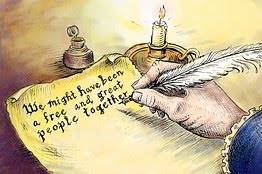
Poignantly, with a plaintive sound, Jefferson addresses and gives voice to the human pain of parting: "We might have been a free and great people together."
What loss there is in those words, what humanity, and what realism, too.
 "To write is to think, and to write well is to think well," David McCullough once said in conversation. Jefferson was thinking of the abrupt end of old ties, of self-defining ties, and, I suspect, that the pain of this had to be acknowledged. It is one thing to declare the case for freedom, and to make a fiery denunciation of abusive, autocratic and high-handed governance. But it is another thing, and an equally important one, to acknowledge the human implications of the break. These were our friends, our old relations; we were leaving them, ending the particular facts of our long relationship forever. We would feel it. Seventeen seventy-six was the beginning of a dream. But it was the end of one too. "We might have been a free and great people together."
 It hurt Thomas Jefferson to see these words removed from his great document. And we know something about how he viewed his life, his own essence and meaning, from the words he directed that would, a half-century after 1776, be cut onto his tombstone. The first word after his name is "Author."
America and Britain did become great and free peoples together, and apart, bound by a special relationship our political leaders don't often speak of and should never let fade. You can't have enough old friends. There was the strange war of 1812, declared by America and waged here by England, which reinvaded, and burned our White House and Capitol. That was rude of them. But they got their heads handed to them in New Orleans and left, never to return as an army.
Even 1812 gave us something beautiful and tender. There was a bombardment at Fort McHenry. A young lawyer and writer was watching, Francis Scott Key. He knew his country was imperiled. He watched the long night in hopes the fort had not fallen. And he saw it — the rocket's red glare, the bombs bursting in air, gave proof through the night that our flag was still there.
 And so to all writers (would-be, occasional and professional) and all editors too, down through our history: Happy 234th Independence Day. And to our British cousins: Nice growing old with you.
A repost from The Wall Street Journal, July 2, 2010. It's no secret -- I'm a big fan of Peggy Noonan:

A Cold Man's Warm Words
Jefferson's tender lament didn't make it into the Declaration.
By PEGGY NOONAN.
The tenderest words in American political history were cut from the document they were to have graced.
It was July 1, 2 ,3 and 4, 1776, in the State House in Philadelphia. America was being born. The Continental Congress was reviewing and editing the language of the proposed Declaration of Independence and Thomas Jefferson, its primary author, was suffering the death of a thousand cuts.
The tensions over slavery had been wrenching, terrible, and were resolved by brute calculation: to damn or outlaw it now would break fragile consensus, halt all momentum, and stop the creation of the United States. References to the slave trade were omitted, but the founders were not stupid men, and surely they knew their young nation would have its date with destiny; surely they heard in their silence the guns of Fort Sumter.
Still, in the end, the Congress would not produce only an act of the most enormous human and political significance, the creation of America, it would provide history with one of the few instances in which a work of true literary genius was produced, in essence, by committee. (The writing of the King James Bible is another.)
The beginning of the Declaration had a calm stateliness that signaled, subtly, that something huge is happening:
"When in the Course of human events it becomes necessary for one people to dissolve the political bands which have connected them with another, and to assume among the powers of the earth, the separate and equal station to which the Laws of Nature and of Nature's God entitle them, a decent respect to the opinions of mankind requires that they should declare the causes which impel them to separate."
This gave a tone of moral modesty to an act, revolution, that is not a modest one. And it was an interesting modesty, expressing respect for the opinion of the world while assuming the whole world was watching. In time it would be. But that phrase, "a decent respect to the opinions of mankind" is still a marker, a reminder: We began with respect. America always gets in trouble when we forget that.
The second paragraph will, literally, live forever in the history of man. It still catches the throat:
"We hold these truths to be self-evident, that all men are created equal, that they are endowed by their Creator with certain unalienable Rights, that among these are Life, Liberty, and the pursuit of Happiness.—That to secure these rights, Governments are instituted among Men, deriving their just powers from the consent of the governed."

Members of the Congress read and reread, and the cutting commenced. Sometimes they cooled Jefferson down. He wrote that the king "suffered the administration of justice totally to cease in some of these states." They made it simpler: "He has obstructed the Administration of Justice."
"For Thomas Jefferson it became a painful ordeal, as change after change was called for and approximately a quarter of what he had written was cut entirely." I quote from the historian David McCullough's John Adams, as I did last year at this time, because everything's there.

"Of more than eighty changes in Jefferson's draft during the time Congress deliberated, most were minor and served to improve it," writes Mr. McCullough. But one cut near the end was substantial, and its removal wounded Jefferson, who was right to be wounded, for some of those words should have stayed.
Jefferson had, in his bill of particulars against the king, taken a moment to incriminate the English people themselves — "our British brethren" — for allowing their king and Parliament to send over to America not only "soldiers of our own blood" but "foreign Mercenaries to invade and destroy us." This, he said, was at the heart of the tragedy of separation. "These facts have given the last stab to agonizing affection, and manly spirit bids us renounce forever" our old friends and brothers. "We must endeavor to forget our former love for them."
Well. Talk of love was a little much for the delegates. Love was not on their mind. The entire section was removed.
And so were the words that came next. But they should not have been, for they are the tenderest words.
Poignantly, with a plaintive sound, Jefferson addresses and gives voice to the human pain of parting: "We might have been a free and great people together."
What loss there is in those words, what humanity, and what realism, too.

America and Britain did become great and free peoples together, and apart, bound by a special relationship our political leaders don't often speak of and should never let fade. You can't have enough old friends. There was the strange war of 1812, declared by America and waged here by England, which reinvaded, and burned our White House and Capitol. That was rude of them. But they got their heads handed to them in New Orleans and left, never to return as an army.
Even 1812 gave us something beautiful and tender. There was a bombardment at Fort McHenry. A young lawyer and writer was watching, Francis Scott Key. He knew his country was imperiled. He watched the long night in hopes the fort had not fallen. And he saw it — the rocket's red glare, the bombs bursting in air, gave proof through the night that our flag was still there.

Subscribe to:
Posts (Atom)