Showing posts with label apostle paul. Show all posts

Sunday, September 6, 2020

Prayer, The Access To Heaven's Portal


Prayer is the soul's sincere desire,
Uttered or unexpressed
The motion of a hidden fire
That trembles in the breast. (Hymns, No. 145)

The words of that familiar hymn have been impressed upon my mind this week. From the dawn of creation prayer has given all of God's children direct access to Him. Prayers do not go through some intermediary like the Virgin Mary, the Savior Jesus Christ, or the beads of a rosary. Prayers are direct communication with our Heavenly Father, even the Great Elohim. We pray to God the Father in the name of God the Son, by the power of God the Holy Ghost. Prayer is the universal language between God and His children. It matters not what color our skin, which nationality we claim or which denomination. The clean, the unclean, the rich, the poor, the mighty and the humble all have an open invitation to pray. All that is necessary is the desire to reach out to our Higher Power for help, anytime, anywhere, and in whatever circumstance we find ourselves.

It was the Apostle Paul who reminded us:

"Let us therefore come boldly unto the throne of grace, that we may obtain mercy, and find grace to help in time of need." (Hebrews 3:16, emphasis mine).

Paul has admonished us to have faith in the perfection of Christ's atoning sacrifice for all His Father's children in these words:

"For verily he took not on him the nature of angels; but he took on him the seed of Abraham.

"Wherefore in all things it behooved him to be made like unto his brethren, that he might be a merciful and faithful high priest in things pertaining to God, to make reconciliation for the sins of the people.

"For in that he himself hath suffered being tempted, he is able to succour them that are tempted." (Hebrews 2:16-18).

The Book of Mormon prophet Alma assures us, speaking of Christ's mortal ministry:

"And he shall go forth suffering pains and afflictions and temptations of every kind; and this that the word might be fulfilled which saith he will take upon him the pains and the sicknesses of his people.

"And he will take upon him death, that he may loose the bands of death which bind his people; and he will take upon him their infirmities, that his bowels may be filled with mercy, according to the flesh, that he may know according to the flesh how to succor his people according to their infirmities." (Alma 7:11-12).

The Greek equivalent of "succor" is literally "to run quickly to help." Christ descended below all things as a mortal so He would know HOW to succor us when we encountered situations in which we need to cry out in our desperation for help.

Of course, prayer is also a way in which we can thank our Heavenly Father for all our blessings in acknowledgement of His abundant blessings we enjoy during our sojourn in mortality. There are so many people who ignore this facet of the diamond of prayer. It's easier perhaps to cry out in need when things are going badly, but much harder to remember God in the days of our abundance and prosperity. The Book of Mormon is replete with stories about those who turned to God in need, then forgot Him in the very moment they were blessed and turned away.

Try this experiment sometime. When you kneel to pray, spend your time on thanking Heavenly Father for all your blessings, and name them one by one. Don't simply go down your checklist of prayer requests, instead, confine yourself to acknowledging all the blessings you have observed in your life. See how long you can stay in the attitude of prayer. Then when you arise from your knees go about your day with a song in your heart and continue counting your blessings. I would hope you develop a new appreciation for all that God has done to bless you, and cease to view Him as a heavenly vending machine for blessings.

One of my contemporary heroes was always Hugh Nibley. Toward the end of his interview called Faith of An Observer, Nibley concluded that all he learned during his life (and it was a prodigious amount of knowledge) could be summarized into getting really good at two things: repentance and forgiveness. When it is most difficult to forgive another, focus on your blessings and the gifts you have received from Heavenly Father. The first gift He offered to all of us was the Light of Christ, then later the Gift of the Holy Ghost. Those are gifts of inestimable value to assist us on our quest for eternal life. When you focus on gratitude and offer back that gratitude in prayer, it will be much easier to repent of our failings and to forgive others of theirs. 

"And now my beloved brethren, I have said these things unto you that I might awaken you to a sense of your duty to God, that ye may walk blameless before him, that ye may walk after the holy order of God, after which ye have been received.

"And now I would that ye should be humble, and be submissive and gentle; easy to be entreated; full of patience and long-suffering; being temperate in all things; being diligent in keeping the commandments of God at all times; asking for whatsoever things ye stand in need; both spiritual and temporal; always returning thanks unto God for whatsoever things ye do receive.

"And see that ye have faith, hope, and charity, and then ye will always abound in good works. 

"And may the Lord bless you, and keep your garments spotless, that ye may at last be brought to sit down with Abraham, Isaac, and Jacob, and the holy prophets who have been ever since the world began, having your garments spotless even as their garments are spotless, in the kingdom of heaven to go no more out.

"And now my beloved brethren, I have spoken these words unto you according to the Spirit which testifieth in me; and my soul doth exceedingly rejoice, because of the exceeding diligence and heed which ye have given unto my word.

"And now, may the peace of God rest upon you, and upon your houses and lands, and upon your flocks and herds, and all that you possess, your women and your children, according to your faith and good works, from this time forth and forever. And thus I have spoken. Amen." (Alma 7:22-27).

Today our youngest grandson was blessed and given his name by his father Michael Litchfield in a home of his aunt on the shores of Lake of the Ozarks in Missouri. The blessing was attended by only a hand-fold of relatives from among a huge extended family on both sides. How grateful we were today for the miracle of face-time technology that permitted us to listen in  and watch remotely from many miles away. Nolan Michael Litchfield was blessed by his father in the authority of the Holy Priesthood, not merely prayed over, and it was a beautiful and powerful blessing. 

Tonight, as we do every night, we will thank our Heavenly Father once again upon bended knees in prayer for the blessing of a righteous posterity. Truly we have been blessed abundantly, and we rejoice!


(Look for Mark Pahnke, the handsome young man in a yellow tie, who is also our nephew).

Saturday, December 5, 2015

How to Get Converted and Stay Converted

It has been a few weeks since my last post. My lapse in writing can be attributed to a definite malaise that has settled in on my mind. I am reminded this morning that I have been fulfilling the prophecy in D&C 84:54. I had allowed my mind to become darkened because of unbelief and because I had been treating lightly the things I have received.

It started with the memories of Patsy's mother's passing a year ago, then continued as I have observed my own father's slow but steady deterioration as he comes up against his 94th birthday. It's hard to stay positive about the future when you see a visual example of the overall entropy that settles in on the aged ones among us. There is a fatalistic sense of the inevitability of the death of everyone and everything you love that sometimes grips your heart and you forget that life is eternal in those moments of doubt and despair.

Added to that is what's been happening in the world around us - the Paris attacks, and just last week the tragic mass murder in San Bernardino. The latter-day Gadiantons are truly glorying in their bloodbaths around the world, unabated it seems by any who would dare to molest or make afraid. News of death is always in the headlines. It's depressing, isn't it?

We were in the bishop's office last week for tithing settlement. Sadly, the bishop mentioned that some in the Woodland Ward had asked for their names to be removed from the records of the Church because of the Church's recent clarification about the policies for handling cases where same sex couples are raising children in their homes and how those children will be dealt with administratively. His observations were that often members who advocate the "politically correct" social positions are perhaps not (and maybe they were never) truly converted. If they understood true doctrine, he asserted, they would not be caught up in the controversial political winds that swirl around us daily. Politics, it has always seemed to me, is a poor substitute for true doctrine.

Our extended family is not unlike everyone else's we know. There are few families in the Church who will not be touched by the same sex attraction realities that infiltrate the lives of those we love. I have said before, and reiterate here once again that this assault strikes at the very core of the eternal plan for families as laid out specifically and with little or no confusion in the inspired document The Family: A Proclamation To The World. While we continue to nurture, love and patiently teach those we love most who are saddened and confused about the Church position on these matters, we must never weaken our own resolve that God is in His heaven and is the author of the plan of salvation because He loves His children unconditionally. Offering empathy and love to all His children, as He does, is the essence of our attempts to become more like Him.

I know a man who has struggled with all the issues over same sex attraction for a lifetime. He was full of hate. He hated his parents, he hated his wife, he hated practically everyone he knew. I'm certain he must have hated me too at times. His countenance was dark and foreboding. Happiness eluded him. I know all the intimate details of his life because he shared them with me. I have stood by as he has sunk to the depths of despair over this issue, been the subject of Church disciplinary councils through the years, been divorced and remarried, acted out his fantasies and in short "done it all" over the course of his life. In search for happiness outside his temple marriage, however, he never found what he was seeking.

Now retired, he has been reborn after the manner of Alma the younger in answer to the pleas and persistent petitions of his father and those who loved him. I believe him when he tells me based upon his lifetime of "gayness" that homosexuality is a choice. As tortured as he has been, he knows that to be true. I do not know it the way he knows it. I know that is true from a doctrinal perspective. I can only take him at his word as a witness who has lived it. And I love him deeply and honestly for his choice to return, Alma-like, cleansed, purified and wholly committed to living out his remaining days in the bonds of his marriage covenant with his wife and with his God. His countenance has changed. He is full of light and truth. He is reaching for more light every day.

I will not multiply words in this post (as tempting as that is for me), because I have laid out the doctrine repeatedly in these pages.

However, as I thought about my visit with the bishop at tithing settlement and as I have pondered "true conversion" since, I can say without reservation that the antidote for throwing off the malaise of the effects of the things that tend to dampen my enthusiasm for living is the "magic" of daily scripture study.

When I am asked how I came to love the scriptures so much the answer is simple - it was my substitute for pornography. As a young married man, I had to find a "replacement therapy" and for me it was immersing myself in the scriptures on a daily basis.

It began with a fascination about the broad topic of the signs of the times and the prophecies of the last days. The eschatology of other religions also came to bear on my studies. After a trip to the Holy Land many years ago I immersed myself in all things Muslim. I am still deeply saddened over how the radicals of Islam have altered forever what was once a religion of peace, one that valued "the people of the book" (meaning the Bible - Christians and Jews alike), and treated them with respect and tolerance.

Then it shifted to reading the New Testament and the Old Testament in depth as I taught the four-year series in gospel doctrine. I fell in love with the principal author of the New Testament, the Apostle Paul. He became a true hero to me. He helped me understand my Mormonism so much better than any other commentaries I had previously read. And conversely, Joseph Smith's writings helped me understand Paul better too. I have always found a marvelous harmony in Joseph and Paul.

Throughout all my explorations in the scriptures and amassing a library I have now mostly given away except for the treasured volumes I simply had to retain, The Book of Mormon continues to light my path. It is my considered belief that those who struggle most with the Church and with doctrine are not immersing themselves daily in the word of God as found in the standard works published by the Church.

Whatever your challenges may be, try this simple experiment. Take down that dusty volume, The Book of Mormon, from your bookshelf, or ask the Church to send you one for free (scroll down to the bottom of this blog and you will find the link). Then do this: For thirty days set aside a half hour and open the book to any page anywhere inside the covers and read at random. You can always go back later and read it from start to finish, but for the purpose of this exercise just thumb through the pages at random every day for thirty minutes. Don't miss a day. At the end of the thirty days see if your life hasn't been improved in some small way. See if ingesting God's word from those pages doesn't help you with whatever it is that is causing your malaise of spirit.

As I am His witness, I testify that The Book of Mormon is the word of God. It is truly a Second Witness of Jesus Christ. Almost any page will seal that testimony in your heart if you seek to know it in the sincerity of your search for truth. Your conversion will be in direct proportion to the degree of diligence you apply to this simple test. No one I know ever left this Church who was reading The Book of Mormon daily. It's such a simple spiritual antidote.

Dare to get converted, truly converted, and then stay converted. And continue in patience to reach out and love those around you who aren't so sure about that.


Wednesday, September 30, 2015

Are We Saved By Grace or By Works?

In 1999, I prepared some thoughts about this topic and handed it out to the members of my gospel doctrine class. Sixteen years later, my son Joe is now teaching gospel doctrine, and updated my original writing recently. When I read it again, I decided it was worth sharing with everyone who reads this page:

Saved by Grace or by Works? 
What Paul Taught
Joe Goates
September 27, 2015

I recently spoke with a friend about his sister, who has been struggling with her testimony and lacking hope. She feels that all the effort to live the gospel is not worth it, after all, only a relative few will make the highest degree of the celestial kingdom, and she isn’t living up to what she would need to do to obtain that kingdom anyway. My friend asked me if I had any suggestions on some reading material that could restore her hope in the gospel and help her understand how she can obtain this kingdom, which is greatest of all the gifts of God (D&C 6:13). I gave him some suggestions and I hope these thoughts are also helpful for this good sister, and anyone else who has struggled with the same thoughts of inadequacy and lack of hope.

The World Teaches About Paul

Millions of people throughout time have asked the question, “What do I need to do to be saved?” Preachers in churches everywhere proclaim the answer to that question, and it usually involves something like “accepting Jesus Christ as your personal Savior.” Almost all these Christian persuasions have a common thread in their preaching. Each preacher declares his or her version of what they think the Apostle Paul meant in his New Testament epistles.

Joseph Smith
Paul’s teachings about “grace” and being “born again” are often confusing and difficult to understand for many Latter-day Saints. Joseph Smith simply declared, “Being born again comes by the Spirit of God through ordinances.” (see TPJS, p. 162). Lacking a knowledge of the restoration and the ordinances of baptism and the gift of the Holy Ghost, most other Christian evangelists rely heavily upon Paul’s letters to the churches in his day. The missing link in their sermons is that the leaders of the branches of the church to whom Paul wrote (along with their followers) had already received the ordinances of baptism and the gift of the Holy Ghost. That is why Paul rarely speaks of the preparatory ordinances.

Paul never mentions temple marriage and only makes vague references to the three degrees of glory. He focuses instead on the requirements for salvation after the ordinances of salvation have been received from legal administrators who have the authority “to preach the gospel and administer in the ordinances thereof” (Fifth Article of Faith). Paul presumes his readers already know about baptism and the gift of the Holy Ghost, the priesthood and the temple.

What We Think We Believe

Members of The Church of Jesus Christ of Latter-day Saints, who have possession of the fullness of the gospel, the priesthood and all its ordinances (including temple ordinances) are often unsure about their doctrinal position on salvation by grace and being born again.

Some Mormons, especially those raised in the Church think that salvation means only resurrection, a free gift, but that exaltation must be earned by performing good works and by keeping all the commandments. I believe we can trace this common belief back to the legacy of our Pioneer ancestry.

The notion of earning our own way is a cultural bias rooted in the fabric of Mormon history. Nobody gave our ancestors anything. His neighbors beat my great-great-great grandfather James Munns nearly to death the night before he left his hometown of Orwell in Cambridgeshire, England, to sail to America with the Mormons. He went to his grave in Lehi, Utah, bent over and scarred from the wounds he suffered that night for his faith.

We are the descendants of people who were chiseled out of the rock of adversity when they were forced to leave their homes in New York, Kirtland, Jackson County, and then Nauvoo. They eventually conquered the desert wilderness of the Utah territory. They earned everything they got.

This attitude of having to earn our stripes and prove ourselves before God often carries over when it comes to our view on salvation. I have heard many people say, “I’m just not good enough to be a Mormon.”  They end up staying outside the doors because they have an incorrect view of how salvation really works. Thinking you have to “prove yourself” to God is like cancer patients who feel they must cure themselves of the disease before they seek medical attention.

Church programs tend to perpetuate the perfection myth. The problem is that measuring the relative behavior of disciples of Christ and comparing their performance to each other seem completely contrary to the gospel. Perfection presumes that some are better than others, when in reality, all disciples of Christ are, by definition, sinners and fallen beings (Romans 3:23). If salvation was all about what you could accomplish on your own, then why would there be a need to come to Christ?

What is Grace?

If we immerse ourselves in the teaching of the prophets of The Book of Mormon there will come an assurance that we are truly saved by grace, and not by our “good works.” Grace and being born again are topics we should speak more freely of in the Church. (See Mosiah 27: 24-26; Alma 7:14; John 3: 1-5).

On Resurrection Morning
Bible Dictionary’s Definition of Grace:

"It is through the grace of the Lord Jesus, made possible by His atoning sacrifice, that mankind will be raised in immortality, every person receiving his body from the grave in a condition of everlasting life. It is likewise through the grace of the Lord that individuals, through faith in the Atonement of Jesus Christ and repentance of their sins, receive strength and assistance to do good works that they otherwise would not be able to maintain if left to their own means. This grace is an enabling power that allows men and women to lay hold on eternal life and exaltation after they have expended their own best efforts.

"Divine grace is needed by every soul in consequence of the Fall of Adam and also because of man’s weaknesses and shortcomings. However, grace cannot suffice without total effort on the part of the recipient. Hence the explanation, 'It is by grace that we are saved, after all we can do.' (2 Ne. 25:23). It is truly the grace of Jesus Christ that makes salvation possible."

Because of Paul and Alma, we know that grace is not a gift that we must qualify for by virtue of righteousness initially, but it is also true that we may grow from “grace to grace” as we obtain “grace for grace.” (See D&C 93:1-20). It is not something you can earn on your own. Grace comes as a gift from God and is showered in doses over all his creations without discrimination.

No one summarizes the idea of what grace is better than Nephi:

"Therefore, cheer up your hearts, and remember that ye are free to act for yourselves -- to choose the way of everlasting death or the way of eternal life.
"Wherefore, my beloved brethren, reconcile yourselves to the will of God, and not to the will of the devil and the flesh; and remember, after ye are reconciled unto God, that it is only in and through the grace of God that ye are saved.
"Wherefore, may God raise you from death by the power of the resurrection, and also from everlasting death by the power of the atonement, that ye may be received into the eternal kingdom of God, that ye may praise him through grace divine. (2 Nephi 10: 23-25).

So, What are “Good Works?”

Simply put, the “good works” are part of the covenant relationship we enter into as members of the Church. We are to do the works of faith in the Lord Jesus Christ. This faith leads us to truly repent of our sins. Then we can accept the ordinances of baptism by immersion for the remission of sins, the laying on of the hands for the gift of the Holy Ghost. In time we receive priesthood ordinations and temple covenants. Enduring to the end of mortal life in those principles and ordinances to the best of our ability.

Those good works built on symbolic covenants are all inspired by obedience to the power of God and his Spirit in us. They are acts of grace growing out of the goodness of God within us. Jesus taught that only God was “good” (Mark 10:18). So did Paul. (Romans 3:10-12). Eternal life is attainable only because of our faith in Christ’s atonement. We earn nothing as fallen beings, because any good in us comes from God. The Holy Ghost either inspires our good works, or our works are merely the works of men and they perish. (3 Nephi 27:10-12). We love and serve others as He loves and serves us — not in an effort to deserve grace, but to accept it and offer it to others as freely as it is offered to us.

Do I Have to Keep the Commandments?

You will not find one latter-day Prophet who stood at the head of this Church in this dispensation who has not admonished the saints to keep the commandments of God.  But we all should realize that the ideal is never achieved in perfection in this life. The long list of commandments and outward ordinances is not unlike the “preparatory gospel” of the Law of Moses, designed to give Israel a “type and shadow” of the spiritual blessings they would ultimately attain through the atonement of Christ. The Law of Moses was never designed to produce salvation (see Mosiah 13: 30-31; 16: 14-15; 2 Nephi 2: 4-7; Romans 3: 20-24), but as sin in the world escalates we zealously admonish one another that not one must be lost. We learn to measure performance and compare relative compliance. We must remember to feed the sheep and not be satisfied with merely counting them. A “real” Mormon, who has been converted from the inside out, may not be praised by man, but he will be praised of God. (See Romans 2: 25-29).

Does Grace or Works Save Us?

The answer is “yes.” When we commit sin and we die a spiritual death we separate ourselves from the companionship of and constant influence of our Heavenly Father’s love and Spirit. When we repent of our sins and come unto Christ, we are rescued and become new creatures. This matter of being saved from sin and being rescued by the Redeemer, is not a one-time confession with our lips only. It takes a lifetime of persistent faith to achieve – but it must be the right “good works” that we do to “retain a remission of our sins” (see Mosiah 4). The works required for salvation are simply accepting, with a pure heart, the covenants and ordinances that give us access to Christ’s atonement and His grace that changes us.

“And of tenets thou shalt not talk, but thou shalt declare repentance and faith on the Savior, and remission of sins by baptism, and by fire, yea, even the Holy Ghost.
“Behold, this is a great and the last commandment which I shall give unto you concerning this matter; for this shall suffice for thy daily walk, even unto the end of thy life.” (D&C 19:31-32).

"And now, my beloved brethren, I would that ye should come unto Christ, who is the Holy One of Israel, and partake of his salvation, and the power of his redemption. Yea, come unto him, and offer your whole souls as an offering unto him, and continue in fasting and praying, and endure to the end; and as the Lord liveth ye will be saved." (Omni 1:26).

"And again I would exhort you that ye would come unto Christ, and lay hold upon every good gift, and touch not the evil gift, nor the unclean thing....
"Yea, come unto Christ, and be perfected in him, and deny yourselves of all ungodliness; and if ye shall deny yourselves of all ungodliness, and love God with all your might, mind and strength, then is his grace sufficient for you, that by his grace ye may be perfect in Christ; and if by the grace of God ye are perfect in Christ, ye can in nowise deny the power of God.
"And again, if ye by the grace of God are perfect in Christ, and deny not his power, then are ye sanctified in Christ by the grace of God, through the shedding of the blood of Christ, which is in the covenant of the Father unto the remission of your sins, that ye become holy, without spot." (Moroni 10: 30, 32-32).

Sometimes this matter of being saved by grace takes a lifetime of learning and a quiet, but persistent overcoming of temptations and habits. We recognize our own feeble efforts will meet with frustration and failure week by week.  That is why we partake of the emblems of Christ’s atonement – the bread and water — each week in the sacramental covenant. The grace of God is the enabling power that makes possible our continued attempts to do better in the works of righteousness as we grow from “grace to grace.” We truly receive more and more as we give more and more grace. Salvation and exaltation is really that simple.


Saturday, November 9, 2013

"Be of Good Cheer"

The Apostle Paul has always been one of my scripture heroes. Once in a group of young married couples gathered for game night, the question was asked, "Who is your favorite author?" My reply, "Paul." Everyone demanded to know, "Paul who?" My answer: "Paul the Apostle." "Oh," was the predictable response. I was admitting my lack of literary awareness in their eyes.

But I stand by the answer. Paul was once in bondage among his accusers, the Jews. It seems they were divided as Sadducees and Pharisees, and offended by his doctrine of the reality of the resurrection of Jesus Christ. Paul, notwithstanding his eyewitness testimony of the events on the road to Damascus, was vilified and discredited among his peers. Here's one example from his life:

And there arose a great cry: and the scribes that were of the Pharisees' part arose, and strove, saying, We find no evil in this man: but if a spirit or an angel hath spoken to him, let us not fight against God.
And when there arose a great dissension, the chief captain, fearing lest Paul should have been pulled in pieces of them, commanded the soldiers to go down, and to take him by force from among them, and to bring him into the castle.
And the night following the Lord stood by him, and said, Be of good cheer, Paul: for as thou hast testified of me in Jerusalem, so must thou bear witness also at Rome.
And when it was day, certain of the Jews banded together, and bound themselves under a curse, saying that they would neither eat nor drink till they had killed Paul.
And they were more than forty which had made this conspiracy. (Acts 23:9-13, emphasis mine).

The Lord said to Paul, who was in chains, "Be of good cheer." That's optimism from the Lord to one faced with certain death. In essence, "You've been incarcerated for my name's sake in Jerusalem, but they won't kill you yet, because you're still going to Rome to testify of me." What Paul couldn't know after he miraculously escaped that conspiracy at Jerusalem was that things would really get dicey in Rome.

Perhaps it was the resurrected Lord quoting the condemned mortal Jesus. Facing the cruel agony He alone knew He would face in Gethsemane and at Golgotha, the Savior said to his baffled disciples:

Verily, verily, I say unto you, That ye shall weep and lament, but the world shall rejoice: and ye shall be sorrowful, but your sorrow shall be turned into joy.
A woman when she is in travail hath sorrow, because her hour is come: but as soon as she is delivered of the child, she remembereth no more the anguish, for joy that a man is born into the world.
And ye now therefore have sorrow: but I will see you again, and your heart shall rejoice, and your joy no man taketh from you.
And in that day ye shall ask me nothing. Verily, verily, I say unto you, Whatsoever ye shall ask the Father in my name, he will give it you.
Hitherto have ye asked nothing in my name: ask, and ye shall receive, that your joy may be full.
These things have I spoken unto you in proverbs: but the time cometh, when I shall no more speak unto you in proverbs, but I shall shew you plainly of the Father.
At that day ye shall ask in my name: and I say not unto you, that I will pray the Father for you:
For the Father himself loveth you, because ye have loved me, and have believed that I came out from God.
I came forth from the Father, and am come into the world: again, I leave the world, and go to the Father.
His disciples said unto him, Lo, now speakest thou plainly, and speakest no proverb.
Now are we sure that thou knowest all things, and needest not that any man should ask thee: by this we believe that thou camest forth from God.
Jesus answered them, Do ye now believe?
Behold, the hour cometh, yea, is now come, that ye shall be scattered, every man to his own, and shall leave me alone: and yet I am not alone, because the Father is with me.
These things I have spoken unto you, that in me ye might have peace. In the world ye shall have tribulation: but be of good cheer; I have overcome the world. (John 16:20-33, emphasis mine).

How could the Savior possibly say, "Be of good cheer" under such adverse conditions? And how audacious to think He had "overcome the world" when the world was about to crucify Him in the fashion of cruel Roman justice to pacify the Jewish co-conspirators!

I thought of the Savior's encounter with stormy seas in the wake of the devastation we have witnessed this past week in what has been dubbed "the worst storm ever" in the Philippines. These images are sobering as we think of the suffering of the families of those estimated 10,000 who perished. The actual number may never be known, the proportions of destruction now being described as "Biblical."

Earlier during His mortal ministry, after learning that day John the Baptist had been beheaded, the Savior spoke to and fed a large multitude. He sent His Apostles into a ship and went alone into a mountain where He observed them toiling all night in a sudden storm on the Sea of Galilee. Late that night, just before dawn, in the "fourth watch" between 3:00 a.m. and 6:00 a.m., He appeared on the stormy waters before them. Then we have this account, once again an indication of His optimism in the face of imminent disaster:

And straightway Jesus constrained his disciples to get into a ship, and to go before him unto the other side, while he sent the multitudes away. And when he had sent the multitudes away, he went up into a mountain, apart, to pray.
And when the evening was come, he was there alone. But the ship was now in the midst of the sea, tossed with the waves; for the wind was contrary.
And in the fourth watch of the night, Jesus went unto them, walking on the sea.
And when the disciples saw him walking on the sea, they were troubled, saying, It is a spirit; and they cried out for fear.
But straightway Jesus spake unto them, saying, Be of good cheer; it is I; be not afraid. (JST John 14:19-23, emphasis mine).

He tried their faith until the uttermost extremity in the early morning hours. And so it is with us sometimes. And after the winds and the waves have sufficiently beaten us down to a point where there is little left to hope for, He appears and reminds us there is nothing to fear after all. He brings "cheer" to comfort us.

We have other examples from scripture. On the night before the Babe of Bethlehem was born, the true believers on the American continent half a world away were faced with certain death at the hands of the unbelievers, who threatened to put them to death unless they disavowed their faith in the Promised Messiah:

Now it came to pass that there was a day set apart by the unbelievers, that all those who believed in those traditions should be put to death except the sign should come to pass, which had been given by Samuel the prophet.
Now it came to pass that when Nephi, the son of Nephi, saw this wickedness of his people, his heart was exceedingly sorrowful.
And it came to pass that he went out and bowed himself down upon the earth, and cried mightily to his God in behalf of his people, yea, those who were about to be destroyed because of their faith in the tradition of their fathers.
And it came to pass that he cried mightily unto the Lord all that day; and behold, the voice of the Lord came unto him, saying:
Lift up your head and be of good cheer; for behold, the time is at hand, and on this night shall the sign be given, and on the morrow come I into the world, to show unto the world that I will fulfil all that which I have caused to be spoken by the mouth of my holy prophets.
Behold, I come unto my own, to fulfil all things which I have made known unto the children of men from the foundation of the world, and to do the will, both of the Father and of the Son — of the Father because of me, and of the Son because of my flesh. And behold, the time is at hand, and this night shall the sign be given. (3 Nephi 1:9-14, emphasis mine).

In our day as early as 1831 in Hiram, Ohio:

Wherefore, be of good cheer, and do not fear, for I the Lord am with you, and will stand by you; and ye shall bear record of me, even Jesus Christ, that I am the Son of the living God, that I was, that I am, and that I am to come. (D&C 68:6, emphasis mine).

A year later, also in Hiram, Ohio:

Verily, verily, I say unto you, ye are little children, and ye have not as yet understood how great blessings the Father hath in his own hands and prepared for you;
And ye cannot bear all things now; nevertheless, be of good cheer, for I will lead you along. The kingdom is yours and the blessings thereof are yours, and the riches of eternity are yours.
And he who receiveth all things with thankfulness shall be made glorious; and the things of this earth shall be added unto him, even an hundred fold, yea, more. (D&C 78:16-19, emphasis mine).

To Thomas B. Marsh in Kirtland, Ohio, 1838:

Nevertheless, inasmuch as thou hast abased thyself thou shalt be exalted; therefore, all thy sins are forgiven thee.
Let thy heart be of good cheer before my face; and thou shalt bear record of my name, not only unto the Gentiles, but also unto the Jews; and thou shalt send forth my word unto the ends of the earth.
Contend thou, therefore, morning by morning; and day after day let thy warning voice go forth; and when the night cometh let not the inhabitants of the earth slumber, because of thy speech.
Let thy habitation be known in Zion, and remove not thy house; for I, the Lord, have a great work for thee to do, in publishing my name among the children of men.
Therefore, gird up thy loins for the work. Let thy feet be shod also, for thou art chosen, and thy path lieth among the mountains, and among many nations.
And by thy word many high ones shall be brought low, and by thy word many low ones shall be exalted.
Thy voice shall be a rebuke unto the transgressor; and at thy rebuke let the tongue of the slanderer cease its perverseness.
Be thou humble; and the Lord thy God shall lead thee by the hand, and give thee answer to thy prayers. (D&C 112:3-10, emphasis mine).

So in the space of a week I've gone from pondering the effects of "sore trials" to the seeming irony of the Savior's injunction, "Be of good cheer."

Sometimes in life we encounter circumstances over which we have absolutely no control. We buckle under the weight of burdens we cannot possibly overcome or sustain. We are promised, however, in sacred precincts that we will be blessed to bear the weight of those burdens placed upon our shoulders. I am grateful for an optimistic God. I am grateful for His optimistic prophets, who seem to have no fear in the face of seemingly impossible odds stacked against them to move the kingdom of God forward in the earth in these last days.

Elder Neal A. Maxwell
I was reminded this week of something Elder Neal A. Maxwell wrote:

"Gospel gladness is possible even in the midst of affliction, because of the reassuring realities that pertain to our mortal circumstance. The everlastingness of certain things puts the temporariness of other things in perspective. God's promises to us are so rich that even difficult tactical circumstances cannot conceal our causes for genuine cheerfulness: God is in charge; God's plan of happiness is underway; momentary tribulation does not set aside the universal resurrection, which is a reality; individual identity and personality are thereby assured; death has been defeated by Christ's atonement; and Satan and his misery-causing minions will finally be defeated. Each of these (and many more) form the litany of reassuring reality.

"Thus we should not let the gray mists of the moment obscure the bright promises and prospects of eternity. Gospel gladness is a precious, precious perspective — essential to have, if one is to keep his attitudinal balance while traveling the straight and narrow way. The way is often no more than a path. It inclines sharply, and it is strewn with loose rocks. Indeed, there are points along the way to be traversed only on one's hands and knees." (Neal A. Maxwell, Even As I Am, 98).

Elder Maxwell concluded this chapter in his book with a marvelous metaphor:

"If in all of this there is some understandable trembling, the adrenalin of affliction can help to ensure that our pace will be brisk rather than casual. His grace will cover us like a cloak — enough to provide for survival but too thin to keep out all the cold. The seeming cold is there to keep us from drowsiness, and gospel gladness warms us enough to keep us going." (ibid., 109, emphasis mine).

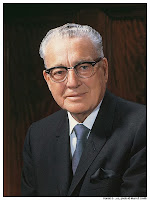
President Harold B. Lee
I also stumbled over a poem (source unknown) that President Harold B. Lee cited in his last First Presidency Message (Ensign, August 1974):

May You Have. . .

Enough happiness to keep you sweet,
Enough trials to keep you strong,
Enough sorrow to keep you human,
Enough failure to keep you humble,
Enough success to keep you eager,
Enough friends to give you comfort,
Enough wealth to meet your needs,
Enough enthusiasm to look forward,
Enough faith to banish depression,
Enough determination to make each day better than yesterday.

I believe we have "enough and to spare" when it comes to our hope in Christ's atonement. He did overcome the world - that means the effects of sin and death - all of which is only temporary based upon our miscalculations about their importance in mortality. I conclude with Jacob, the brother of Nephi:

Therefore, cheer up your hearts, and remember that ye are free to act for yourselves — to choose the way of everlasting death or the way of eternal life.
Wherefore, my beloved brethren, reconcile yourselves to the will of God, and not to the will of the devil and the flesh; and remember, after ye are reconciled unto God, that it is only in and through the grace of God that ye are saved.
Wherefore, may God raise you from death by the power of the resurrection, and also from everlasting death by the power of the atonement, that ye may be received into the eternal kingdom of God, that ye may praise him through grace divine. Amen. (2 Nephi 10:23-25, emphasis mine).


Sunday, August 14, 2011

Quiet the Mind, Accelerate the Spirit

Trial Lake, Uinta Mountains
This past week I was invited to go with my sons and grandsons on a camp out to the High Uintas near our mountain home. The campground at Trial Lake is a popular destination for city folks, and the elevation rises to 9800 feet surrounded by majestic mountain peaks. It puts one closer to heaven in every way.

My sons are all equipped with camping gear -- cool stuff to assure comfort and warmth outdoors. What used to be dreaded scouting experiences of my youth, are no longer. The food was great, the companionship was fantastic, and the scenery and the wind gently whistling through the trees overhead created an almost reverential mood late at night around the campfire. The full moon for two nights added to the magic. The mosquitoes were out in full force, but even repellent has improved to make their unwelcome presence bearable. Other distractions like an unhappy and quarrelsome family next door, barking dogs, and a crying baby nearby, eventually diminished.

We played their favorite game, "Would you rather. . ." It provided a lot of laughter. It began with one, "Would you rather drink a bucket of snot, or eat a bucket of scabs?" There are endless permutations and combinations spinning out of their fertile young minds -- try it sometime if you haven't heard of it. Trust me, it can take you on a wild ride from the frivolous to the imponderable.

Trial Lake, Uinta Mountains
Because of the nature of their work, their "other equipment" -- company-provided iphones -- were rendered useless. We were away. No Internet. No computers. And while they hiked and fished to their hearts' content, I had time to finish a good book I had been reading and to ponder and reflect. They took off the second day for a hike up to another little picturesque lake, not far away. It was great to see those fathers, once my little boys, returning to camp with their little boys whose legs are still too short, riding atop their fathers' shoulders. It's a joy to be a grandfather and to witness life replay itself.

To quiet the mind, to study and ponder the word of God, to be alone with your thoughts is an activity worth pursuing, but those rare moments must almost be manufactured, planned in advance, and savored to glean the full benefits.

I pondered about the High Priest lesson I was to give. I wondered how to approach a lesson on "Family Responsibilities," knowing how inadequate the vessel can seem when teaching the venerable brethren who have lived their lives to the fullest. How to teach them anything becomes a challenge. As I pondered and prayed about it in the open air in a quiet setting, white whispy smoke ascending from a dying fire one morning, I remembered Abraham and the covenant. I pondered Abraham 2:8-12, and considered how improbable his promised blessings were, and how unlikely it is that I have inherited the same promised blessings he did. Today I am still a son of God, a son of earthly parents, a grandson, a father, a husband, a brother, an uncle, a grandfather, and I feel in someways like I am holding hands in a circle of life spanning the pre-mortal world, mortality and the spirit world. Five more grandchildren are due in coming months.

I thought about the weaknesses I possess and how truly unworthy I am as a recipient of so much when I have done so little to merit such blessings.

I read Ether 12:27, and asked myself again where all my weaknesses came from. Did they come from the Lord? If he gave me all my weaknesses, why? I thought the goal was to grow in light and truth and to become like Him. Because Christ is perfect and my Father in Heaven is perfect, why would they give me anything but strength and powerful gifts to overcome?

I've heard a thousand false sermons taught about that scripture. People just say, like no one should ever challenge it, "The Lord gives us our weaknesses."

Well, it just isn't true. Moroni doesn't say the Lord gives us weaknesses. Instead, Ether 12:27 refers to our weakness. I pondered it anew that morning last week, alone with my thoughts in the mountains. I was renewed again in the realization that has become a comforting insight. The Lord defines words for us if we are attuned to His dictionary.

The Lord didn't give us weaknesses (the tendency to overeat, be impatient, angry, lazy, lustful, etc.). What we did receive from Him as a gift, however, is weakness. His meaning was not that we have character flaws, but that we will be in a mortal state where our physical bodies will tend to be weaker than our spirits in order for our spirits to be tested, tempted and tried in nearly all things this mortal laboratory can inflict upon us. (See Abraham 3:25). That weakness has more to do with the state of mortality than with individual character flaws afflicting all of us. As a spirit I didn't have mortal weakness. But when I was born into mortality I received a body in a fallen world — a state of weakness — because it was the only way we could become as He is.

The brother of Jared prayed: "Now behold, O Lord, and do not be angry with thy servant because of his weakness before thee; for we know that thou art holy and dwellest in the heavens, and that we are unworthy before thee; because of the fall our natures have become evil continually; nevertheless, O Lord, thou hast given us a commandment that we must call upon thee, that from thee we may receive according to our desires. (Ether 3:2).

The Apostle Paul, noting his "infirmities," spoke about his "thorn in the flesh." So troubled by it was he that he pled with the Lord three times to remove it. (See 2 Corinthians 12:5, 7-8). "And he said unto me, My grace is sufficient for thee: for my strength is made perfect in weakness. Most gladly therefore will I rather glory in my infirmities, that the power of Christ may rest upon me. Therefore I take pleasure in infirmities, in reproaches, in necessities, in persecutions, in distresses for Christ's sake: for when I am weak, then am I strong." (2 Corinthians 12:9-10).

As we study Paul's missionary journeys again this year in our gospel doctrine classes, I am reminded just how unworthy I am in the comparison with him. But when I quiet my mind, forswear the noise about me, my spirit accelerates with knowledge. Paul understood it was the conditions of the flesh constituting our weakness. He also knew what Moroni knew — the Lord desires to help us, not heap weaknesses upon us to increase our difficulties in this mortal probation.

It's the plan of a loving Father for us. That's what Moroni was talking about in Ether 12:27. Paul reached a point in his understanding we must all come to individually. He was actually grateful for the weakness of the flesh, for a merciful plan of mortality, for the expectation of exaltation.

Like Paul, my mind was quiet, my spirit accelerated as I connected with Christ, who helps make me stronger.