Monday, June 14, 2010

Baptism -- the eternal ordinance of salvation

This letter was written to a missionary son, Andrew, and answers his questions about the origins of the ordinance of baptism:

December 27, 2008


Dear Andrew:

You asked in your last e-mail about baptism. Specifically, you wanted to know if John the Baptist was the first account in the Bible to baptize, or was it done sooner. Did baptism have any part in the law of Moses? You suggest that 2 Nephi 31 is the first place in The Book of Mormon to talk about it. Then you asked if baptism has always been performed back to Adam. You say, correctly, that seems to make the most sense to you, but you just don’t ever remember reading about it in the Old Testament at all. Let me see if I can give you some perspective on the answers to these questions.

Your question sent me back to a compilation of the teachings of Harold B. Lee to a group of Seminary and Institute instructors on the campus of BYU in the summer of 1954. There is a long and interesting story associated with the “chain of custody” of his teachings that summer, but I’ll skip that interesting history and just say that I had the privilege back in 1981 of correcting and editing the compilation that had been done by Grandfather’s brother Perry.  My father subsequently published a limited number of copies for the members of our family. Elder Quentin L. Cook recently told my father the compilation is being used by President Packer to periodically instruct and prepare the four newest Apostles for their individual ministries under the direction of President Monson. All of that is interesting history, but takes too long to lay out here. Someday, ask me to show you As a Prophet Taught, which holds a treasured spot in my library at home.

In that compilation, Elder Lee tells an interesting story. Here is his account:

As Walter Dansie and I were at a stake conference, I referred to a conversation I had with an official of the Phillips Petroleum Board of Directors, who came to the BYU by invitation of President Wilkinson in the spring of 1953, to talk to the student body. He is of Cherokee Indian descent, and had read the Book of Mormon. He declared to the students that he believed the Book of Mormon was a true record of his ancestors. On the way back to Salt Lake, Elder Kimball and I, who had accompanied him to that assembly, engaged him in an interesting conversation (at least for us it was interesting).

We said to him, “If you accept the Book of Mormon, what will that make of Joseph Smith?”

He said, “I accept Joseph Smith as a prophet.”

“If he is a prophet, what about the other works he produced? And what about the Church that he established?”

He said, “I think they are divine.”

“Well, that doesn’t put us so far apart.” And, of course, we were backing him into a corner, a technique used by all good missionaries.

And then he said, “Well, I would accept it, but I can’t quite understand this matter of baptism of the dead,” as he spoke of it. “I can’t conceive of God requiring a proxy baptism for one who never had a chance to hear the gospel. I believe God could have saved him any way he chose to.”

And my reply was, “Yes, I think he could have done so. God could have said you can throw your hat over the cliff and be saved, but he didn’t say that. He said, that unless one was born of the water and of the spirit, he could not be saved.” It was that part of the conversation I was relating to Walter Dansie.

He said, “Brother Lee, is that true that God could have had any other plan if he wanted to? Could he have said, ‘Throw your hat over the cliff and be saved?’ That disturbs me.”

“No, I think my remark was not accurate,” I agreed. “This was a plan by which people on other worlds had been saved. It was a plan which had meaning and significance in every part. In my impulsive reply to this man of the world I am sure I said something that no student of the gospel should accept.”

Then Elder Lee goes on to drive home the doctrinal point in the proper context of his remarks:

The Lord had a plan, and this was the plan of salvation in the heavens, and planned before this world was, and had to do with other worlds. This was a plan by which all mankind might be saved. I have thought about that, and about the subject of this chapter, and the meaning of the word “salvation.” The dictionary defines salvation as, “deliverance from sin and its consequences through Christ as the exemplar.” That is a sort of the Christian Evolutionist idea – that we are saved by following the example of Jesus. That is their idea of salvation. Another definition by Mary Baker Eddy is found Science and Heath, the Christian Science Bible. She says, “Life, Truth, and Love, understood and demonstrated as supreme over all; sin, sickness, and death destroyed.”

That is the salvation of the Christian Scientist. But to the Latter-day Saint, salvation means liberation from bondage, and the results of sin by divine agency; deliverance from sin and eternal damnation through the atonement of Christ.

I think there is no other place where we have a finer discussion of the plan of the atonement than in the writings of Jacob, as found in The Book of Mormon, 2 Nephi, the 9th chapter [this was Harold B. Lee's favorite chapter of scripture]. I therefore call it to your attention, and urge you to read carefully again and again that precious explanation from this great father to members of his household:

But, behold, the righteous, the saints of the Holy One of Israel, they who have believed in the Holy One of Israel, they who have endured the crosses of the world, and despised the shame of it, they shall inherit the kingdom of God, which was prepared for them from the foundation of the world, and their joy shall be full forever.
O the greatness of the mercy of our God, the Holy One of Israel! For he delivereth his saints from that awful monster the devil, and death, and hell, and that lake of fire and brimstone, which is endless torment.
O how great the holiness of our God! For he knoweth all things, and there is not anything save he knows it.
And he cometh into the world that he may save all men if they will hearken unto his voice; for behold, he suffereth the pains of all men, yea, the pains of every living creature, both men, women, and children, who belong to the family of Adam.
And he suffereth this that the resurrection might pass upon all men, that all might stand before him at the great and judgment day.
And he commandeth all men that they must repent, and be baptized in his name, having perfect faith in the Holy One of Israel, or they cannot be saved in the kingdom of God.
And if they will not repent and believe in his name, and be baptized in his name, and endure to the end, they must be damned; for the Lord God, the Holy One of Israel, has spoken it.
Wherefore, he has given a law; and where there is no law given there is no punishment; and where there is no punishment there is no condemnation; and where there is no condemnation the mercies of the Holy One of Israel have claim upon them, because of the atonement; for they are delivered by the power of him.
For the atonement satisfieth the demands of his justice upon all those who have not the law given to them, that they are delivered from that awful monster, death and hell, and the devil, and the lake of fire and brimstone, which is endless torment; and they are restored to that God who gave them breath, which is the Holy One of Israel. (Verses 18-26).

Herein is defined what we have referred to throughout all our teachings as individual salvation, which comes to each dependent upon his own conduct and his own life.  But we have what we call “general salvation” – that which comes upon all mankind, whether or not they are good or bad, rich or poor, and the way they have lived makes no difference.  All have the blessings of the atonement and the resurrection given to them as a free gift because of the Savior’s atoning sacrifice.

He then cited several other scriptures in his teachings, including this scripture chain (and you may want to study these in depth – I’ll just cite them) relating to agency and the resurrection, etc., 2 Nephi 2:26-27; John 5:26-29; Revelation 20:12-13; Romans 5:18; 1 Corinthians 15:21-22; Mark 16:16; Hebrews 5:8-9; Mosiah 5:11-12; D&C 19:16-19.

Then he continues by posing this question to his audience:

How old is the gospel upon the earth?  In one of our earliest revelations that was given to the Church, the Lord spoke of the gospel as the “everlasting covenant.”  He said:

And even so I have sent mine everlasting covenant into the world, to be a light to the world, and to be a standard for my people, and for the Gentiles to seek to it, and to be a messenger before my face to prepare the way before me. (D&C 45:9).

And then this, from D&C 49:9-10:

Wherefore, I say unto you that I have sent unto you mine everlasting covenant, even that which was from the beginning.
And that which I have promised I have so fulfilled, and the nations of the earth shall bow to it; and, if not of themselves, they shall come down, for that which is now exalted of itself shall be laid low of power.

Why should it be called a covenant?  What is a covenant?  A covenant is a contract.

If an attorney were to explain it to us he would say that it was an instrument in writing drawn up between one or more contracting parties, one called the party of the first part, and one called the party of the second part.  They agree to certain mutual covenants or agreements, stipulated with that contract, and as an evidence of their good faith they sign their names in the presence of a legal officer known as a notary public.

If either one or the other of the parties of the contract were to default and fail to live up to his agreement, the other might bring him into court and sue him for breach of contract.  That is what a contract means.  Here, the gospel is referred to as a covenant or a contract.  It is called everlasting.  Why?  Because it didn’t begin with this world.  It had a wider application than the people who live here on this earth.  It was everlasting.  It is the plan that has been since all mankind, and has been dealt with as the creatures of our Father’s creations.  It was everlasting.  It is the plan that is called “new,” because it is new in this dispensation and everlasting because it is the same plan by which all mankind have been saved from the beginning of God’s creations.

The first reference we have made of this covenant is in the Book of Abraham [found in The Pearl of Great Price].  That scripture should become one which we should keep with us always, because here the Lord is speaking of the organized intelligences before the world was.  And he said:

Abraham, thou art one of them; thou wast chosen before thou wast born. (Abraham 3:23).

Some of these, he said, were the noble and illustrious ones of whom he would make his rulers. Now mark the terms of the contract. He said:

. . . We will go down. . . and we will. . . make an earth whereon these may dwell; And we will prove them herewith, to see if they will do all things whatsoever the Lord their God shall command them; And they who keep their first estate shall be added upon and they who keep not their first estate shall not have glory in the same kingdom with those who keep their first estate; and they who keep their second estate shall have glory added upon their heads for ever and ever. (Abraham 3:24-26).

Those are the terms of the contract.  We were among the contracting parties.  The fact that we are here in mortal flesh having added to our spirit a mortal body with added opportunities here in mortality, is an evidence that we kept our first estate, and therefore passed our first test, and the first part of that contract with the Lord.  He is the contracting party of the first part, and we are the party of the second part.  Now we are in the second estate.  We are now being tried to see if we will do all things whatsoever the Lord our God shall command us.  The commandments are the principles and ordinances of the gospel, as we speak of them, and they together constitute what we call the Gospel of Jesus Christ.  Every principle, every ordinance has a vital bearing upon the whole of the purpose of our testing.  It is for the keeping of the contract by which we will have glory added upon our heads forever and ever.

With respect to the timing of when the gospel was first introduced on this earth, Elder Lee continues his instructions with this observation:

Here the Lord says plainly:

The same which came in the meridian of time unto mine own, and mine own received me not;
But to as many as received me, gave I power to become my sons; and even so will I give unto as many as will receive me, power to become my sons.
And verily, verily, I say unto you, he that receiveth my gospel receiveth me; and he that receiveth not my gospel receiveth not me.
And this is my gospel – repentance and baptism by water, and then cometh the baptism of fire and the Holy Ghost, even the Comforter, which showeth all things, and teacheth the peaceable things of the kingdom. (D&C 39:3-6).

This should persuade all teachers of the Gospel to understand one essential fact.  There are those who believe that one cannot enter the celestial kingdom unless he has been to the temple, that the temple is the gateway to the celestial kingdom.  That isn’t what the Lord teaches.  The ordinance of baptism is the essential ordinance for those who have reached the age of accountability.  The ordinance of baptism is the gateway to the celestial kingdom.  That is the way by which we become sons and daughters of God.  However, in order to receive exaltation in the celestial kingdom there are certain higher ordinances, including the everlasting covenant of marriage which are also essential, as we have learned by our study of the 130th section of the Doctrine and Covenants.

We have found that to Adam, even in the beginning, the Gospel plan was given when he was driven out of the Garden of Eden, following the fall.  The Lord came to him and commanded him to offer as a sacrifice to the Lord, the firstlings of his flock.  You remember when an angel came and asked him why he was offering sacrifice.  He said he knew not, save the Lord had commanded him.  Then the angel taught him further and said: “This thing is a similitude of the sacrifice of the Only Begotten of the Father.”

With that first teaching came also the instruction: “Thou shalt do all that thou doest in the name of the Son.”  And the second teaching was, “Thou shalt repent,” and the third, “Thou shalt call upon God in the name of the Son forever more,” or in other words, to pray.  And in that day the Holy Ghost fell upon Adam, bearing record of the Father and the Son, and taught him the meaning of the atonement.

We find recorded in The Pearl of Great Price (Moses 6:64-68) that after he had received these teachings:

. . .that Adam cried unto the Lord, and he was caught away by the Spirit of the Lord, and was carried down into the water, and was brought forth out of the water.
And thus he was baptized, and the Spirit of God descended upon him, and thus he was born of the Spirit, and became quickened in the inner man.

Then we find following that, there came a voice saying to him:

. . .This is the record of the Father, and the Son, from henceforth and forever;
And thou art after the order of him who was without beginning of days or end of years, from all eternity to all eternity.
Behold, thou art one in me, a son of God; and thus may all become my sons.

You see, that statement agrees exactly with what we read in the 39th section of the Doctrine and Covenants.  These are the essential first principles and ordinances of the Gospel, and characterize the Gospel itself.

So be it that we may well conclude that where there is authority, as the Prophet Joseph said [see TPJS, 271], an authorized minister clothed with the authority to perform those essential ordinances, enumerating them as the Lord has in the scriptures, there is set up on the earth the Kingdom of God.

Now as to the Gospel through the various ages, as it has come down to us.  We herewith sketch it briefly.  Following the time of Adam was the commencement of the first of God’s Kingdom on this earth in which Adam had authority given him to perform the saving ordinances of the Gospel. Scriptures indicate to us that in the days of Abraham, he had received those essentials, and there was a dispensation of the Gospel committed to him.

The first chapter of the writings of John confirms what we have already said about those essentials of the Gospel.  In the writings of the Apostle Paul, he says this about the dispensation of Abraham:

And the scripture, foreseeing that God would justify the heathen through faith, preached before the gospel unto Abraham, saying, In thee shall all nations be blessed. (Galatians 3:8).

After making that statement, he asked the question, perhaps the very question that was being asked of him in his day: “Wherefore then serveth the law?” referring to the law of Moses, or in other words, “For what purpose is the law of Moses, if Christ is the fullness of the law?”  And then the Apostle Paul answered his own question by saying:

It was added [i.e., the law of Moses was added] because of the transgressions, till the seed should come to whom the promise was made. . . Wherefore the law was our schoolmaster to bring us unto Christ, that we might be justified by faith.
But after that faith is come, we are no longer under a schoolmaster. (Galatians 3:19, 24-25).

President Brigham H. Roberts, commenting about that, refers to the fact that the Prophet Joseph Smith had explained in plainness about the priesthood in the days of Moses.  This was the Prophet’s statement, in answer to the question, “Was the priesthood of Melchizedek taken away when Moses was translated?”

All Priesthood is Melchizedek, but there are different portions or degrees of it.  That portion which brought Moses to speak with God face to face was taken away; but that which brought the ministry of angels remained.  All the prophets had the Melchizedek Priesthood, and were ordained by God himself. (TPJS, 180).

Even during the law of Moses the Aaronic Priesthood was held among men.  It is found in the Teachings of the Prophet Joseph Smith, as just cited.

The Lord by revelation has made even a plainer statement than that one in section 84 of the Doctrine and Covenants. I call attention to a most important scripture in the 84th section of the Doctrine and Covenants, beginning at verse 6, and leading on through to the end of verse 17:

And the sons of Moses, according to the Holy Priesthood which he received under the hand of his father-in-law, Jethro;
And Jethro received it under the hand of Caleb;
And Caleb received it under the hand of Elihu;
And Elihu under the hand of Jeremy;
And Jeremy under the hand of Gad;
And Gad under the hand of Esaias;
And Esaias received it under the hand of God.
Esaias also lived in the days of Abraham, and was blessed of him—
Which Abraham received the priesthood from Melchizedek, who received it through the lineage of his fathers, even till Noah;
And from Noah till Enoch, through the lineage of their fathers;
And from Enoch to Abel, who was slain by the conspiracy of his brother, who received the priesthood by the commandments of God, by the hand of his father Adam, who was the first man —
Which priesthood continueth in the church of God in all generations, and is without beginning of days or end of years.

The priesthood is traced from Adam right down to the time of Moses, and in the time of Moses, the Aaronic Priesthood was held by those who administered in the ordinances of the Mosaic law.  At the same time, keep in mind what the Prophet Joseph said, that the Melchizedek Priesthood also was held by the prophets – not just the Aaronic.  “All the prophets,” he said, “had the Melchizedek Preisthood, and were ordained by God himself.”

With the priesthood having continued from the beginning, may we now sketch briefly the type of organizations the kingdom has had from the beginning.  In the time of Adam he was told he should have dominion over every living thing that moveth upon the earth.  The government at his time was patriarchal, and the priesthood ruled.  Men holding the priesthood ruled by direct revelation and by commandments.  In Enoch’s time, likewise, his government was patriarchal. Zion, the City of Holiness, was established, and Enoch gave a perfect economic law known to us as the Order of Enoch.  There was likewise a similar type of government from Noah to Abraham, and we are informed by modern revelation of these words contained in the Doctrine and Covenants, 107th section, verse 40:

The order of this priesthood was confirmed to be handed down from father to son, and rightly belongs to the literal descendants of the chosen seed, to whom the promises were made.

From Moses to the Prophet Samuel, Israel was governed by judges who were chosen from among the people.  And then because they thought they were “peculiar” in having that type of government, they clamored for a king, despite the counsel of the prophet.  But they wanted a king, and so the Lord gave them a king to rule over the secular matters, while a prophet still continued to guide them in spiritual affairs.  Saul was first chosen, followed by David, and then Solomon.  Then the division of the children of Israel occurred under Rehoboam and Jeroboam.

With the advent of the Savior, the Jews, you will recall, were in a state of apostasy.  He chose twelve men to be his special witnesses, and to one of these, Peter, he said: “And I will give unto thee the keys of the kingdom of heaven. . .” (Matthew 16:19).  Mark those words.  They are significant in view of the definition that the Prophet has given us.  The significance of that commission of the keys of the kingdom to Peter is better understood in a revelation given unto us by the Prophet Joseph Smith, when the Lord said this, speaking of Joseph:

Unto whom I have given the keys of the kingdom, which belong always unto the Presidency of the High Priesthood. (D&C 81:2).

So Peter, holding the keys of the kingdom, was as much the president of the High Priesthood in his day as President David O. McKay is the president of the High Priesthood in our day [it was 1954].  You see, that also is essential – one must be commissioned to hold the keys to the kingdom of God.  There is never but one on the earth at a time who holds these keys – that man being the one who is the head of the earthly organization upon the earth. (Refer to D&C 132:7).

With those facts in mind, let us turn to discuss the various dispensations.  We have spent a great deal of time, and some of our writers have labored hard, in trying to determine the number of dispensations there have been.  There are the dispensations of Adam, of Abraham, Moses, and Enoch, the dispensation of the meridian of time, the special dispensations of the Nephites, and the dispensation of the fullness of times.
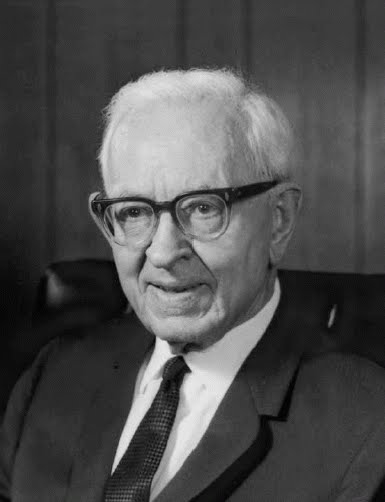
After I had finished speaking on this subject at a General Conference, I walked with one of my senior brethren of the Twelve [it was Joseph Fielding Smith].  We were talking about some things that I had discussed in the preceding session, and he made this comment:

"I believe that God has never for one moment of the earth’s existence abandoned the earth to Satan.  There has always been one or more holding the Holy Priesthood to hold Satan in check."

That comment started me on a whole new line of thinking.  There has never been a moment of time since the earth’s organization when there has not been someone holding the priesthood on the earth.  I have for you some remarks by President J. Reuben Clark on this same subject, taken from an address delivered at the October General Conference in 1953, in which he said:

Adam and Eve were thrust out of the Garden of Eden; they became mortal, subject to temporal death; but the Lord then said, and did as he said, that he would give to Adam the gospel plan by which the spirits that were to come here could live and gain the reward which he had promised.  That gospel plan he gave, and when he gave it he said it would never be taken away until the end of the world.

Here is the statement I want you to get, and it is in agreement with what I have just given you:

It is my faith that the gospel plan has always been here, that his priesthood has always been here on the earth, and that it will continue to be so until the end comes.  While through the apostasy since the time of Christ, the priesthood was lost to the people generally and to the Christian church, yet there have always been on the earth from the beginning, servants of the Lord who have held the priesthood.

If you will refer to the 84th section of the Doctrine and Covenants, you will see the significance of that statement in tracing the lineage of the priesthood from Adam right down through Moses.  And then recall that we have had those who were translated in the City of Enoch, the Three Nephites who are here upon the earth, and we have had John, who was translated, but is still upon the earth.  You can see the significance of what I have quoted, that God has never for one moment abandoned the earth to Satan without having someone holding the priesthood to keep him in check.

Well, that’s plenty for you digest, and I hope it fleshes out a useful outline for you in answer to your questions.  To summarize: There is always a priesthood organization of some kind on the earth that authorizes baptism as the key essential saving ordinance of salvation.  Within that organization, whatever form it takes, there is only ONE MAN at a time on the earth who controls the whole organization through the use of all the authorized priesthood keys.  The ordinances of the gospel have never changed since Adam, and in fact the “gospel” predates the organization of this earth because it is the same plan by which God became God in the same way that we hope to become God someday in our future existence.

And you thought you were asking a simple question about baptism.  Note that once again (and always) the answers to the questions are always based in the revelatory process of the Restoration.  It is very hard to make this case from the Bible alone – all the answers are nested in the context of Joseph’s latter-day scriptures.  If someone cannot accept Joseph as the Prophet, the answers I have given you here will never satisfy them.  However, if this all makes logical sense to someone when you lay it all out for them, it is likely they will be more inclined to attribute its origins to God through a prophet raised up in the latter days to restore that knowledge which has been lost to the rest of the world.

I love you, and hope you enjoy your pursuit of this topic, as with all others in your expanding gospel scholarship.

Dad

Saturday, June 12, 2010

John Wooden, a coaching legend

I recently heard a wonderful tribute to the life of John Wooden, UCLA's legendary basketball coach.  The speaker's admiration for the coach was visible and emotional, having been one of millions over the years who has had the privilege of hearing him speak in person.

John Wooden was affectionately called "The Wizard of Westwood."  He built one of the greatest dynasties in all of sports at UCLA and became one of the most revered coaches who ever lived.  He died recently at age 99.

I have sons who became great basketball players, but none of them even knows Coach Wooden's legacy the way those of us who are older remember it.  Wooden led the UCLA Bruins to 10 NCAA championships.  Seven of those national championships were reeled off in consecutive years from 1967 to 1973.  That's just an amazing feat by anybody's calculations, and will likely never be duplicated.

Over a period of 27 years he won 620 games, including 88 straight during one historic stretch.  He coached many of the game's greatest players such as Bill Walton and Lew Alcindor — later known as Kareem Abdul-Jabbar.

The tributes to the coach have been heaped upon him not only in life, but in the aftermath of his death -- all well-deserved.  As a coach, he was a groundbreaking trendsetter who demanded his players be in great condition so they could play an up-tempo style of basketball.  His withering full-court defenses smothered opponents and broke their will to win again and again.  He revolutionized the approach to the team game.

But his impact only began with his coaching.  He was the master of the simple one- or two-sentence homily, instructive little messages best presented in his famous "Pyramid of Success," which remains must-read material, not only for fellow coaches but for anyone in a leadership position in American business.  (Click on the image to enlarge).

He taught the team game and had only three hard-and-fast rules — no profanity, tardiness or criticizing fellow teammates. Layered beneath that seeming simplicity, though, were a slew of life lessons — primers on everything from how to put on your socks correctly to how to maintain poise: "Not being thrown off stride in how you behave or what you believe because of outside events."

In today's NBA game is a long-lost Woodenism:  "It takes ten hands to make a basket."  He despised one-on-one showboating.

Asked in a 2008 interview the secret to his long life, Wooden replied: "Not being afraid of death and having peace within yourself.  All of life is peaks and valleys. Don't let the peaks get too high and the valleys too low."

Asked what he would like God to say when he arrived at the pearly gates, Wooden replied, "Well done."

Even with his amazing achievements, he remained humble and gracious. He said he tried to live by advice from his father: "Be true to yourself, help others, make each day your masterpiece, make friendship a fine art, drink deeply from good books — especially the Bible, build a shelter against a rainy day, give thanks for your blessings and pray for guidance every day."

While he lived his father's words, many more lived his. Those lucky enough to play for him got it first hand, but there was no shortage of Wooden sayings making the rounds far away from the basketball court.

"Learn as if you were to live forever; live as if you were to die tomorrow," was one.

"Don't give up on your dreams, or your dreams will give up on you," was another.

And those are just a few for starters.  Here's the Christian Science Monitor's top 10 Wooden quotes:

10. Failure is not fatal but failure to change might be.

9. Ability is a poor man’s wealth.

8. It’s the little details that are vital. Little things make big things happen.

7. Don’t measure yourself by what you have accomplished, but by what you should have accomplished with your ability.

6. What you are as a person is far more important that what you are as a basketball player.

5. You can’t live a perfect day without doing something for someone who will never be able to repay you.

4. Talent is God given. Be humble. Fame is man-given. Be grateful. Conceit is self-given. Be careful.

3. Be more concerned with your character than your reputation, because your character is what you really are, while your reputation is merely what others think you are.

2. Don’t let what you cannot do interfere with what you can do.

1. Never mistake activity for achievement.

Born Oct. 14, 1910, near Martinsville, Indiana, on a farm that didn't have electricity or indoor plumbing, Wooden's life revolved around sports from the time his father built his own "field of dreams" -- a baseball diamond among his wheat, corn and alfalfa.  Baseball was his favorite sport, but there was also a basketball hoop nailed in a hayloft. Wooden played there countless hours with his brother, Maurice, using any kind of ball they could find.

Wooden could easily have written the script for the famous movie "Hoosiers."  He led Martinsville High School to the Indiana state basketball championship in 1927 before heading to Purdue, where he was an All-American from 1930-32.  The Boilermakers were national champions his senior season, and Wooden, nicknamed "the Indiana Rubber Man" for his dives on the hardcourt, was college basketball's player of the year.

But it wasn't until he headed west to Southern California that Wooden really made his mark on the game. Wooden's Bruins were 330-19, including four 30-0 seasons.  Will that feat ever again be matched in college basketball?  No one I know ever thinks it will.

Wooden was honest.  Awaiting a call from the University of Minnesota for its head coaching job which he really wanted, then thought he had been passed over when it didn't come, he accepted an offer from UCLA in Los Angeles.

Minnesota officials called later that night, saying they couldn't get through earlier because of a snowstorm, and offered him the job.  Though Wooden wanted it more than the UCLA job, he told them he already had given UCLA his word and could not break it.

Still, it would be 16 seasons before Wooden won his first NCAA championship with a team featuring Walt Hazzard that went 30-0 in 1964.  After that, the awesome players began arriving in bunches, and top players such as Alcindor, Walton, Sidney Wicks and Lucius Allen played year after year for him in Westwood.

Each would learn at the first practice how to properly put on socks and sneakers.  Each would learn to keep his hair short and face clean-shaven, even though the fashions of the 1960s and '70s dictated otherwise.

And each would learn Wooden's "pyramid of success," a chart he used to both inspire players and sum up his personal code for life.  Industriousness and enthusiasm were its cornerstones; faith, patience, loyalty and self-control were some of the building blocks.  At the top of the pyramid was competitive greatness.

Wooden never had to worry about his reputation.  He didn't drink or swear or carouse with other coaches on the road, though he did have a penchant for berating referees.  Because he taught his players to never swear and wanted to set the proper example for them, his outbursts usually sounded like this:

"Dadburn it, you saw him double-dribble down there!  Goodness gracious sakes alive!"

I love Jerry Sloan, the legendary coach of the Utah Jazz, but if you've ever sat close enough to the bench to hear one of his outbursts, well, suffice it to say he could take a page from Coach Wooden on vocabulary.  When Wooden was asked a few years ago who his favorite basketball player was -- the player he would consistently pay to see play -- his reply was simply, "John Stockton."  The man was always a good judge of talent and character.

Wooden would coach 27 years at UCLA, finishing with a record of 620-147.  He won 47 NCAA tournament games.  His overall mark as a college coach was 885-203, an .813 winning percentage that remains unequaled.

After the loss to Notre Dame that ended his 88-game streak , Wooden refused to allow his players to talk to reporters.

"Only winners talk," he said.  A week later, UCLA beat the Irish at home by 19 points.

A little more than a year later, Wooden surprisingly announced his retirement after a 75-74 NCAA semifinal victory over Louisville. He then went out and coached the Bruins for the last time, winning his 10th national title with a 92-85 win over Kentucky.

After that victory, Wooden walked into the interview room at the San Diego Sports Arena to face about 200 reporters, who let their objectivity as sports writers slip.  To the man, they all stood and applauded.

Long before that, though, the road to coaching greatness began after Wooden graduated with honors from Purdue and married Nell Riley, his high school sweetheart.

In a 2008 public appearance with Los Angeles Dodgers announcer Vin Scully, in which the men were interviewed in front of an audience, Wooden said he still wrote his late wife — the only girl he ever dated — a letter on the 21st of each month.  "She's still there to me," he said.  "I talk to her every day."

He coached two years at Dayton (Kentucky) High School, and his 6-11 losing record the first season was the only one in his 40-year coaching career.

He spent the next nine years coaching basketball, baseball and tennis at South Bend (Indiana) Central High School, where he also taught English.

"I think the teaching profession contributes more to the future of our society than any other single profession," he once said.  "I'm glad I was a teacher."

Wooden served in the Navy as a physical education instructor during World War II, and continued teaching when he became the basketball coach at Indiana State Teachers College, where he went 47-17 in two seasons.

In his first year at Indiana State, Wooden's team won the Indiana Collegiate Conference title and received an invitation to the NAIB tournament in Kansas City.  Wooden, who had a black player on his team, refused the invitation because the NAIB had a policy banning African Americans. The rule was changed the next year, and Wooden led Indiana State to another conference title.

It was then that UCLA called, though Wooden didn't take the job to get rich.  He never made more than $35,000 in a season, and early in his career he worked two jobs to make ends meet.

"My first four years at UCLA, I worked in the mornings at a dairy from six to noon then I'd come into UCLA," he told The Associated Press in 1995.  "Why did I do it?  Because I needed the money.  I was a dispatcher of trucks in the San Fernando Valley and was a troubleshooter.  After all the trucks made their deliveries and came back, I would call in the next day's orders, sweep out the place and head over the hill to UCLA."

After he enjoyed great success at UCLA, the Los Angeles Lakers reportedly offered Wooden their head coaching job at a salary 10 times what he was making, but he refused.

Nell, Wooden's wife of 53 years, died in 1985. He is survived by son, James, and daughter, Nancy Muehlhausen; several grandchildren and great-grandchildren.

His was a life worth celebrating here on this page.  It is a life worth emulating everywhere.

Months ago I wrote about Ted Kennedy's death, suggesting that as debauched and fallen as he was he could still hope for a better life in the spirit world and a subsequent glorious resurrection.  I have a feeling John Wooden, believing as he did in eternal marriage, will embrace all the ordinances of salvation offered to him without reservation.  Everyone, whether they have ever heard about Mormons and the teachings of the Church, fundamentally believes in eternal love and marriage -- that love does not die in the grave, but continues, as Coach Wooden expressed it.

He will view those ordinances as being of even greater worth than 10 national championships.

TARP repayments now exceed principal expended


WASHINGTON —  It's no secret to the readers of this page that I was adamantly opposed to the whole idea of a $700 Billion TARP bailout in the first place.  The very underpinnings of the Constitution suggest freedom of choice, and that includes the freedom to fail without intervention by the government. 

Despite the obvious contradiction, the biggest banks in America were offered a lifeline, deemed "too big to fail."  So the demise of the financial house of cards we have constructed in America was staved off yet again for a future day of reckoning.  Many still contend the hastily constructed bill was patently unconsitutional on its face for those reasons alone, and I remain one of those people.

But in the spirit of fairness to the reader, I have to admit I was pleasantly surprised to get an update this week on exactly what happened under the program (yes, these things are actually reported by the U.S. Treasury Department, and they are public documents anyone can find online).

Treasury said Friday the total amount repaid to taxpayers for government funds used to bail out U.S. companies has surpassed, for the first time, the amount of outstanding debt.

The Treasury, in its May report to Congress on the Troubled Asset Relief Program, reported TARP repayments reached $194 billion, which has exceeded by $4 billion the total amount of outstanding debt — $190 billion.  Forget the fact the money was never used for its once-intended and stated purpose to buy up the toxic paper.  The banks used the money any way they desired with very little restraint.

Truth be told, the hammering on financial institutions by the very government that promoted and mandated that sub-prime mortgage lenders extend risky loans to unqualified buyers in the first place may have prompted the accelerated repayments.  Many would argue it was a government-created sub-prime mortgage bubble.  Recipients of TARP proceeds couldn't wait to get the money repaid just to get the threat of government intervention out of their boardrooms.

Those are facts, but there is always "more to the story."

The outstanding debt amount does not include $106.36 billion that has been committed to institutions but has yet to be paid out by the Treasury.  Factoring in that amount, the outstanding debt would be roughly $296 billion.  That's still way short of the original amount of $700 billion, so what happened to the balance?

According to the report, $489.88 billion has been committed to specific institutions, and $383.52 billion of that has been paid out by Treasury. The department said it does not expect to use more than $550 billion of the $700 billion program.

A Treasury official described the manner in which the department characterized the totals as "a cash flow issue."

"Going forward, there will continue to be repayments and expenditures on both sides of the ledger," Treasury officials explained, making it clear "the other money has not ultimately been dispersed yet."

With that said, the Treasury's report indicates the department has already signed contracts with institutions regarding the already and to-be distributed funds.

Still, the Treasury's assistant secretary for financial stability, Herb Allison, in a statement described the totals as a "milestone" and said this is "further evidence that TARP is achieving its intended objectives: stabilizing our financial system and laying the groundwork for economic recovery."

The preliminary benchmark was reached in May when the Treasury completed its sale of 1.5 billion shares of Citigroup Inc., "a transaction that provided gross proceeds of $6.18 billion to taxpayers," the Treasury said.

TARP investments posted an additional $23 billion return, bringing total revenue to $217 billion through the end of May, according to the Treasury.

Don't breathe that big sigh of relief too quickly, however.  Despite the government's positive investments made through the TARP program for banks, taxpayers could still face a loss on the program.

The Obama administration estimated last August that the total cost of TARP would be $341 billion. The Treasury, in May, told Congress that the lifetime cost of the program had decreased to $105.4 billion.

Looking ahead, the Treasury said additional expenditures from the TARP program are likely to focus on housing initiatives, and other programs that are tailored to help smaller banks and the securitization markets.

The department still anticipates repayments to continue to exceed the outstanding debt.

All I can say is that TARP touched my life a year ago, when my bank announced I was being considered for a mortgage modification if I could make three months of reduced trial payments.  That was ten months ago, and while I have been notified in writing I have been approved under the program there has been no evidence of the requisite modification paperwork.

And this is the very government gradually taking over every waking function in our lives through unprecedented and unsustainable amounts of debt financing, now in excess of $13 Trillion, and deficit spending for as far as the eye can see?  God help us all.

Only the American voters can reverse this trend by electing people who are sworn to reduce the size and the scope of the federal government.  There is absolutely no excuse for not voting this year, when the Afghan and Iraqi people can risk death to vote when they show up at the polls. 

If we can't see the assault on our freedoms when it is so obvious, we don't deserve deliverance from our enemies much less from ourselves.

Saturday, June 5, 2010

Elder Richard J. Maynes

I discovered my notes today of a special presentation by Elder Richard J. Maynes of the 1st Quorum of the Seventy to our singles branch in the Kamas Stake on July 11, 2005.  His wise counsel is worth repeating here:

Yesterday the young adults in our stake had a rare privilege to sit at the feet of our own local General Authority, Elder Richard J. Maynes, a member of the 1st Quorum of the Seventy, whose home is Oakley, Utah. He has been abroad on Church assignments in South America and now the Philippines since his call to the Second Quorum of the Seventy back in 1989. Melanie and I were there.

His brother, Steve, is our newly-called Stake Sunday School President. I was with Steve, Tom Brown and Steve Edmunds early yesterday morning (I left high council meeting early to be with them in their presidency meeting as their advisor). He said Rick has decided his calling as a Seventy is all about being a teacher. Steve explained Rick has missed virtually every major event in the lives of his children (including his son Rick’s graduation from Harvard Law School this spring) because of his Church assignments. He and his wife have sacrificed everything for the kingdom.

This month he is home, enjoying what has only recently been inaugurated as “family leave time” for those Brethren with foreign assignments requiring them to live abroad. He said the new policy was implemented with the help of Elders Holland and Oaks, once they became acquainted with the family deprivations attaching to living for extended periods of time in third-world countries. Rick has succeeded Elder Oaks as the Area President in the Philippines.

President Stewart Grow, who was recently called as the new singles branch president in the stake, asked his good friend, Elder Maynes, to come for a combined priesthood and Relief Society two-hour block and to give them instruction. I have attempted to reconstruct his presentation for all of you, since it was such inspired counsel for all of us.

Chile and the Philippines

He began with some preliminary remarks about Chile and the Philippines. The one thing both countries have in common is a very high baptism rate (around 250 per month per mission, he said), but a very low retention rate (around 20 percent before the Apostles were deployed). He said they are now up to 82 percent retention in the Philippines after three years of concerted application of the principles he said he would share with the young people of our stake.

Tiger Woods

First, he quoted Tiger Woods from an ad that appeared in a travel magazine he had picked up on an airplane recently: “There comes a time when execution is more important than theory.”

Brigham Young

Next, he read a statement and asked if we could identify its source. Which prophet, he queried, said the following? “The work of building up Zion is in every sense a practical work; it is not a mere theory. A theoretical religion amounts to very little real good or advantage to any person. To possess an inheritance in Zion or in Jerusalem only in theory — only in imagination — would be the same as having no inheritance at all. It is necessary to get a deed of it, to make an inheritance, practical, substantial and profitable. Then let us not rest contented with a mere theoretical religion, but let it be practical, self-purifying, and self-sustaining, keeping the love of God within us, walking by every precept, by every law, and by every word that is given to lead us to truth, to God, and to life eternal.”

He suggested it could have come from either Brigham Young or Gordon B. Hinckley, then confirmed it was Brigham Young who said it (JD 9:284). I looked it up today on the Internet – one or two words, and you can find it!

Then he made this accurate statement that I’ve thought a lot about in recent years: “Children ALWAYS follow the traditions of their family to some degree, whether those traditions are true or false.” Abusers tend to come from homes where abuse in all its forms was the norm, and conversely faithful families tend to beget faithful families.

He then stated, “There is a big difference between activity in the Church (which is easy to measure), and faithfulness (which is difficult to measure).” What we appear to be on the outside is very often different than what is on the inside. Outward appearance does not always reflect inward levels of commitment. Too often we merely give assent to true doctrine, thinking it’s a good idea, but too often failing to implement what we merely believe into definable actionable events in our lives. The closest we come to measuring faithfulness is the temple recommend interview, but even then people too often lie.

The "Little Things"

Then he suggested three small things young people who are standing on the threshold of marriage and parenting might want to consider as they establish their own traditions. These are Family Home Evening, family and personal scripture study, and family and personal prayer. He said these are "little things" that are so seemingly insignificant as to be easily dismissed because they either happen or don’t happen on a very quiet and personal level.

Said he, “However, these are the only things that confound Satan and his hosts.”

Spencer W. Kimball

He said these revolve around simple choices – we either DO IT (President Kimball’s motto), or we don’t. If we choose to hold Family Home Evening we establish a habit that establishes EITHER a celestial tradition or a false tradition, and that choice establishes a culture. This is true, he said, of families, of wards, of stakes and of nations. He arrayed these on the board as follows:

CHOICES lead to habits; HABITS lead to traditions; TRADITIONS lead to CULTURE.

Only Two Traditions -- Celestial and False

There are only two kinds of traditions, he asserted – celestial and false. Families are caught in the middle. We are choosing in our families each day to either embrace the celestial traditions or the world’s traditions. Influences from the World Culture and from the Gospel Culture blend and combine to create the Family Culture, he explained.

Celestial influences come from Gospel Culture. Negative worldly influences and false traditions come from World Culture, found most profoundly through TV – the World Culture’s greatest teacher in our homes. Through its expansive lens our children learn about adultery, dishonesty, murder, violence, pornography, unbridled desire for more and more materialism, and so forth. He allowed there are some worthwhile world culture attributes, such as patriotism and education, but not many.

Our Family Culture will always become the embodiment of good and evil influences, because we live in the telestial world. Only the “little things” – the seemingly insignificant things – like FHE, scripture study and prayer – can confound Satan’s influences.

He encouraged those who had come from a home where they had not experienced celestial traditions to establish those traditions for themselves in their own homes as parents. He suggested we list all the false traditions of the world we can identify within our family, then focus on them, take them on one by one, and kill them.

Replace all those false traditions with changed behavior based upon true repentance.

Establishing Zion in our Day

He said establishing the Church back in Joseph’s day was an important step, but even more important in our day is establishing Zion.

He admitted that changing culture, however, is tough work. If we don’t believe in change, we don’t believe in repentance. He defined repentance as changing one’s behavior, or heart or patterns. He said those who love the Savior, truly love him, will humble themselves through meekness and lowliness of heart and embrace the chance to change.

Only the poor and the meek, he reminded us, will inherit the earth when it is celestialized. Only people who repent and actually change their behavior through the power of the atonement of Jesus Christ will inherit the celestial kingdom. Proud people will NEVER become celestial beings. Proud people do not believe they need to change. Proud people are always demanding others to change instead of them, because they always believe they are right and everyone around them is wrong.

He said the wards are where Zion can most easily be established among us. Weak wards produce weak stakes. If you want to strengthen the stake, strengthen the wards, he admonished. The wards are where the action is. And all of it begins with each individual family’s choices.

When we choose not to hold FHE, we are establishing a pattern that can prove to be destructive when little children go to Primary and hear that FHE is a good idea, then return to a home where the tradition has been established not to have FHE.

Preparing the world for the Second Coming means establishing Zion – in our hearts, homes, wards and stakes by doing the little things that do not seem to be that important. Your faith and what you do to ACT upon your faith will be the only determining factor about whether you are prepared or not. It’s all about choices.

There is no such thing as “free agency” in the scriptures, he said – only “agency” or “moral agency.”

Most Important Choices in Life Happen Early

Imagine you are now in your eighties, old and gray-haired. A reporter from the Church News comes to your home to interview you. He asks you one question: “Tell me the four greatest decisions you have ever made (or wished you had made) in your life.” What would they be?

Would they be essentially the same for all of us? Probably. They would likely be 1) the decision to either join or to remain in the Church; 2) the decision to serve a mission for the Church; 3) the choice of whom you will marry; and 4) the decision to stay and be faithful in the Church. Wouldn’t everyone respond essentially the same way?

He said since he was addressing young people he wanted to point out, ironically, those decisions, those very basic and most influential decisions in our lives, are all made between the ages of 18 – 30, at a relatively young age. All of those decisions, those simple basic choices, essentially determine whether or not we will inherit Zion and celestial glory.

How we ACT upon those choices determines our eternal destiny.

As we choose, let us always remember that only the faithful saints can discern correctly (D&C 45:57) by the power of the Holy Ghost.

Doing Is More Important Than Talking

There’s a big difference between talking and doing.

The Lord said it this way: “For if you will that I give unto you a place in the celestial world, you must prepare yourselves BY DOING the things which I have commanded you and required of you.” (D&C 78:7). The atonement, powerful as it is, only has power in the lives of those who actually change their behavior by repenting.

There is always room in the strait and narrow path of discipleship for mistakes, and there is also room to change.

Spirit of the Holy Ghost

The Spirit of the Holy Ghost always tells us when we are forgiven. Interestingly, he said, we don’t hear as many talks from the pulpit about this third member of the Godhead as we do the Father and the Son, because we tend to relate better to a Father figure and an Elder Brother figure, than we do some seemingly abstract spirit being like the Holy Ghost.

How would you describe the Holy Ghost? These were revolutionary concepts in the day of Joseph Smith – that our Godhead was really three separate and distinct individuals, two with tangible, glorified bodies of flesh and bone, and the third a spirit (see D&C 130:22). But we always pray, it seems, in the Church that we may have the Spirit to be with us.

We don’t have to be perfect to have the Spirit of the Holy Ghost as our constant companion, but we must be worthy. Being worthy, he explained, means being on the path that leads toward eternal life. It means trying to do the best we can, even though we make mistakes while we’re in the path.

In the final judgment, Christ bridges the gap between our worthiness and perfection. Sanctification is a lifelong process, not an event that happens only once in our lives.

Scriptures Teach Truth of These Principles

Then he said, “Let’s go to the scriptures and see if what we’ve been talking about is scriptural.” Choosing means we are embracing the principle of responsibility for our own actions, and not blaming others for our sins or their sins and imperfections (which are always so much easier for us to see than our own).

He then quoted several verses from D&C 88, explaining it is one of his favorite revelations. He began with verse 15: “And the spirit and the body are the soul of man.” He stopped right there and observed the rest of the world has no idea about the full meaning of those few words. How blessed are we as a people to know what that means!

He said as we look around at each other we are dealing with living, breathing souls of our Father in Heaven, and we are all brothers and sisters in the literal sense of that meaning. “And the resurrection from the dead is the redemption of the soul.” (Verse 16). “And the redemption of the soul is THROUGH HIM that quickeneth all things, in whose bosom it is decreed that the poor and the meek of the earth shall inherit it.” (Verse 17).

These are powerful ideas, he said, and explained the root word for “quickeneth” in Spanish is the verb meaning “to give life.” He explained, “Therefore, it [the earth] must needs be sanctified from all unrighteousness, that it [the earth] may be prepared for the celestial glory;” (Verse 18).

If we are true and faithful, he taught, the earth will become our Celestial Kingdom, which we inherit through our repentance. He emphasized only those who actually repent and change their behavior, not those who just think it’s a good idea to repent, will inherit the earth. “For after it [the earth] hath filled the measure of its creation, it [the earth] shall be crowned with glory, even with the presence of God the Father; That bodies who are of the celestial kingdom may possess it forever and ever; for, for this intent was it made and created, and for this intent are they [those who repent] sanctified.” (Verses 19-20).

It was a powerful reminder of what we are seeking and how we must embrace repentance to inherit the highest degree of the celestial kingdom.

Then he turned to some sobering reminders about how essential repentance really is. It’s not just optional to repent – it’s a commandment. “Therefore I COMMAND YOU TO REPENT – repent lest I smite you by the rod of my mouth, and by my wrath, and by my anger, and your sufferings be sore – how sore you know not, how exquisite you know not, yea, how hard to bear you know not.” (D&C 19:15).

He explained only one person in the whole universe comprising all our Heavenly Father’s creations could say those words, and that one person is the Savior.  He is the only one who knows what he’s talking about when it comes to suffering because he experienced it in Gethsemane and at Golgotha.

He continued reading verse 16: “For behold, I, God, have suffered these things for all, that they might not suffer if they would repent; But if they would not repent they must suffer even as I; Which suffering caused myself, even God, the greatest of all, to tremble because of pain, and to bleed at every pore, and to suffer both body and spirit — and would that I might not drink the bitter cup, and shrink — Nevertheless, glory be to the Father, and I partook and finished my preparations unto the children of men. Wherefore, I command you again to repent, lest I humble you with my almighty power; and that you confess your sins, lest you suffer these punishments of which I have spoken, of which in the smallest, yea, even in the least degree you have tasted at the time I withdrew my Spirit. And I command you that you preach naught but repentance . . .” (Verses 16-21).

The plan of salvation, or happiness, or life, or joy, or mercy, or redemption (all synonyms) as described by Alma (see Alma 42), describes the need for repentance. Whatever degree of happiness we choose in this life, we inherit in the resurrection.  The degree to which we repent determines the degree of glory we inherit.

Our body is a temple and the place we learn about the celestial ordinances that help us create a celestial body to inherit in the celestial kingdom is the temple. There are no other ordinances in the temple but celestial ordinances.

He concluded with his testimony.  "None of this is new," he reminded us. God has always communicated these truths beginning with Adam through living prophets. There have been many periods of apostasy from the beginning, but God never gives up on his children.

That’s why he called upon Joseph Smith in our dispensation to deliver these truths once again to his children. He bore witness the priesthood keys making all these things possible have been transmitted from God to man through a succession of living prophets down to today’s living prophet, Gordon B. Hinckley.

Tuesday, June 1, 2010

Saviors on Mount Zion

I was searching for something else tonight and stumbled over a journal entry dated May 1, 2006:

Last Saturday morning, I went to the temple to accompany our ward youth group to do baptisms for the dead. I went at Merilee’s urging – she said she wanted me to baptize her.

It was a much needed morning of proxy service I enjoyed very much. Temple Square's flower beds bursting in color were resplendent in the soft light of the early Spring morning -- a perfect day.

We assembled in the small chapel in the baptistry in the Salt Lake Temple. A "Sister Scott," likely an octogenarian and brim full of the Spirit, greeted us and gave us some opening remarks. What struck me so forcibly among the things she said was that as temple workers she and her associates have come to the conclusion that they feel the Spirit more strongly in the baptistry than anywhere else in the temple.

I thought to myself, "I’ve never heard anyone say that before." She also said we had come out of a wicked world full of evil people into the sanctuary and peace of the Lord’s house, and we were safe. She wrapped us all in the warm blanket of the Spirit and set a remarkable tone for what would follow.

She lauded the young people for getting up so early on a Saturday morning to come to the Lord’s house, and assured us the blessings of the temple always follow us out into the world when we leave.

She concluded by telling us her husband twenty years earlier had been a mission president in Florida, he had contracted cancer while they were serving there, and when President Monson came to their mission to release him and install a new president he told them it really didn’t matter which side of the veil they served on – the work is the same in both the spirit world and here.

Her husband died within three months of their return. She said she had gone on serving on this side of the veil, while knowing her husband was busy on the other side, and when they were reunited they would go on doing what they have always done together again. She was so powerful in the simplicity of her convictions. The really good ones never really know how good they are.

We had family names from members of our ward dating back into the 1300’s. The names came from England. One of the ordinance workers indicated in all his years in the temple he had never seen names that old. He reminded us those people we would be doing the work for in the temple that day have waited a very long time to begin their ordinance work, and we would be doing something for them that could only be done here on earth. We were able to assist them that morning in putting them on a path they had waited to obtain for over 700 years.

It was humbling to think about that. "Imagine what their lives must have been like," I thought to myself.

I was the first of our group to go into the font. As I stepped into the water and looked at the screen and the first name appeared, there was an overwhelming sense of knowing – a vision opened up in my mind's eye. I was shown what their lives must have been like 700 years ago in ancient England. Small, thatched roofs covering modest, humble dwellings; dirt roads, muddy with rain, expansive green pastures, grazing animals on the hillside; stone row fences drenched in mossy green from too much rain; cold, damp and bitter cold weather; families huddling against the biting cold outside trying to stay warm inside. Marauding foreign armies were marching across the countryside, leaving destruction and poverty in their wake year after year. Evidence of the vestiges of Roman rule were everywhere. Fear permeated the air.

The “view” was startling to me – their lives were so harsh, their surroundings so unforgiving and so primitive.

I was instantly humbled by what an unprofitable servant I am, complaining routinely to the Lord about my challenging circumstances right now, when in fact I live by contrast like the King of England must have lived in those days. How ungrateful I have become.

I was stunned by the revelation of my ingratitude and my lack of awareness that I am only one of billions of sons of God, so highly favored in comparison. They had nothing, forced day by day to squeeze out an existence that threatened their lives every day. Mortality rates were high in those days. I now understand my privileged circumstances.

I was reduced to emotions that flooded close to the surface, so much so that I struggled with the choking in my voice to get out the words, “Having been commissioned of Jesus Christ.” That day they were more than mere words.

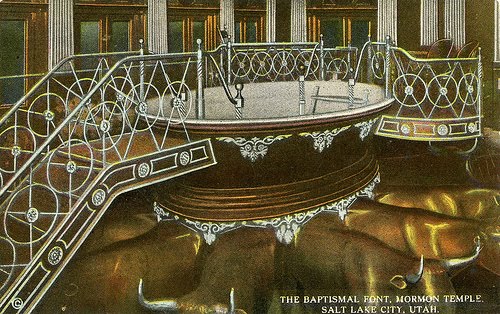
I was standing in the water of a baptismal font supported by twelve oxen, all symbolizing the twelve tribes of Israel. I was unlocking the prison doors for those spirits who had been held captive for hundreds of years. I was in that simple act of the baptizer a "savior on Mount Zion," just as the Savior had prophesied I would be.

There was specific fulfillment in my life, an awareness I was where I should be, doing what I should be doing to fulfill my priesthood opportunities. I was overcome with the reality of what I was doing unlike anything I have previously known. Sister Scott’s prediction I would feel the Spirit more strongly here than anywhere had been realized in that moment. It was all true, truer than it had ever been before.

Their names came and went on the screen – some sixty or so men and women before I was relieved. I didn’t want to quit – I never wanted it to end. I was linked to them in a very real embrace of the Spirit. They were real – they were so grateful the work had finally been done so they could enter in at the gate and have all the covenant blessings they had been promised.

Their mortal lives never knew the light and the hope of the restored gospel of Jesus Christ in its fulness. They never had access to scriptures, to prophets, to temples, to the gift of the Holy Ghost. I marveled once again that the plan of happiness is so perfect; that there are no shortcuts; that the ordinances of salvation are uniquely, yet universally, individual; that each child is treated with the same deference, given the same ordinances without exception, without consideration for privilege, rank or distinction; that all are alike unto God; that we are all His spirit children with names and individual identities and endless eternal possibilities that He knows perfectly; that if faithful we can become as He and Christ already are.

How is it possible? How can He know all of them as perfectly as He seems to know me? How can His Spirit be poured out in such rich abundance upon me and upon them simultaneously for the edification and blessing of us all? How marvelous that it is so – I just don’t know the details.

I waited in the lobby of the baptistry for all the others to finish (first in first out). An ordinance worker who had been one of the witnesses came over and sat down beside me. He put his hand on my knee, leaned in and whispered, “I have been witness to thousands of baptisms over the years, and I must tell you that I have never seen anyone baptize the way you do. I appreciated how you were so gentle, so kind the way you carefully laid them into the water without so much as a slight splash. Others I have seen splash them under and throw them around. Thank you for doing it better than anyone I have ever seen before.”

I had thought he was going to tell me he saw their spirits, or something grand and glorious, but only some encouraging words about my “technique.” He was such a nice man, possessed of a loving, gentle and kind spirit. I suppose his words were the Lord’s way of confirming to me that the work I had done that day was acceptable, and that good brother blessed me without even knowing by offering his unsolicited commendation about something so seemingly trivial.

What a great lesson to all of us -- that we can lift and bless others with a few softly spoken and deeply felt words of comfort and encouragement. So interesting how simple it was, like Sister Scott. These are gentle giants who work in the Lord’s house. Their missions of mercy extend to the living (me) and to the dead.

I was so buoyed up spiritually. I went away rejoicing, and as Sister Scott predicted the blessings of the temple followed me all day, then the next day, and all through today. I have been strengthened, and I can testify it is tangible and wonderful.

Yesterday, I gave the pornography power point presentation in one of the wards for the fifth Sunday, once again at the bishop’s invitation. I had revised it since the last time I did it – added some more recent slides of breaking news as it relates to the “overflowing scourge.” This time all the youth and the adults were invited. I felt the Spirit strongly this time, much more so than the first time I did it in the adult fireside on a Sunday evening. It was more powerful, and the Spirit emboldened me.

Our county sheriff came with me again, and this time I went first and he finished. (I had to leave to speak in another ward). The bishop gave us two full hours to present. He believes it is a topic that needs attention in our ward and throughout the valley – he is lobbying the stake presidency to have us do this in each ward. We’ll see where it all leads. Others have e-mailed their bishop friends to promote our “road show.”

I spoke in another ward. Two youth speakers, and a returning missionary, Elder Benedict, took most of the meeting. The topic was “testimony.” He used the little booklet True to the Faith to illustrate his main talking points. Following his talk we sang a rest hymn, “How Great Thou Art.” I watched the people as we stood and sang. There were many teary eyes. When it was my turn there were nine minutes left. I commented on the tears I had witnessed during the hymn, and testified the spirit of testimony ran deep within their souls as evidenced by their tears.

I quoted Elder McConkie’s five essentials of a true testimony – that we have a Father in Heaven; that His Firstborn Son is Jehovah, Jesus Christ, and the Messiah in his pre-mortal, mortal and resurrected states; that together they established their Church among men and that it was lost repeatedly through the various dispensations; that Joseph Smith was the chosen vessel through whom the ancient rites and ordinances of salvation would be restored; and there is and always will be a living testator upon the earth as prophet follows prophet in orderly succession until the Second Coming.

I testified their testimonies would be tried to the very quick, if they hadn’t been already. I testified there would be a fiery furnace through which each of us will have to pass – tailor made tests and trials designed to forge us, galvanize us, and that we would never be left alone in the flames. I testified the scriptures are full of examples of deliverance, but they also contain accounts of no intervention by God where His children are left to suffer and die without any deliverance.

Through it all, even if we don't the get answers to the "why questions" just yet that our faith must never waver or fail us regardless of the outcomes we seek. I testified there would not be a way around that fiery furnace, only that we must go through – that those of us who aspire to be as Father Abraham would be tested to the uttermost even as he was if we would gain an eternal seat at the right hand of our Father someday.

I testified in the due course of the Lord each of us will see His face and know Him, because Jacob told us at the veil He employeth no servants. The Holy One of Israel is the keeper of the gate. (See 2 Nephi 9:41). Knowing that fact will shape our decisions day by day, keeping us in the strait and narrow way that leads back to Him and the Father.

There was hushed silence – the Spirit was powerful. I testified all the answers to all the “why questions” would someday be supplied, but for now we walk by faith not knowing.

I never could have delivered that message a year ago – I didn’t know a year ago what I have come to know today. I am so much more dependent than ever before on a merciful covenant partner who is chastening me for purposes only He can know about fully. I testified of the things I have to remind myself about every day of my existence in the here and now of my life. Perspective – knowing because you know – what a deal!

Do we ever cease to learn the lessons? Do we ever become wise enough? Do we ever graduate from the graduate courses and the gentle (though difficult) tutorials of the Lord?

Then last night, a fireside. Elder Vaughn J. Featherstone, now an emeritus Seventy, was our invited guest speaker to the youth of the stake. He has a cabin up Weber Canyon, so we consider him one of our own here in the Kamas Stake.

The man is amazing. No notes, much of his repertoire memorized after long years of speech making and youth fireside giving, he wrapped us in the same spiritual warm blanket Sister Scott had the day before in the temple.

He began with three jokes, funny, really funny jokes, explaining that humor is important -- it releases endorphins into the blood stream that make us feel better. He highlighted four ideals for living he had gleaned from the people who had touched his life. Who wouldn’t want to know his four ideals?

First, from Elder McConkie at a stake conference in Grace, Idaho. “There is no greater talent than spirituality.” He said we can all receive this talent of spirituality if we nurture it. He gave several examples from his life where his spirituality at work had produced marvelous and beneficial results.

He told a story about praying to find some lost glasses that belonged to a humble stake president in a cold river in Canada while attending scouting training.

Second, from Elder David B. Haight, at a temple dedication. “Do you think the brethren of the priesthood will ever come to understand they were born to serve their fellowmen?” Then several examples of how he had attempted to serve others throughout his life. Simple responses by him to requests of others when he was bone weary, and that when he responded and served he was always blessed for doing so. A story about going in the middle of the night to give a blessing at the hospital to the daughter of a member of his stake -- serving took away the weariness.

Third, from Ray Welker, a prodigious lesson writer for the Church, whose contributions had spanned a long career at Church headquarters. Then in his nineties, Elder Featherstone asked Brother Welker once at a stake conference to tell him who the greatest General Authority was he had ever known. He paused, hesitating to answer. He said they were all wonderful men, true sons of God endowed with the powers of heaven. When pressed, however, he said, “I suppose it would have to be Elder Boyd K. Packer, because of the purity of his heart for one so young.”

So then he spent several minutes talking about what purity really means to those young people – about sexual purity most of all. He was so gracious and gentle with such a sensitive topic. He spoke about an attempt by a school teacher to sexually molest him as a young thirteen year-old boy, and told the young women especially that if ever anyone forced themselves sexually upon them that they were not to consider that they had committed sin. “You are pure, and you will always be pure if someone forces themselves upon you sexually against your will. Heavenly Father will pour out his judgment upon those who have perpetrated such sins against you, but you are pure. Don’t ever believe anything else about yourself if it happens to you,” he concluded. He then cited the sobering statistic that one in four young women in the U.S. is sexually molested while they are teenagers.

He went on to denounce homosexuality as a learned behavior. “The God of Heaven never puts a female spirit into a male body, nor a male spirit into a female body,” he said. “You can trust Heavenly Father to get something like that right. Our gender is a divinely appointed gift of eternal dimensions that never changes.”

He went on to renounce those who had concluded falsely that DNA studies disprove The Book of Mormon’s origins. He said, “Read D&C 17:6, where the Lord swears an oath by Himself when He declares, ‘as your Lord and your God liveth it is true.'” End of discussion.

Fourth, from his blessing when he was set apart as a member of the Presiding Bishopric in 1972. “I prayed for days that President Harold B. Lee would be able to set me apart when I went down for the setting apart. He had set me apart before as a stake president, and I wanted that blessing once again to come from him.

"When I got there, President Joseph Fielding Smith was there with President Lee and President Tanner. President Lee announced that President Smith had asked him to conduct, and that he felt impressed that he needed to give me my blessing.”

In the blessing, President Lee counseled Elder Featherstone that whenever he had a problem that he didn’t know the answer to that he was to ask himself this question to govern his actions: “What would the Master do as measured by His teachings?”

He then gave examples from his almost forty-year ministry as a General Authority about how that counsel given so long ago had guided him throughout his life. He also cited from memory this statement by President Lee: “It is my conviction that every man who will be called to a high place in the Church will have to pass tests not devised by human hands, by which our Father numbers them as a united group of leaders willing to follow the prophets of the living God and be loyal and true as witnesses and exemplars of the truths they teach.” (Teachings of Harold B.Lee, 527).

I was dripping silent tears throughout, but by the end of his talk the water works were on in full force.

In our own small corners of the Kingdom, each of us is truly a "savior on Mount Zion."  These are examples of a few who crossed my path in a weekend.  God, please give me the courage to live by their ideals!