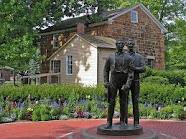
Joseph Smith (1805 - 1844)
A few years ago in recognition of the 200th anniversary of his birth in 1805 on December 23rd, our stake held a youth fireside at the end of the year honoring the Prophet Joseph Smith. I was asked to be the keynote speaker.
I assembled many notes for that talk, most of which I never used. This morning I discovered them in a deeply buried archive file on the computer, and share them here with the readers of this page.
Joseph Smith was a remarkably candid and forthright speaker and writer. He pulled no punches, it appears to me, particularly in his own self-appraisals. Most of what I have gathered below comes from his
History of the Church compilation (hereafter
HC), some 3,200 pages in total. (Many of these statements have also been compiled by Joseph Fielding Smith in
Teachings of the Prophet Joseph Smith.) Today legislation in Washington can be cobbled together approaching that many pages with ease and speed (it's frightening how fast), but in Joseph's case this compilation of his history was laborious and done with quill pens and parchment paper by those who recorded it. His own words reveal far more about him than anything else.
As one of her first gifts to me when we were still in college, and knowing of my love for the Prophet Joseph, Patsy spend a goodly sum of money to buy me my own seven-volume set. I treasure those books.
Joseph, an eighteen-year-old, was promised by the angel Moroni that "my name should be had for good and evil among all nations, kindreds, tongues, or that it should be both good and evil spoken of among all people." (
JS-H 1:33). Despite the chilly prospect of what that declaration must have portended for his future, it is obvious Joseph Smith was a spirit not easily deterred, knowing what he knew.
I
read a statement from Hugh Nibley several years ago that startled me. It came from Eduard Meyer, the great German historian. He made a comparison of Joseph Smith and Mohammed. He concluded Mohammed had to be ranked higher by his standard because from the records Meyer discerned Mohammed experienced periods of self-doubt, vagueness, and misgiving in developing his religious views. On the other hand, said Meyer, he felt Joseph Smith never showed any signs of those despairing thoughts. The comparisons between Islam and Mormonism are fascinating, and this is just one among many.
I thought about that a lot. It was true. I never found any evidence in his sermons or writings that the Prophet Joseph Smith ever had doubts about the divinity of his calling or his message, and despite his adversities he was rarely discouraged.
"Never be discouraged. If I were sunk in the lowest pits of Nova Scotia, with the Rocky Mountains piled on me, I would hang on, exercise faith, and keep up good courage, and I would come out on top." (Quoted in
My Errand from the Lord: A Personal Study Guide for Melchizedek Priesthood Quorums, 1976–77, 175–76).
Here's what he said about his life's mission:
“I have actually seen a vision; and who am I that I can withstand God, or why does the world think to make me deny what I have actually seen? For I had seen a vision; I knew it, and I knew that God knew it, and I could not deny it. . . " (
JS-H 1:25).
“I was called of my Heavenly Father to lay the foundation of this great work and kingdom in this dispensation, and testify of His revealed will to scattered Israel. . . ” (
HC 5:516).
“If any person should ask me if I were a prophet, I should not deny it, as that would give me the lie. . .” (
HC 5:516).
Knowing who he was and what he was about, Joseph spoke powerfully “as one having authority.” (
HC 5:356)
“I know what I say; I understand my mission and business.” (
HC 5:259).
“In relation to the power over the minds of mankind which I hold, I would say, It is in consequence of the power of truth in the doctrines which I have been an instrument in the hands of God of presenting unto them, and not because of any compulsion on my part. . . I am the voice of one crying in the wilderness, ‘Repent ye of your sins and prepare the way for the coming of the Son of Man, for the kingdom of God has come unto you. . .’ ” (
HC 6:273)
“I defy all the world to destroy the work of God; and I prophesy they never will have power to kill me till my work is accomplished, and I am ready to die.” (
HC 6:58).
There is little doubt Joseph Smith was not easily intimidated. He had an indominable spirit. Confident and fearless, his allegiance was first and always to God. “I never knew what it was, as yet, to fear the face of clay, or the influence of man,” he wrote to James Arlington Bennett. “My fear, sir, is before God. I fear to offend Him and strive to keep His commandments.” (
HC 5:157).
Declared Joseph on another occasion: “The object with me is to obey and teach others to obey God in just what He tells us to do. It mattereth not whether the principle is popular or unpopular. I will always maintain a true principle, even if I stand alone in it.” (
HC 6:223).
In another letter to Bennett he wrote, “The whole earth shall bear me witness that I, like the towering rock in the midst of the ocean, which has withstood the mighty surges of the warring waves for centuries, am impregnable, and am a faithful friend to virtue, and a fearless foe to vice. . . I combat the errors of ages. . . ” (
HC 6:78).
Some critics have concluded Joseph Smith was arrogant, impressed with his own self-importance, but that is not the case. “God Almighty is my shield,” he told the Saints. (
HC 5:259). “I am His servant.” (
HC 6:305).
He knew his role: “I realize in some measure my responsibility, and the need I have of support from above, and wisdom from on high, that I may be able to teach this people. . . ” (
HC 4:230). “Jesus Christ, the Son of God, is my Great Counselor.” (
HC 6:93).
It is impossible to calculate all he learned and never taught.
“I could explain a hundred fold more than I ever have of the glories of the kingdoms manifested to me in the vision, were I permitted, and were the people prepared to receive them.” (
HC 5:402).
The Prophet loved “the learning and wisdom of heaven.” (
HC 5:423). His focus was how to reveal sacred truths. “It is my meditation all the day, and more than my meat and drink, to know how I shall make the Saints of God comprehend the visions that roll like an overflowing surge before my mind.” (
HC 5:362).
Impatience at times overtook him: “When things that are of the greatest importance are passed over by weak-minded men without even a thought, I want to see truth in all its bearings and hug it to my bosom. I believe all that God ever revealed. . . ” (
HC 6:477).
Many conspired against him within and without the Church. He was committed to the law, the Constitution and due process despite all the opposition he and the saints encountered.
“It is a love of liberty which inspires my soul — civil and religious liberty to the whole of the human race. Love of liberty was diffused into my soul by my grandfathers while they dandled me on their knees. . . ” (
HC 5:498).
“I want the liberty of thinking and believing as I please. It feels so good not to be trammelled.” (
HC 5:340).
“I cannot believe in any of the creeds of the different denominations, because they all have some things in them I cannot subscribe to, though all of them have some truth. I want to come up into the presence of God, and learn all things; but the creeds set up stakes, and say, ‘Hitherto shalt thou come, and no further;’ which I cannot subscribe to.” (
HC 6:57).
“I will spill my heart’s blood in our defence. They [the Missourians] shall not take away our rights. …” (
HC 5:473).
Joseph the Prophet was likewise a patriot: “I would ask no greater boon, than to lay down my life for my country,” (
HC 4:382) he told the Nauvoo Legion. Having described himself as a “patriot and lover of my country,” (
HC 5:159) he once proclaimed, “I am the greatest advocate of the Constitution of the United States there is on the earth. In my feelings I am always ready to die for the protection of the weak and oppressed in their just rights.” (
HC 6:56-57).
Four months later he said, “I feel it to be my right and privilege to obtain what influence and power I can, lawfully, in the United States, for the protection of injured innocence; and if I lose my life in a good cause I am willing to be sacrificed on the altar of virtue, righteousness and truth, in maintaining the laws and Constitution of the United States, if need be, for the general good of mankind.” (
HC 6:210).
Despite the steel in his spine, there was velvet in his touch: “Sectarian priests cry out concerning me, and ask, ‘Why is it this babbler gains so many followers, and retains them?’ I answer, It is because I possess the principle of love. All I can offer the world is a good heart and a good hand.” (
HC 5:498).
“. . . my heart is large enough for all men.” (
HC 6:459). “I have no enmity against any man. I love you all.” (
HC 6:317).
One cannot plumb the depth of that love in these statements:
“I love to wait upon the Saints, and be a servant of all. . . ” (
HC 4:492).
“I am not learned, but I have as good feelings as any man. O that I had the language of the archangel to express my feelings once to my friends! But I never expect to in this life. When others rejoice, I rejoice; when they mourn, I mourn.” (
HC 5:362).
“I hope I shall see them [his friends] again, that I may toil for them, and administer to their comfort also. They shall not want a friend while I live; my heart shall love those, and my hands shall toil for those. . .” (
HC 5:109).
“As I grow older, my heart grows tenderer for you. I am at all times willing to give up everything that is wrong, for I wish this people to have a virtuous leader.” (
HC 6:412).
“The nearer we get to our Heavenly Father,” he said to the Relief Society sisters, “the more we are disposed to look with compassion on perishing souls; we feel that we want to take them upon our shoulders. . .” (
HC 5:24).
His journal records these words: “. . . those holy doctrines. . . I cherish in my bosom with the warmest feelings of my heart, and with that zeal which cannot be denied. I love friendship and truth; I love virtue and law; I love the God of Abraham, of Isaac, and of Jacob. . .” (
HC 5:108).
He knew his own limitations and warned his followers: “A prophet is a prophet only when he [is] acting as such.” (
HC 5:265).
Even in a public setting Joseph Smith was ever candid in his self-evaluations:
“I am subject to like passions as other men, like the prophets of olden times. Notwithstanding my weaknesses, I am under the necessity of bearing the infirmities of others. . .” (
HC 5:516).
“I told them [the Saints] I was but a man, and they must not expect me to be perfect; if they expected perfection from me, I should expect it from them; but if they would bear with my infirmities. . . I would likewise bear with their infirmities.” (
HC 5:181).
Like Nephi, Joseph Smith’s sins were not "magnificent," he said, “. . . a disposition to commit such was never in my nature.” (
JS-H 1:28).
His famous words en route to Carthage and certain death reveal much about his character:
“I have a conscience void of offense toward God and toward all men.” (
HC 6:555).
He was refined in adversity:
“I am like a huge, rough stone rolling down from a high mountain; and the only polishing I get is when some corner gets rubbed off by coming in contact with something else, striking with accelerated force against religious bigotry, priestcraft, lawyer-craft, doctor-craft, lying editors, suborned judges and jurors, and the authority of perjured executives, backed by mobs, blasphemers, licentious and corrupt men and women — all hell knocking off a corner here and a corner there. Thus I will become a smooth and polished shaft in the quiver of the Almighty, who will give me dominion over all and every one of them, when their refuge of lies shall fail, and their hiding place shall be destroyed, while these smooth-polished stones with which I come in contact become marred.” (
HC 5:401).
“Excitement has almost become the essence of my life,” reported the Prophet on another occasion. “When that dies away, I feel almost lost.” (
HC 5:389).
His faithfulness resulted in these declarations by God that he would be exalted. (See
D&C 121:8; D&C 122:9.)
These are only flashes of the brilliance of the Prophet's character in his own words about himself. His name lives on as a testament to the God he loved and served.